Japan eases back tsunami warning after magnitude 7.7 quake, no immediate reports of casualties, damage
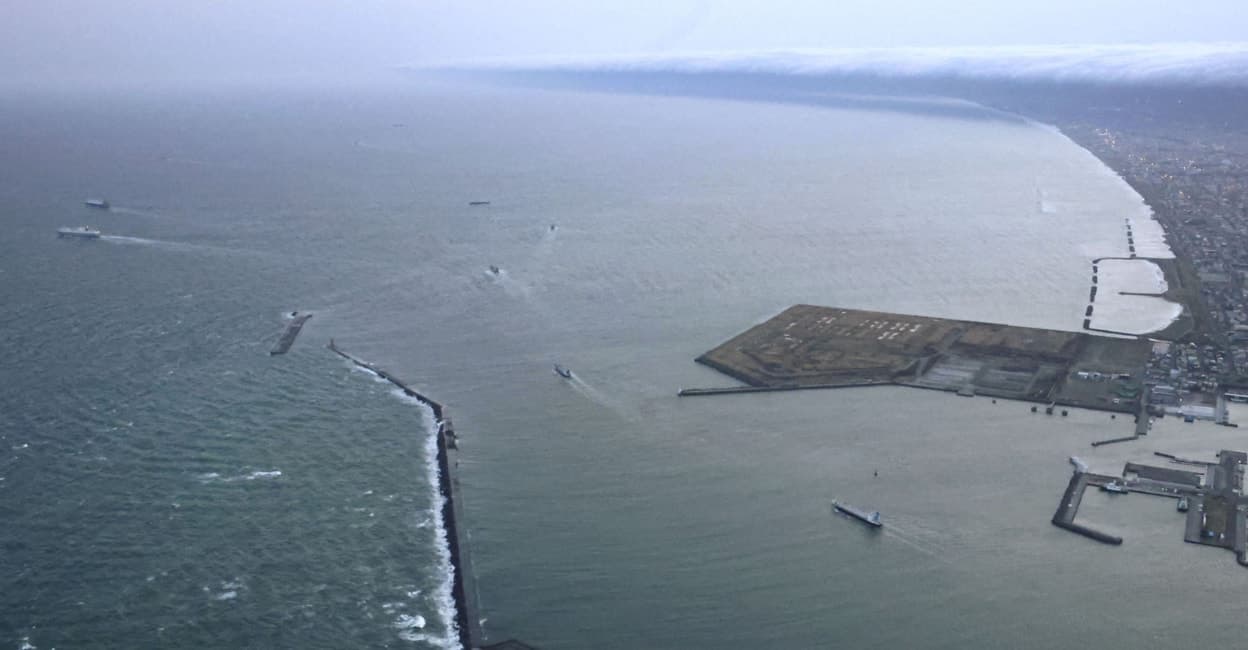
A magnitude 7.7 earthquake off Japan's northeastern coast triggered tsunami warnings and coastal evacuations, echoing the biblical pattern of escalating seismic and oceanic upheaval described as a sign of the approaching end of the age.
Haggai 2:6-7
Prophetic Fulfillment“For thus says the LORD of hosts: Yet once more, in a little while, I will shake the heavens and the earth and the sea and the dry land. And I will shake all nations, so that the treasures of all nations shall come in, and I will fill this house with glory, says the LORD of hosts.”
Why this passage
Haggai 2:6-7 was delivered to post-exilic Israel as God reassured a discouraged remnant that His glory was not finished. The phrase 'shake the heavens and the earth and the sea and the dry land' operates on a near horizon (the political upheavals of the Persian period) and a far horizon explicitly cited by the author of Hebrews (Heb 12:26-27), who quotes this verse and applies it eschatologically to the final removal of all that can be shaken.
The grammar — 'yet once more' — signals a decisive, climactic shaking still to come. The inclusion of 'the sea' is notable: tsunamis are precisely a shaking of the sea triggered by a shaking of dry land.
The prophet Haggai records God's sovereign declaration: 'I will shake the heavens and the earth and the sea and the dry land.' This is not merely ancient poetry — it is a covenantal promise that the created order itself will tremble at God's appointed hour. When a 7.7 magnitude quake shakes Japan's northeastern coast and drives thousands from their homes toward higher ground, we are watching that pattern rehearsed.
The ocean does not rise at random; the earth does not crack at random. Every tremor beneath the Pacific reminds believers that the God who made the Ring of Fire has not relinquished His hand from it.
Let these shakings drive us not to fear, but to fix our hope on 'a kingdom that cannot be shaken.'
Today's Prayer
Pray for the coastal communities of northeastern Japan — that those evacuated would find safety, that emergency responders would be protected, and that this shaking would open hearts across Japan, one of the least-evangelized nations on earth, to the God who holds the seas in His hands.
Further Scripture
Additional passages that illuminate this event, each grounded in a distinct interpretive lens.
“And there will be signs in sun and moon and stars, and on the earth distress of nations in perplexity because of the roaring and tossing of the sea, and people fainting with fear and with foreboding of what is coming on the world. For the powers of the heavens will be shaken.”
Why this passage
In Luke's version of the Olivet Discourse, Jesus specifically identifies 'the roaring and tossing of the sea' as a distinct sign accompanying the distress of nations in the last days — language that goes beyond Luke's parallel in Matthew 24. The Greek word for 'tossing' (salos) refers specifically to the surging and heaving of ocean waters.
This is not metaphorical in context; Jesus is describing physical oceanic phenomena that will accompany the approach of the Son of Man. The 'perplexity' (aporia — having no way out) describes the condition of nations that have no framework to interpret what they are seeing.
How it applies
Japan's tsunami warning, with coastal populations fleeing and authorities scrambling to assess a 7.7 magnitude offshore quake, is precisely the kind of 'roaring and tossing of the sea' that produces the distress and perplexity Jesus described. Japan — a technologically sophisticated nation — must still evacuate coastal cities when the sea rises, because no human engineering fully masters the ocean's power.
For believers, Christ's words reframe these events: they are not merely geophysical data points but signals to 'straighten up and raise your heads, because your redemption is drawing near' (Luke 21:28).
“Therefore we will not fear though the earth gives way, though the mountains be moved into the heart of the sea, though its waters roar and foam, though the mountains tremble at its swelling.”
Why this passage
Psalm 46 was composed as a song of confident trust in God's sovereignty precisely in the face of catastrophic natural upheaval. The imagery — earth giving way, mountains moving into the sea, roaring waters — is drawn from the most extreme seismic and oceanic disasters the ancient world could imagine.
The theological principle is not denial of danger but the grounding of fearlessness in God's identity as 'our refuge and strength, a very present help in trouble' (v.1). The psalmist is not promising no harm will come; he is asserting that God's presence is a more foundational reality than any geophysical instability.
How it applies
For Japanese coastal residents and the watching world, a 7.7 magnitude quake with tsunami waves is exactly the scenario this psalm envisions — the earth giving way beneath the sea. For Christian believers observing this event, Psalm 46 is not a naive dismissal of danger but a theological anchor: the God who governs tectonic plates is the same God who is 'a very present help in trouble.' This passage calls the Church to both honest acknowledgment of creation's groaning and unshaken confidence in the Creator.
“For we know that the whole creation has been groaning together in the pains of childbirth until now.”
Why this passage
Paul's argument in Romans 8:18-23 establishes that the created order was subjected to futility as a consequence of the fall (v.20) and has been in a state of 'groaning' ever since — a present-tense, ongoing condition. The metaphor of childbirth pains is deliberate: the groaning is not random suffering but purposeful travail aimed at a coming deliverance, the 'revealing of the sons of God' (v.19) and the 'redemption of our bodies' (v.23).
Earthquakes, tsunamis, and natural disasters are in Paul's framework not anomalies but symptoms of a cursed creation straining toward its own liberation.
How it applies
The magnitude 7.7 earthquake and resulting tsunami off Japan represent creation 'groaning' in precisely the sense Paul describes — the tectonic machinery of a fallen world producing upheaval, displacement, and threat. This passage prevents two errors: fatalism (this is just how things are) and theological despair (God has lost control).
Instead, Paul frames natural catastrophe as eschatological anticipation — the earth itself is in labor, and what is coming is not destruction but transformation. Believers watching Japan's coast can mourn the danger while holding this cosmic hope.
Related by Scripture
Other events we've interpreted through the same passage or hermeneutical lens.
‘The sea took everything away’: how Nigeria’s ‘Happy City’ is disappearing beneath the waves
Earthquakes & Natural DisastersShares Luke 21:25-26Japan reactor restart sparks fresh fears over nuclear waste storage
Earthquakes & Natural DisastersShares Romans 8:22Iran: Daily life shadowed by war, scarcity and fear
Wars & Rumors of WarsShares Luke 21:25-26Dollar holds near 1-1/2-week high as Iran-US standoff persists
Wars & Rumors of WarsShares Luke 21:25-26The Crisis In The Strait Of Hormuz Is The Greatest Threat To The Global Economy In My Entire Lifetime
Wars & Rumors of WarsShares Haggai 2:6-7
Community launching soon
Get the invite by email when the Watchman's Wall opens
Share this article
Source: Malayala Manorama— we link to the original for full context.