Iran: Daily life shadowed by war, scarcity and fear
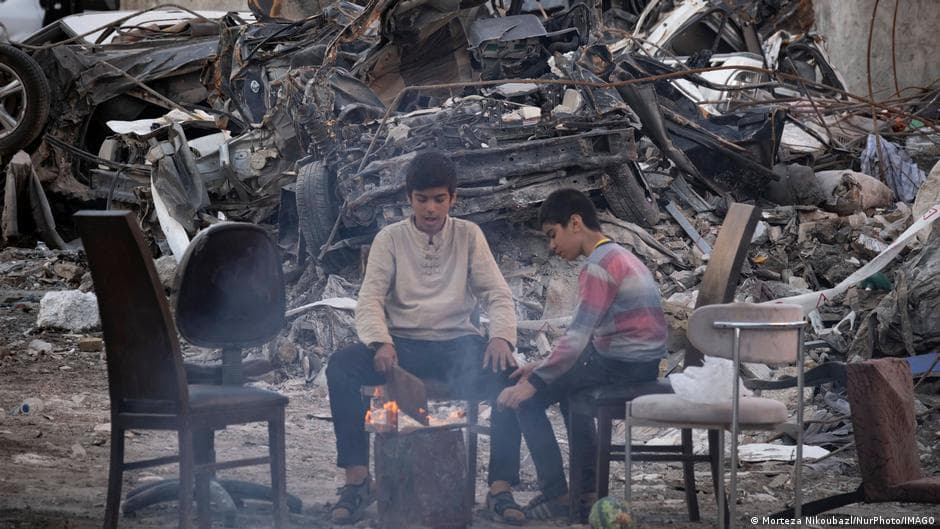
A US naval blockade is driving widespread scarcity and fear among ordinary Iranians as Washington and Tehran push toward open conflict, a pattern of nation-against-nation pressure that Scripture repeatedly identifies as characteristic of the age preceding judgment.
Luke 21:25-26
Prophetic Fulfillment“And there will be signs in sun and moon and stars, and on the earth distress of nations in perplexity because of the roaring of the sea and the waves, people fainting with fear and with foreboding of what is coming on the world. For the powers of the heavens will be shaken.”
Why this passage
In Luke 21, Jesus describes conditions that will characterize the age culminating in his return. The phrase 'distress of nations in perplexity' (synoche ethnon en aporia) refers to nations caught in situations from which there is no clear exit — geopolitical entrapment.
'People fainting with fear and with foreboding' describes civilian psychological collapse under sustained threat. The near horizon was the fall of Jerusalem in AD 70; the far horizon encompasses the full scope of history's distress before the consummation.
Both horizons involve the same human pattern: nations in collision, civilian populations bearing the cost in fear and exhaustion.
Historical context, theological significance, application today — denomination-neutral, ~1,000-word walk-through.
The prophet Jeremiah watched his own generation consumed by the grinding machinery of great-power conflict and wrote, 'Disaster follows hard on disaster; the whole land is laid waste' (Jer. 4:20).
What is unfolding in Iran — shelves emptied, medicine scarce, families living in the shadow of potential war — is not merely a geopolitical story. It is a human one, and Scripture sees it clearly.
Jesus warned that 'nation will rise against nation, and kingdom against kingdom,' not to satisfy curiosity about calendars, but to prepare his people for compassion and steadiness amid exactly this kind of distress. The suffering of civilian populations caught between the ambitions of powers greater than themselves is one of history's most constant sorrows — and one of the clearest calls to intercession.
Today's Prayer
Pray for the Iranian people enduring scarcity and fear under the weight of geopolitical conflict, that God would protect the vulnerable, restrain the ambitions of nations that grind civilians in their gears, and open doors for the gospel where political walls are highest.
Further Scripture
Additional passages that illuminate this event, each grounded in a distinct interpretive lens.
“My anguish, my anguish! I writhe in pain! Oh the walls of my heart! My heart is beating wildly; I cannot keep silent, for I hear the sound of the trumpet, the alarm of war. Disaster follows hard on disaster; the whole land is laid waste. Suddenly my tents are laid waste, my curtains in a moment.”
Why this passage
Jeremiah 4 records the prophet's visceral anguish over the approach of the Babylonian army against Judah — a superpower bearing down on a nation, with ordinary people facing the collapse of daily life, supply chains, and security. The grammatical-historical context is Judah's impending devastation under an empire that held overwhelming military and economic leverage.
The structural pattern — a powerful nation applying crushing pressure on a smaller one, disaster cascading into disaster, civilian life laid waste — is precisely what this passage describes, and it is not unique to Judah's moment but recurs throughout the age of nations.
How it applies
The US naval blockade of Iran produces exactly the cascading pattern Jeremiah described: one geopolitical pressure produces scarcity, which produces fear, which produces social exhaustion, which produces instability — 'disaster follows hard on disaster.' Iranian civilians, like Judah's population in Jeremiah's day, are not the architects of the conflict but are absorbing its full weight. The parallel is structural and moral, not merely emotional.
“Thus says the LORD: 'For three transgressions of Damascus, and for four, I will not revoke the punishment, because they have threshed Gilead with threshing sledges of iron.'”
Why this passage
Amos 1-2 establishes a consistent theological principle across eight consecutive oracles: God holds nations — including those outside the covenant — accountable for the manner in which they exercise military and economic power against civilian populations. The 'threshing sledge' image captures the grinding, impersonal destruction of people caught beneath the weight of geopolitical conflict.
The principle is not limited to Damascus but is applied by Amos to Philistia, Tyre, Edom, Ammon, and Moab — meaning it is a universal standard God applies to all nations in all eras regarding how power is used against the vulnerable.
How it applies
The naval blockade described in the article functions as a modern threshing sledge: a mechanism of geopolitical pressure that grinds civilian populations regardless of their personal culpability in the conflict between governments. Amos's oracles remind readers that God does not regard the suffering of Iranian civilians as a mere side effect beneath his notice — the manner in which powerful nations press pressure against populations is itself a matter of divine moral accounting.
“Ah, the thunder of many peoples; they thunder like the thundering of the sea! Ah, the roar of nations; they roar like the roaring of mighty waters! The nations roar like the roaring of many waters, but he will rebuke them, and they will flee far away, chased like chaff on the mountains before the wind and whirling dust before the storm.”
Why this passage
Isaiah 17:12-13 is appended to the Damascus oracle but functions as a broader theological coda: the roaring, crashing collision of great powers is a recurring feature of the age of nations, and it is ultimately subject to divine rebuke. The 'thunder of many peoples' and 'roar of nations' is the sound of geopolitical confrontation — the machinery of empire and counterforce.
Isaiah's point is not merely predictive but doxological: however loud and unstoppable the clash of great powers appears, God's rebuke is louder and more final.
How it applies
The US-Iran confrontation — a global naval power applying sustained pressure on a regional power — is exactly the kind of 'roaring of nations' Isaiah described: massive, frightening to those caught beneath it, and seemingly beyond the control of ordinary human beings. For Christians watching this escalation, Isaiah's coda provides the essential counterweight: these powers thunder, but they are not ultimate.
The same God who rebuked the ancient empires has not relinquished sovereignty over Washington or Tehran.
Related by Scripture
Other events we've interpreted through the same passage or hermeneutical lens.
‘The sea took everything away’: how Nigeria’s ‘Happy City’ is disappearing beneath the waves
Earthquakes & Natural DisastersShares Luke 21:25-26Captain warns ‘no ship will be a hero’ by risking Hormuz transit
Wars & Rumors of WarsShares Isaiah 17:12-13UK on verge of joining EU's £78bn loan for Ukraine as Starmer seeks reset with Brussels
Wars & Rumors of WarsShares Jeremiah 4:19-20Sirens in Misgav Am: Interceptors launched at suspicious aerial objects
Wars & Rumors of WarsShares Jeremiah 4:19-20Israel-Iran LIVE: Trump orders U.S. Navy to 'shoot, kill' small boats laying mines in Strait of Hormuz
Wars & Rumors of WarsShares Isaiah 17:12-13
Community launching soon
Get the invite by email when the Watchman's Wall opens
Share this article
Source: Shabnam von Hein; Niloofar Gholami; Sarah Majidi— we link to the original for full context.