The Crisis In The Strait Of Hormuz Is The Greatest Threat To The Global Economy In My Entire Lifetime
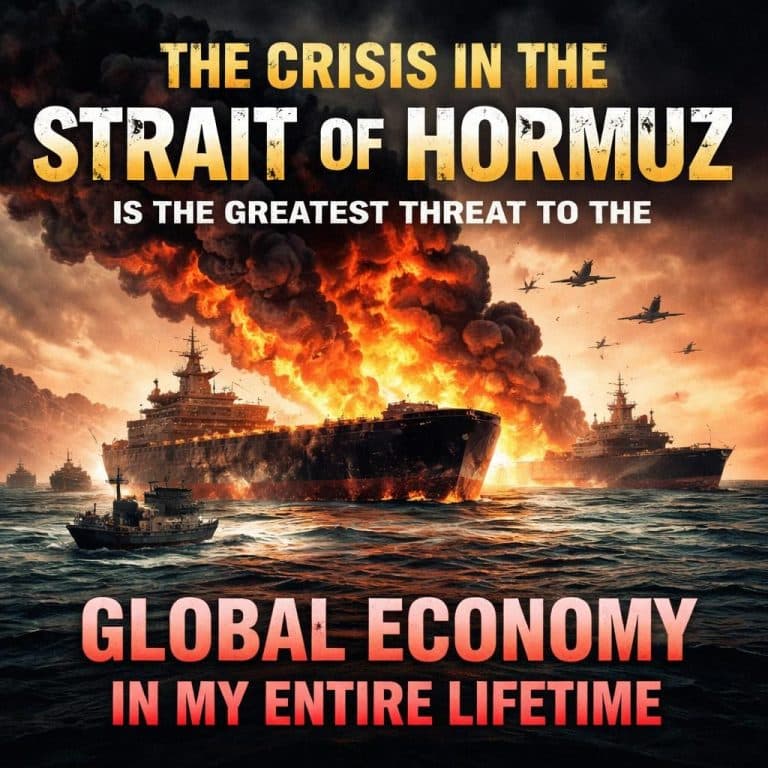
Iran's threatened closure of the Strait of Hormuz — a chokepoint for a significant portion of the world's oil — represents a potentially catastrophic escalation in Middle East tensions, with the capacity to destabilize the global economy and draw multiple great powers into armed conflict. This convergence of economic vulnerability and regional war-making echoes Scripture's warnings about the last days.
Haggai 2:6-7
Prophetic Fulfillment“For thus says the LORD of hosts: Yet once more, in a little while, I will shake the heavens and the earth and the sea and the dry land. And I will shake all nations, so that the treasures of all nations shall come in, and I will fill this house with glory, says the LORD of hosts.”
Why this passage
Haggai delivered this oracle in 520 BC to encourage a discouraged remnant rebuilding the Jerusalem temple. The near-horizon fulfillment involved God's providential movement of the nations to honor the second temple; the author of Hebrews (12:26-27) explicitly applies a far-horizon dimension to this shaking, identifying it as the eschatological disruption of all earthly orders before the unshakeable kingdom is fully revealed.
The shaking is cosmic in scope — heavens, earth, sea, and dry land — encompassing political, military, and economic realms simultaneously. This is not merely metaphor; it describes God's sovereign destabilization of the systems nations trust in.
The prophet Haggai declared on behalf of the Lord, 'I will shake the heavens and the earth and the sea and the dry land.' These words, first spoken to a post-exilic people rebuilding amid great uncertainty, carry a far-horizon dimension: a cosmic shaking that precedes the establishment of God's final kingdom. Today, as a single narrow strait in the Persian Gulf holds the power to convulse the entire global economy, we see precisely how interdependent and fragile human civilization has become — and how little it takes for the Lord to permit the shaking of every system men trust in.
The threat at Hormuz is not merely a geopolitical crisis; it is a reminder that no empire, no energy grid, no financial architecture is beyond the reach of divine sovereignty. Let the Christian not be anxious but anchored, knowing that what can be shaken will be, so that what cannot be shaken — the kingdom of God — may remain.
Today's Prayer
Pray that God would restrain the escalation at the Strait of Hormuz, protect the nations and peoples who would suffer most from economic collapse, and awaken believers to the fragility of earthly systems so that their trust is fixed firmly on the unshakeable kingdom of Christ.
Further Scripture
Additional passages that illuminate this event, each grounded in a distinct interpretive lens.
“And I will turn you about and put hooks into your jaws, and I will bring you out, and all your army, horses and horsemen, all of them clothed in full armor, a great host, all of them with buckler and shield, wielding swords.”
Why this passage
Ezekiel 38-39 describes a future coalition of northern and Persian-axis nations drawn toward a great conflict involving the land of Israel, with Persia (modern Iran) explicitly named in 38:5. The text describes God sovereignly drawing these nations — through their own aggrandizing ambitions — into a convergent military crisis.
The Gog/Magog coalition and its precise modern identification remain disputed among scholars; nevertheless, Persia's explicit naming and its characterization as a militarized actor drawn toward the Middle Eastern theater is textually unambiguous. The 'hooks in the jaws' imagery captures perfectly how national self-interest and military posturing can pull a nation step by step toward a confrontation it cannot fully control.
How it applies
Iran's escalating threats over Hormuz reflect this same dynamic: a Persian-heritage nation leveraging military brinkmanship, drawing in American naval assets, Gulf Arab states, and Israel into an increasingly dangerous proximity. Whether or not this specific episode is the Gog/Magog event itself — which should not be asserted dogmatically — the pattern is unmistakably consistent with the kind of Persia-led escalation Ezekiel foresaw.
The acceleration of Iranian aggression in the strait region continues to position the modern Persian state in the geopolitical alignment the prophet described.
“When he opened the third seal, I heard the third living creature say, 'Come!' And I looked, and behold, a black horse! And its rider had a pair of scales in his hand. And I heard what seemed to be a voice in the midst of the four living creatures, saying, 'A quart of wheat for a denarius, and three quarts of barley for a denarius, and do not harm the oil and the wine!'”
Why this passage
The third seal of Revelation 6 depicts famine-level economic conditions: a denarius (a full day's wage in the Roman economy) purchasing only a single quart of grain — extreme scarcity pricing. The scales in the rider's hand signify rationing and economic coercion at a systemic level.
John's original audience would have recognized this as the kind of economic devastation that follows military conflict and trade disruption. The 'do not harm the oil and the wine' phrase indicates that luxury commodities — controlled by the wealthy — remain available even as staples become unaffordable, depicting economic stratification under crisis conditions.
How it applies
A successful blockade of the Strait of Hormuz would produce precisely this scenario at a global scale: oil supply shocks cascading into food distribution failures, with commodity prices spiking to levels unaffordable for the world's poor. The rider's scales and the rationing of grain map directly onto what economists warn would follow a Hormuz closure — stagflation, supply chain collapse, and the kind of economic suffering that always falls hardest on the vulnerable.
The Strait of Hormuz is, in effect, the modern chokepoint over which the scales of Revelation 6 could be held.
“Is a trumpet blown in a city, and the people are not afraid? Does disaster come to a city, unless the LORD has done it?”
Why this passage
Amos 3:6 is a rhetorical couplet establishing the theological principle of divine sovereignty over national calamity. The prophet's argument is that no disaster descends upon a city or nation without the LORD's ultimate causation or permission — including military threats, sieges, and the alarms of war.
This is not fatalism but a call to prophetic discernment: when the trumpet of alarm sounds, the people of God are to ask not merely what human actors are doing, but what God is declaring through the event. The verse sits within a passage (3:1-8) where Amos insists that God does nothing without revealing it to his servants the prophets.
How it applies
The alarm being sounded over Hormuz — described by the article's author as the greatest economic threat of his lifetime — is precisely the kind of trumpet blast Amos has in view. The Christian reading this crisis is called not to mere economic anxiety but to theological discernment: this escalation, like all escalations, occurs within the sovereign government of God, who uses the threatening movements of nations to awaken, judge, and redirect his people.
Iran's belligerence at Hormuz is not outside God's awareness or control — it is, in Amos's framework, a divinely permitted alarm demanding attention.
Related by Scripture
Other events we've interpreted through the same passage or hermeneutical lens.
U.S.-Iran War’s Next Casualty: Global Food
FaminesShares Revelation 6:5-6World Bank expects fertilizer prices to rise by 31% this year
FaminesShares Revelation 6:5-6Russia’s Northern Fleet Bastion missile system crews hold exercise in Arctic
Wars & Rumors of WarsShares Amos 3:6What is the Azawad Liberation Front, part of the Mali attacks?
Wars & Rumors of WarsShares Amos 3:6The Fertilizer Shock of 2026-2027: A Man-Made Famine in the Making
FaminesShares Revelation 6:5-6
Community launching soon
Get the invite by email when the Watchman's Wall opens
Share this article
Source: Activistpost.com— we link to the original for full context.