US-Israel war on Iran driving historic levels of global hunger, UN says
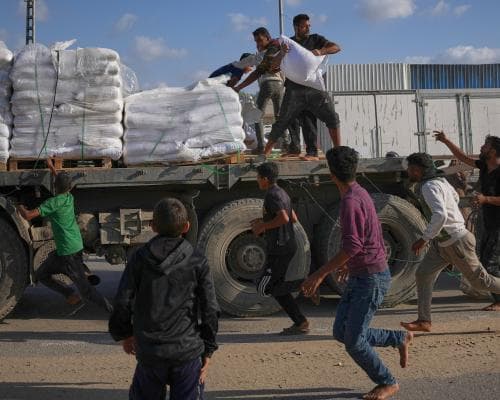
A war between the US, Israel, and Iran is driving historic global hunger, with the UN's World Food Programme forced to ration aid—fulfilling biblical warnings of war-induced famine that strikes the earth.
Joel 1:15-18
Prophetic Fulfillment“Alas for the day! For the day of the LORD is at hand, and as destruction from the Almighty it comes. Is not the food cut off before our eyes, joy and gladness from the house of our God? The seed is rotten under their clods; the garners are desolate; the barns are broken down, for the grain has withered. How the beasts groan! The herds of cattle are perplexed because there is no pasture for them; even the flocks of sheep suffer.”
Why this passage
Joel's prophecy describes a locust plague and drought that devastate Israel's food supply, but the language quickly escalates to 'the day of the LORD'—a time of divine judgment on the nations. The prophet sees food cut off, seed rotting, and barns broken down as signs of that coming day.
This is not merely about insects; Joel frames agricultural disaster as a herald of God's judgment on human sin. The pattern—war and conflict leading to famine—is the same dynamic the article describes: a US-Israel war on Iran has disrupted global food systems, leaving the WFP unable to feed the hungry.
Scripture declares that when nations rage and swords devour, the land groans under famine. The prophet Joel saw this: 'The seed is rotten under their clods, the garners are laid desolate, the barns are broken down; for the corn is withered' (Joel 1:17).
Behold, a war between great powers has not only killed on the battlefield but has shattered the world's food supply, leaving the poorest to starve while the wealthy nations spend their treasure on weapons. This is the bitter fruit of human pride and violence—a sign that the earth itself mourns under the weight of our sins.
Today's Prayer
Pray that the Lord would open the eyes of world leaders to see that war against His ancient people and their neighbors brings a curse upon the nations, and that they would turn to seek peace before the famine consumes the innocent.
Further Scripture
Additional passages that illuminate this event, each grounded in a distinct interpretive lens.
“"I gave you cleanness of teeth in all your cities, and lack of bread in all your places, yet you did not return to me," declares the LORD. "I also withheld the rain from you when there were yet three months to the harvest; I would send rain on one city, and send no rain on another city; one field would have rain, and the field on which it did not rain would wither; so two or three cities would wander to another city to drink water, and would not be satisfied; yet you did not return to me," declares the LORD. "I struck you with blight and mildew; your many gardens and your vineyards, your fig trees and your olive trees the locust devoured; yet you did not return to me," declares the LORD.”
Why this passage
Amos speaks God's covenant lawsuit against Israel: He sent famine, drought, blight, and locusts as disciplinary judgments, yet the people refused to repent. The phrase 'cleanness of teeth' is a vivid metaphor for empty stomachs—total lack of food.
This is not random disaster; it is God's purposeful call to repentance. The pattern of war-induced famine in the article fits this covenantal framework: when nations pursue violence and rebellion, God allows the earth to yield its fruit sparingly, and the sword compounds the scarcity.
How it applies
The article describes a war that has driven global hunger to historic levels—a famine caused not by natural disaster but by human conflict. Amos would recognize this as a divine warning: when nations refuse to turn from their violence and pride, God sends 'lack of bread' as a sign.
The US, Israel, and Iran are all caught in this cycle. The church must hear the call: 'yet you did not return to me'—and respond with repentance before the famine deepens.
“When he opened the third seal, I heard the third living creature say, "Come!" And I looked, and behold, a black horse! And its rider had a pair of scales in his hand. And I heard what seemed to be a voice in the midst of the four living creatures, saying, "A quart of wheat for a denarius, and three quarts of barley for a denarius, and do not harm the oil and wine!"”
Why this passage
The third seal of Revelation depicts a black horse representing famine, with a rider holding scales—symbolizing rationed food at inflated prices. A denarius was a day's wage; a quart of wheat for a day's pay means basic survival consumes all income.
This is a prophetic picture of economic collapse and scarcity during the end-times judgments. The article's description of the WFP 'taking from the hungry to feed the starving' and rationing aid mirrors this exact dynamic: food becomes a luxury, and the poor are crushed.
How it applies
The World Food Programme's ration cuts—taking from some hungry to barely sustain others—is a modern fulfillment of the black horse's scales. War has driven food prices beyond reach for millions, just as the rider's 'quart of wheat for a denarius' depicts.
This is not merely a humanitarian crisis; it is a sign that the judgments of Revelation are casting their shadow over the present age. The church must prepare spiritually for the full unveiling of these seals.
Related by Scripture
Other events we've interpreted through the same passage or hermeneutical lens.
The Consequences of War and State Sponsored Poverty in Amhara Region, Ethiopia
FaminesShares Amos 4:6-9Growing bread queues in Gaza as Israel restricts fuel, flour imports
FaminesShares Amos 4:6-9U.S.-Iran War’s Next Casualty: Global Food
FaminesShares Revelation 6:5-6World Bank expects fertilizer prices to rise by 31% this year
FaminesShares Revelation 6:5-6The Fertilizer Shock of 2026-2027: A Man-Made Famine in the Making
FaminesShares Revelation 6:5-6
Community launching soon
Get the invite by email when the Watchman's Wall opens
Share this article
Source: The Guardian— we link to the original for full context.