The Consequences of War and State Sponsored Poverty in Amhara Region, Ethiopia
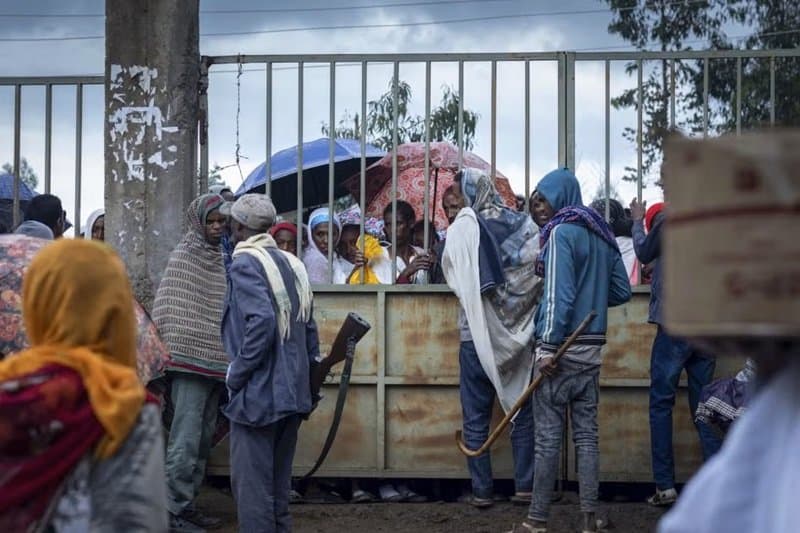
The Amhara region of Ethiopia faces a severe humanitarian crisis driven by war and state-sponsored policies, leading to widespread famine and suffering—a sobering echo of biblical warnings about the sword and famine as instruments of judgment.
Amos 4:6-9
Direct Principle“"I gave you cleanness of teeth in all your cities, and lack of bread in all your places, yet you did not return to me, declares the LORD. I also withheld the rain from you when there were yet three months to the harvest; I would send rain on one city, and send no rain on another city; one field would have rain, and the field on which it did not rain would wither; so two or three cities would wander to another city to drink water, and would not be satisfied; yet you did not return to me, declares the LORD. I struck you with blight and mildew; your many gardens and your vineyards, your fig trees and your olive trees the locust devoured; yet you did not return to me, declares the LORD."”
Why this passage
In Amos 4, the prophet recounts a series of covenant judgments—famine, drought, crop failure—that God sent upon Israel to call them to repentance. The repeated refrain "yet you did not return to me" underscores that these disasters were both punitive and remedial, designed to awaken a rebellious people.
The plain historical sense is that God sovereignly uses famine and scarcity as instruments of discipline and warning. This principle is not limited to ancient Israel; it applies whenever a nation or people group experiences famine as a result of sin—whether their own or the oppression of others.
Behold, the Lord declares through Amos: "I also withheld the rain from you when there were yet three months to the harvest; I would send rain on one city, and send no rain on another city" (Amos 4:7). The famine in Amhara is not random calamity but a consequence of human sin and oppression—a stark reminder that God sees the affliction of the poor and the schemes of the wicked.
Yet even in judgment, Scripture calls us to repentance and mercy. As you read of children starving and families displaced, let your heart break with what breaks His.
Pray that the Church in Ethiopia would be a vessel of relief and that the nations would remember that the Lord "executes justice for the oppressed" (Psalm 146:7).
Today's Prayer
Pray for the starving and displaced in Ethiopia's Amhara region, that God would raise up relief efforts, expose the oppressors, and turn hearts toward repentance and mercy.
Further Scripture
Additional passages that illuminate this event, each grounded in a distinct interpretive lens.
“"Alas for the day! For the day of the LORD is at hand, and as destruction from the Almighty it comes. Is not the food cut off before our eyes, joy and gladness from the house of our God? The seed shrivels under the clods; the storehouses are desolate; the granaries are torn down because the grain has dried up. How the beasts groan! The herds of cattle are perplexed because there is no pasture for them; even the flocks of sheep suffer."”
Why this passage
Joel 1 describes a locust plague and severe famine as a foreshadowing of the coming "day of the LORD"—a time of judgment and divine visitation. The prophet calls the people to lament because the basic staples of life have been destroyed, cutting off even the grain offerings in the temple.
While Joel's immediate context was a literal agricultural disaster, the New Testament (Acts 2:16-21) applies Joel's prophecy to the last days, indicating that such famines are part of the birth pangs preceding Christ's return. The pattern of food being "cut off before our eyes" is a recurring sign of the age.
How it applies
The famine in Amhara—where grain stores are depleted, fields lie barren due to conflict, and families wander in search of food—echoes Joel's lament. This is not merely a humanitarian crisis; it is a sign that the "day of the LORD" draws near, when all human systems of provision will fail apart from Christ.
Christians should see in this tragedy a call to both urgent relief and urgent evangelism, knowing that only the Bread of Life can ultimately satisfy.
“"Blessed is he whose help is the God of Jacob, whose hope is in the LORD his God, who made heaven and earth, the sea, and all that is in them, who keeps faith forever; who executes justice for the oppressed, who gives food to the hungry. The LORD sets the prisoners free."”
Why this passage
Psalm 146 contrasts trust in mortal princes with trust in the LORD, who is described as the Creator and the One who actively executes justice for the oppressed and gives food to the hungry. This is a covenantal principle: God's character includes a special concern for the vulnerable.
The psalm's plain meaning is that God is not indifferent to famine or oppression. He is the one who "keeps faith forever" and acts on behalf of those who cannot help themselves.
This principle stands as both comfort and indictment.
How it applies
The state-sponsored poverty and dispossession targeting the Amhara people is a direct violation of the God who "executes justice for the oppressed." The famine is not an accident of nature but a man-made catastrophe that cries out for divine intervention.
Believers are called to place their hope not in political solutions but in the God who gives food to the hungry and sets prisoners free—and to be His hands in bringing that relief to Ethiopia.
Related by Scripture
Other events we've interpreted through the same passage or hermeneutical lens.
Community launching soon
Get the invite by email when the Watchman's Wall opens
Share this article
Source: Borkena— we link to the original for full context.