Trump launches strikes against Iran after downing of US army helicopter
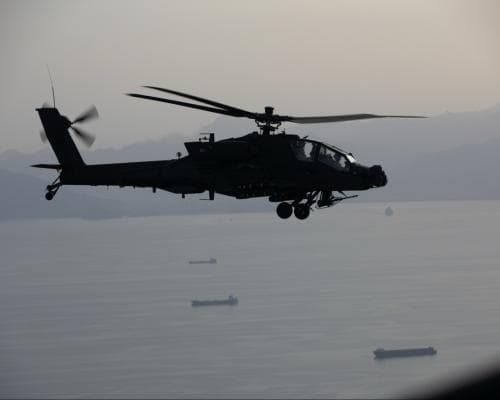
President Trump launches strikes against Iran after Tehran downed a US Apache helicopter near the Strait of Hormuz, escalating a conflict that echoes biblical warnings of nations rising against nations and the gathering storm of war in the Middle East.
Joel 3:9-10
Prophetic Fulfillment“Proclaim this among the nations: Prepare war; stir up the mighty men. Let all the men of war draw near; let them come up. Beat your plowshares into swords, and your pruning hooks into spears; let the weak say, 'I am a warrior.'”
Why this passage
In its original context, Joel 3:9-10 is a summons to the nations to gather for the valley of Jehoshaphat—God's end-times judgment on the nations that have scattered His people. The language is deliberately ironic: the nations are called to reverse the peace of Isaiah 2:4 and prepare for war.
The plain sense is a prophetic oracle of a future gathering of hostile nations against God's purposes, culminating in divine judgment.
This passage legitimately extends to the current US-Iran escalation because it describes the very pattern of nations arming and preparing for war in the region that Scripture identifies as the stage for end-times conflict. The Strait of Hormuz, a strategic chokepoint near the Persian Gulf, sits at the heart of the biblical geography of Ezekiel 38-39 and Joel 3.
Behold, the Lord declares through Joel: 'Proclaim this among the nations: Prepare war; stir up the mighty men. Let all the men of war draw near; let them come up' (Joel 3:9).
The downing of an American helicopter and the swift retaliatory strikes are not merely geopolitical news—they are a trumpet call echoing the ancient summons to the nations.
As the Strait of Hormuz becomes a stage for confrontation, the believer is called to watchfulness, not panic. Scripture does not promise peace on earth before the King returns, but it does promise that the Prince of Peace holds the final word over every rising storm.
Today's Prayer
Pray for the protection of civilians and military personnel caught in this escalation, and for the peace of Jerusalem and the nations that the Lord alone can give.
Further Scripture
Additional passages that illuminate this event, each grounded in a distinct interpretive lens.
“Why do the nations rage and the peoples plot in vain? The kings of the earth set themselves, and the rulers take counsel together, against the Lord and against his Anointed, saying,”
Why this passage
Psalm 2 is a royal psalm describing the futile rebellion of the nations against Yahweh and His Messiah. The 'raging' of the nations is not aimless—it is a deliberate setting of themselves against divine authority.
The psalm's original hearers understood this as a pattern of human pride that God ultimately mocks and judges.
This principle applies directly to the US-Iran confrontation: two powerful nations, each with their own pride and strategic calculations, are locked in a cycle of escalation that ultimately defies the sovereignty of the One who sits in the heavens. The psalm does not predict this specific event but diagnoses the spiritual reality behind all such conflicts.
How it applies
The strikes against Iran and the downing of the helicopter are the latest expression of the nations' rage that Psalm 2 describes. Whether in Washington or Tehran, rulers take counsel and set themselves in opposition—not merely to each other, but to the Lord's ultimate authority over history.
The believer watches this with sober confidence, knowing that the Anointed One will one day dash the nations like a potter's vessel.
“My anguish, my anguish! I writhe in pain! Oh the walls of my heart! My heart is beating wildly; I cannot keep silent, for I hear the sound of the trumpet, the alarm of war. Crash follows hard on crash; the whole land is laid waste. Suddenly my tents are destroyed, my curtains in a moment.”
Why this passage
Jeremiah 4 is the prophet's lament over the coming invasion from the north—a literal judgment on Judah through Babylon. The language is visceral: the sound of the trumpet, the alarm of war, crash following crash.
Jeremiah speaks as a watchman who sees the disaster before it fully arrives and is anguished by what he perceives.
This narrative parallel applies to the current situation because the Strait of Hormuz is a flashpoint where 'crash follows hard on crash'—a downed helicopter, then retaliatory strikes, then the threat of wider war. The pattern of escalating violence that Jeremiah lamented is the same pattern visible today, though the actors and geography differ.
How it applies
The article describes a sequence of military actions that could easily spiral: a helicopter downed, a crew rescued by drone, then presidential authorization of strikes. This is Jeremiah's 'crash following hard on crash' in real time.
The believer, like the prophet, hears the alarm of war and feels anguish—not because God has lost control, but because the wages of human rebellion are always destruction.
Related by Scripture
Other events we've interpreted through the same passage or hermeneutical lens.
Middle East crisis live: Iran launches broad retaliatory attacks after US strikes over downed helicopter
Wars & Rumors of WarsShares Psalm 2:1-2Israeli attack on Tyre in Lebanon kills eight as evacuation ordered for Christian quarter
Wars & Rumors of WarsShares Joel 3:9-10Eight killed in south Lebanon strike as Israel warns entire city to evacuate
Wars & Rumors of WarsShares Joel 3:9-10Middle East crisis live: People flee Lebanese city of Tyre after Israel orders evacuation ahead of strikes
Wars & Rumors of WarsShares Joel 3:9-10Iran fires missiles at Israel in first strike since April ceasefire, defense systems intercept
Wars & Rumors of WarsShares Joel 3:9-10
Community launching soon
Get the invite by email when the Watchman's Wall opens
Share this article
Source: The Guardian— we link to the original for full context.