Middle East crisis live: Iran launches broad retaliatory attacks after US strikes over downed helicopter
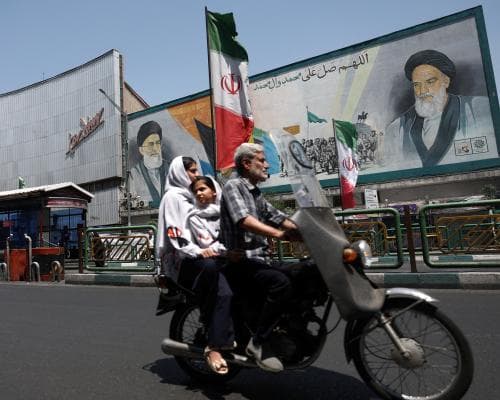
Iran launches broad retaliatory attacks against US forces in Jordan, Kuwait, and Bahrain, escalating regional conflict and echoing biblical prophecies of nations rising against nations in the last days.
Psalm 2:1-2
Prophetic Fulfillment“Why do the nations rage and the peoples plot in vain? The kings of the earth set themselves, and the rulers take counsel together, against the LORD and against his Anointed, saying,”
Why this passage
Psalm 2 is a royal psalm describing the rebellion of earthly rulers against Yahweh and His Messiah. In its original context, it likely celebrated the Davidic king's coronation amid surrounding nations' threats.
The New Testament applies it to the opposition against Christ (Acts 4:25-28), and the psalm's pattern of nations conspiring against God's purposes recurs throughout history.
This pattern is visibly enacted when Iran—a nation that explicitly calls for Israel's destruction and opposes the US-led coalition—launches coordinated military strikes across multiple countries. The 'raging' of the nations is not merely poetic but is manifest in missile launches and airbase attacks.
Behold, the nations rage and the kingdoms take counsel together against the Lord and His anointed. Psalm 2 declares that He who sits in the heavens shall laugh; the Lord shall hold them in derision.
Yet this is no time for fear, but for watchfulness. As Iran strikes at US forces across the Middle East, we see the pattern Jesus warned of: nation rising against nation.
Let your heart not be troubled, but let your hope be fixed on the coming King who will break the nations with a rod of iron.
Today's Prayer
Pray for the peace of Jerusalem and for the protection of all those caught in the widening conflict, that many would turn to Christ before the final trumpet sounds.
Further Scripture
Additional passages that illuminate this event, each grounded in a distinct interpretive lens.
“Proclaim this among the nations: Consecrate for war; stir up the mighty men. Let all the men of war draw near; let them come up. Beat your plowshares into swords, and your pruning hooks into spears; let the weak say, 'I am a warrior.'”
Why this passage
Joel 3 is a prophecy of the Lord's judgment on the nations in the Valley of Jehoshaphat, where God gathers all nations for war. The original audience was Judah, facing surrounding enemies.
The passage reverses the famous peace prophecy of Isaiah 2:4—instead of beating swords into plowshares, the nations are called to turn agricultural tools into weapons.
This reversal signals a time of escalated warfare before God's final intervention. The command to 'consecrate for war' and 'stir up the mighty men' describes a deliberate, organized military mobilization, not merely border skirmishes.
How it applies
Iran's Revolutionary Guards Corps launching 'broad retaliatory attacks' against US forces across three nations—Jordan, Kuwait, and Bahrain—matches Joel's call for nations to prepare for war. The language of 'consecrating for war' fits Iran's religiously motivated military action, as the IRGC frames its operations in Islamic apocalyptic terms.
The escalation from isolated strikes to multi-front retaliation signals the kind of regional war Joel describes, where nations are drawn into conflict before the Lord's final judgment. This is a sobering reminder that peace will not come through human diplomacy but through the Prince of Peace.
“At the time of the end, the king of the south shall attack him, but the king of the north shall rush upon him like a whirlwind, with chariots and horsemen, and with many ships. And he shall come into countries and shall overflow and pass through.”
Why this passage
Daniel 11 is a detailed prophecy of conflicts between the Seleucid (north) and Ptolemaic (south) empires, culminating in the end-times figure of the 'king of the north.' Many conservative interpreters see Iran (ancient Persia/Elam) as part of the northern coalition in end-times prophecy, especially given its alliance with Russia and opposition to Israel and the West.
The verse describes a sudden, overwhelming attack by the northern king against the south, involving multiple countries and swift military advances. The language of 'overflow and pass through' suggests a broad, multi-front offensive.
How it applies
Iran's retaliatory strikes against US forces in Jordan, Kuwait, and Bahrain—all southern or southwestern relative to Iran—echo the pattern of the king of the south being attacked by northern forces. While this is not a direct identification of specific end-times figures, the geopolitical alignment (Iran as a northern power relative to the Gulf states and Israel) fits the Danielic template.
The 'broad' nature of the attacks, targeting multiple nations simultaneously, matches the prophecy's description of a king who 'comes into countries and overflows.' Believers should watch for further escalation that aligns with Daniel's end-times scenario.
Related by Scripture
Other events we've interpreted through the same passage or hermeneutical lens.
Trump launches strikes against Iran after downing of US army helicopter
Wars & Rumors of WarsShares Joel 3:9-10Israeli attack on Tyre in Lebanon kills eight as evacuation ordered for Christian quarter
Wars & Rumors of WarsShares Joel 3:9-10Eight killed in south Lebanon strike as Israel warns entire city to evacuate
Wars & Rumors of WarsShares Joel 3:9-10Middle East crisis live: People flee Lebanese city of Tyre after Israel orders evacuation ahead of strikes
Wars & Rumors of WarsShares Joel 3:9-10Iran fires missiles at Israel in first strike since April ceasefire, defense systems intercept
Wars & Rumors of WarsShares Joel 3:9-10
Community launching soon
Get the invite by email when the Watchman's Wall opens
Share this article
Source: The Guardian— we link to the original for full context.