Mali crisis: Junta entrenches itself with no political solution in sight
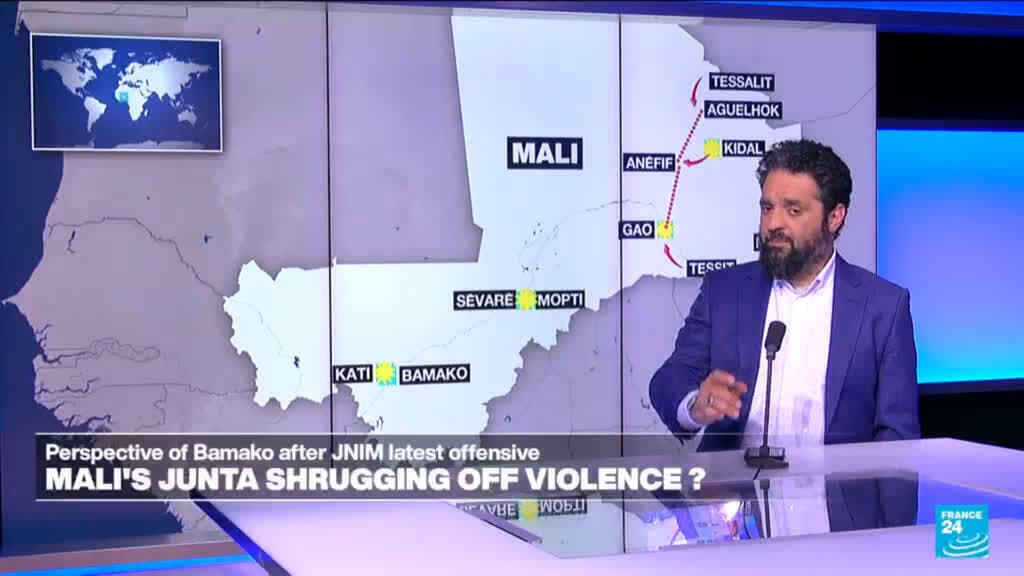
Mali's ruling junta faces an existential military assault by jihadist and separatist forces who have seized a northern stronghold and are blockading the capital Bamako — a vivid portrait of the nation-devouring warfare Scripture foretells will characterize the last days.
Jeremiah 4:13-20
Narrative Parallel“Behold, he comes up like clouds; his chariots like the whirlwind; his horses are swifter than eagles — woe to us, for we are ruined! O Jerusalem, wash your heart from evil, that you may be saved. How long shall your wicked thoughts lodge within you? For a voice declares from Dan and proclaims trouble from Mount Ephraim. Warn the nations that he is coming; announce to Jerusalem, 'Besiegers come from a distant land; they shout against the cities of Judah.' Like keepers of a field are they against her all around, because she has rebelled against me, declares the Lord. Your ways and your deeds have brought this upon you. This is your doom, and it is bitter; it has reached your very heart. My anguish, my anguish! I writhe in pain! Oh the walls of my heart! My heart is beating wildly; I cannot keep silent, for I hear the sound of the trumpet, the alarm of war. Crash follows crash; the whole land is laid waste. Suddenly my tents are laid waste, my curtains in a moment.”
Why this passage
Jeremiah 4 records the prophet's vision of catastrophic invasion sweeping down on Judah — chariots like whirlwinds, cities besieged, the capital threatened, governance dissolving. The grammatical-historical sense is a specific warning to covenant-breaking Judah that God would use a northern power as His instrument of judgment.
The structural parallel to Mali is genuine and sobering: a capital city (Bamako / Jerusalem) surrounded, a defense minister slain on the first day of the offensive, strategic strongholds falling, and no political solution visible. Jeremiah's lament — 'crash follows crash; the whole land is laid waste' — reads as an almost literal field report from northern Mali today.
Jeremiah witnessed the same scene in his generation: a capital besieged, its defenders overwhelmed, its political order crumbling — and he heard God declare, 'Behold, a people is coming from the north country.' The crisis in Mali is not merely a geopolitical failure; it is another chapter in the ancient story of kingdoms that refuse righteousness being given over to the sword.
Scripture does not promise that every nation will stand. It promises that the Lord of hosts reigns over every falling throne.
Let the believer fix his hope not on stable governments but on the Kingdom that cannot be shaken (Hebrews 12:28), and let these images of besieged Bamako drive us to intercession for the millions of civilians caught in the grinding millstone of war.
Today's Prayer
Pray that the Christians and vulnerable civilians of Mali would know the protection of God amid the siege, and that the chaos driving thousands to despair would open hearts to the Prince of Peace.
Further Scripture
Additional passages that illuminate this event, each grounded in a distinct interpretive lens.
“And I will stir up Egyptians against Egyptians, and they will fight, each against his neighbor and each against his city, and city against kingdom.”
Why this passage
Isaiah 19's oracle against Egypt describes a divine judicial pattern: when God withdraws sustaining order from a nation, its factions turn on one another — city against city, internal forces fragmenting what was once a unified polity. The plain sense is that civil and internal war is itself a form of divine judgment upon a nation.
This principle is not limited to Egypt as a single geographic event; Isaiah is articulating a covenantal pattern of national judgment (cf. Isaiah 19:14 — 'the Lord has mingled within her a spirit of confusion') that recurs wherever nations reach a moral and political breaking point.
How it applies
Mali's crisis is precisely this pattern: junta soldiers, jihadist factions, and Tuareg separatists — all Malian or Sahelian actors — fighting one another in a fratricidal collapse. No foreign power is needed to destroy Mali; its own armed factions are consuming it.
Isaiah's oracle stands as a timeless diagnostic: internal fragmentation unto civil war is not merely a political failure but a sign of a nation under the weight of its own accumulated disorder.
“The great day of the Lord is near, near and hastening fast; the sound of the day of the Lord is bitter; the mighty man cries aloud there. A day of wrath is that day, a day of distress and anguish, a day of ruin and devastation, a day of darkness and gloom, a day of clouds and thick darkness, a day of trumpet blast and battle cry against the fortified cities and against the lofty battlements.”
Why this passage
Zephaniah prophesied the coming Day of the Lord as encompassing not only Judah but the surrounding nations (Zeph 2:4-15), characterized by trumpet blasts, battle cries, and fortified cities breached. The grammatical-historical sense includes an immediate horizon (Babylonian judgment on Judah) and a far horizon extending to the consummation of all things.
The far-horizon application — the escalating pattern of wars and cities falling — is what Jesus drew upon in Luke 21:25-26 ('distress of nations in perplexity'). Each theater of warfare in which strongholds fall and capitals are besieged is part of the widening birth-pang pattern Scripture associates with the approach of the Day.
How it applies
The fall of Mali's northern military stronghold and the attempted blockade of Bamako — 'battle cry against the fortified cities' — is one more data point in the global constellation of conflicts Scripture says will intensify before the Lord's return.
Zephaniah's word is not fatalistic but urgent: the nearness of the Day is meant to produce repentance and seeking of the Lord (Zeph 2:3), not paralysis. The believer reads these headlines as a call to sobriety and intercession.
Related by Scripture
Other events we've interpreted through the same passage or hermeneutical lens.
Oil prices jump as Iran attacks UAE, US warships enter Hormuz
Wars & Rumors of WarsShares Jeremiah 4:13-20War Pushes Iran's Economy Even Further Toward The Brink
Wars & Rumors of WarsShares Jeremiah 4:13-20One year after Spain’s blackout, its shift to renewables and grid evolution power on
Wars & Rumors of WarsShares Isaiah 19:2Mali PM urges 'not to panic' after coordinated attack by jihadists, separatists
Wars & Rumors of WarsShares Zephaniah 1:14-16Oil prices rise as U.S. and Iran appear locked in a costly stalemate
Wars & Rumors of WarsShares Jeremiah 4:13-20
Community launching soon
Get the invite by email when the Watchman's Wall opens
Share this article
Source: france24— we link to the original for full context.