Dozens killed in Lebanon as Israel intensifies strikes
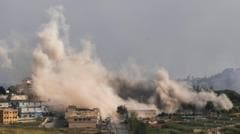
Israel's intensified strikes on Lebanon, killing dozens and targeting Hezbollah infrastructure, echo the biblical pattern of nations rising against nations and the ongoing conflict involving Israel and its neighbors—a sign Jesus foretold would mark the age before His return.
Matthew 24:6-7
Prophetic Fulfillment“And you will hear of wars and rumors of wars. See that you are not alarmed, for this must take place, but the end is not yet. For nation will rise against nation, and kingdom against kingdom, and there will be famines and earthquakes in various places.”
Why this passage
Jesus spoke these words on the Mount of Olives in response to His disciples' question about the sign of His coming and the end of the age. He listed wars, rumors of wars, and nation-rising-against-nation as the 'beginning of birth pains'—not the end itself, but the opening of the tribulation period.
In its plain sense, this prophecy describes a world of escalating conflict between nations and kingdoms, a pattern that intensifies as the age draws to a close. The 'wars and rumors of wars' are not isolated incidents but a global trend.
Historical context, theological significance, application today — denomination-neutral, ~1,000-word walk-through.
Behold, the Lord Jesus warned, 'You will hear of wars and rumors of wars. See that you are not alarmed, for this must take place, but the end is not yet' (Matthew 24:6).
The news from Lebanon—dozens dead, strikes on Hezbollah, vows to crush—is not a cause for panic but a call to watchfulness.
These conflicts are birth pains, not the final delivery. They remind us that the Prince of Peace has not yet returned to establish His kingdom.
Let your heart be anchored in the certainty that every war is a signpost pointing to the coming King, not a reason for despair.
Today's Prayer
Pray for the peace of Jerusalem and Lebanon, that the Lord would protect civilians caught in the crossfire and bring many to repentance through the witness of His people amid the conflict.
Further Scripture
Additional passages that illuminate this event, each grounded in a distinct interpretive lens.
“Proclaim this among the nations: Consecrate for war; stir up the mighty men. Let all the men of war draw near; let them come up. Beat your plowshares into swords, and your pruning hooks into spears; let the weak say, 'I am a warrior.'”
Why this passage
Joel 3 is a prophecy of the Lord's judgment on the nations that have scattered His people, culminating in the valley of Jehoshaphat. The call to 'beat plowshares into swords' is a vivid reversal of the peace of Micah 4:3—a sign that the nations are preparing for the final confrontation against Jerusalem and Israel.
In its original context, Joel summoned surrounding nations to gather for divine judgment. The language of consecrating war and turning farming tools into weapons describes a world abandoning peace for conflict, a pattern that recurs whenever Israel's enemies mobilize against her.
How it applies
Israel's strikes on Hezbollah in Lebanon, with Netanyahu's vow to 'crush' the Iran-backed group, reflect this very reversal: the region is arming for war, not peace. Hezbollah's infrastructure and fighters are being targeted, and dozens have died—a concrete instance of the nations being stirred up against Israel, as Joel foresaw.
This is not the final valley of decision, but it is a rehearsal of the pattern that will culminate in that day.
“Why do the nations rage and the peoples plot in vain? The kings of the earth set themselves, and the rulers take counsel together, against the Lord and against his Anointed, saying,”
Why this passage
Psalm 2 is a royal psalm describing the rebellion of the nations against God's appointed King, the Messiah. The 'raging' of the nations and the 'plotting' of rulers is a timeless principle: human governments and powers naturally resist God's authority, often targeting His people and His Anointed.
Historically, this psalm was used at the coronation of Davidic kings, but its ultimate referent is Christ (Acts 4:25-28). The pattern of nations conspiring against God's purposes is a constant in redemptive history.
How it applies
Hezbollah, backed by Iran, is a prime example of a 'nation' and 'ruler' raging against God's Anointed by attacking Israel, the people through whom the Messiah came. Netanyahu's vow to crush them is a defensive response, but the deeper spiritual reality is that the nations—including Iran and its proxies—continue to set themselves against the Lord's purposes in the land of Israel.
This verse judges the rebellion of those who wage war against God's covenant people.
Related by Scripture
Other events we've interpreted through the same passage or hermeneutical lens.
Israeli attack on Tyre in Lebanon kills eight as evacuation ordered for Christian quarter
Wars & Rumors of WarsShares Joel 3:9-10Eight killed in south Lebanon strike as Israel warns entire city to evacuate
Wars & Rumors of WarsShares Joel 3:9-10Middle East crisis live: People flee Lebanese city of Tyre after Israel orders evacuation ahead of strikes
Wars & Rumors of WarsShares Joel 3:9-10Since beginning of war, 29 ships attacked in Middle East — UKMTO
Wars & Rumors of WarsShares Matthew 24:6-7Israel and Iran trade strikes, threatening to drag the region back into full-scale war
Wars & Rumors of WarsShares Psalm 2:1-2
Community launching soon
Get the invite by email when the Watchman's Wall opens
Share this article
Source: bbc— we link to the original for full context.