U.S. says examining latest Iran proposal on Hormuz
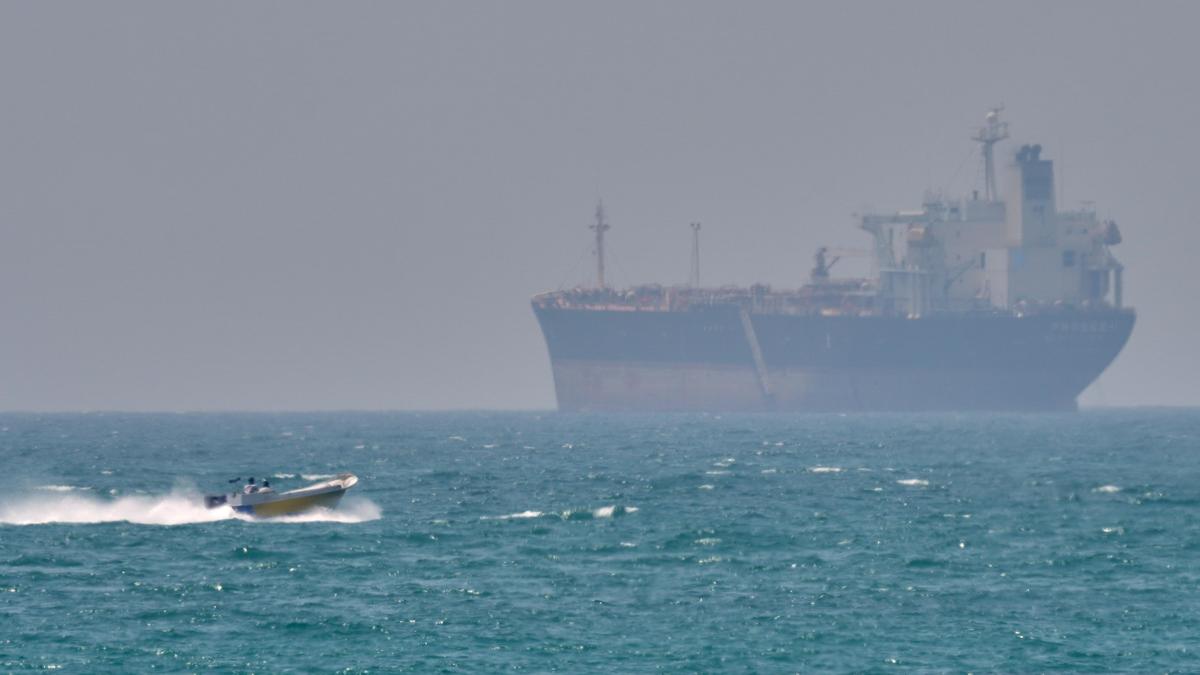
Iran's blockade of the Strait of Hormuz — the world's most critical oil corridor — following a U.S.-Israeli offensive has sent shockwaves through the global economy, as Washington examines Tehran's latest diplomatic proposal. This collision of military action, economic coercion, and fragile diplomacy echoes Scripture's repeated witness to the nations gathering in conflict over the ancient lands of the Middle East.
Jeremiah 4:13-17
Prophetic Fulfillment“Behold, he comes up like clouds; his chariots like the whirlwind; his horses are swifter than eagles— woe to us, for we are ruined! O Jerusalem, wash your heart from evil, that you may be saved. How long shall your wicked thoughts lodge within you? For a voice declares from Dan and proclaims trouble from Mount Ephraim. Warn the nations that he is coming; announce to Jerusalem, 'Besiegers come from a distant land; they shout against the cities of Judah.'”
Why this passage
Jeremiah 4 addresses the near-horizon reality of Babylonian invasion sweeping down upon Israel from the north, depicted as a swift, consuming military force that throws the whole land into upheaval. The prophetic pattern Jeremiah establishes — swift military actors, disruption of the surrounding nations, economic and civic chaos radiating outward from the epicenter of conflict — is precisely what the biblical prophets identify as the recurring shape of judgment in the Middle Eastern theater.
The far-horizon application is not a forced novelty: the prophets consistently use these oracles to describe the pattern by which God brings the nations into contention around the land of Israel. An Iranian blockade of Hormuz, triggered by a U.S.-Israeli offensive, is structurally identical — a distant power wielding swift, overwhelming disruption against the cities and economies of the region, with shockwaves felt in every direction.
The prophet Jeremiah declared of a coming catastrophe from the east: 'A lion has gone up from his thicket, a destroyer of nations has set out' (Jeremiah 4:7). The Strait of Hormuz — a narrow passage through which a fifth of the world's oil flows — has now been seized as a weapon, and the trembling of markets reflects precisely the kind of destabilization Jeremiah described when proud nations wield destruction as leverage.
Beloved, take heed: the world's confidence in its energy systems, its supply chains, its fragile diplomatic arrangements — these are reeds that bend and break. The watchman's call is not to panic but to remember that every earthly chokepoint is held in the hand of One whose counsel shall stand.
Let this moment drive the people of God not to the financial news but to their knees.
Today's Prayer
Pray that God would restrain the ambitions of nations that wield economic destruction as a weapon, that He would protect the innocent peoples who suffer when the powerful contend, and that His sovereign hand would be visible to those with eyes to see.
Further Scripture
Additional passages that illuminate this event, each grounded in a distinct interpretive lens.
“The oracle concerning the wilderness of the sea. As whirlwinds in the Negeb sweep on, it comes from the wilderness, from a terrible land. A stern vision is told to me; the traitor betrays, and the destroyer destroys. Go up, O Elam; lay siege, O Media; all the sighing she has caused I bring to an end.”
Why this passage
Isaiah 21 is the 'burden of the desert of the sea' — an oracle directed against Babylon but delivered through the lens of Elam (ancient Persia, roughly modern Iran) and Media as the instruments of its fall. The phrase 'wilderness of the sea' has long been associated by commentators with the region of the Persian Gulf and its surrounding terrain, the very theater in which the Strait of Hormuz sits today.
The oracle's plain sense is that a power arising from the ancient Persian geography becomes an instrument of upheaval — besieging, destroying, and causing the 'sighing' of nations. That Elam/Persia should be the actor who lays siege and causes geopolitical anguish is the clear grammatical-historical sense of the text, and modern Iran occupying the geographic inheritance of ancient Elam makes this oracle a compelling lens for understanding Iranian aggression in the Persian Gulf region.
How it applies
Iran — the geographic and cultural heir of ancient Elam and Persia — has now closed the 'sea' passage that all the trading nations of the world depend upon, causing exactly the sighing and anguish Isaiah foresaw from this quarter of the earth.
Washington's careful examination of Tehran's proposal reflects the posture of a great power suddenly humbled by the leverage of a smaller one that controls a critical maritime chokepoint — a dynamic Isaiah's oracle captures with striking clarity.
“When your wares came from the seas, you satisfied many peoples; with your abundant wealth and merchandise you enriched the kings of the earth. Now you are wrecked by the seas, in the depths of the waters; your merchandise and all your crew in your midst have sunk with you.”
Why this passage
Ezekiel 27 is the great lament over Tyre — the ancient world's supreme maritime trading power — and its sudden, catastrophic collapse. The oracle establishes a durable biblical principle: that maritime commerce is the nervous system of the nations' wealth, and that when God permits its disruption, 'the kings of the earth' are shaken and impoverished along with it.
The principle is not limited to Tyre's singular fate but is presented by Ezekiel as the judgment-pattern for any civilization that has made the sea-lanes the source of its security. The plain grammatical-historical sense establishes that 'many peoples' and 'kings of the earth' are enriched or devastated together by the condition of global trade routes.
How it applies
The Strait of Hormuz carries approximately 20 percent of the world's oil and liquefied natural gas — the precise kind of sea-borne wealth Ezekiel describes as the enricher of kings. Iran's blockade has done precisely what Ezekiel's oracle warned: disrupted the maritime arteries and sent 'shockwaves through the global economy.'
The nations that built their prosperity on the uninterrupted flow of Persian Gulf energy now discover what Tyre's trading partners discovered — that what the sea gives, geopolitical upheaval can swiftly take away.
“Thus says the LORD of hosts: Behold, I will break the bow of Elam, the mainstay of their might. And I will bring upon Elam the four winds from the four quarters of heaven. And I will scatter them to all those winds, and there shall be no nation to which those driven out of Elam shall not come. I will terrify Elam before their enemies and before those who seek their life. I will bring disaster upon them, my fierce anger, declares the LORD.”
Why this passage
Jeremiah 49:34-39 is one of Scripture's most specific oracles directed at Elam — ancient Persia, the geographic predecessor of modern Iran — and it describes a season of Elam's power being broken after a period in which that power was formidable ('the mainstay of their might' being the Elamite bow, their military instrument of projection).
The oracle's near horizon was the Babylonian and subsequent Persian-era disruptions of Elamite power. The far horizon, consistently noted by commentators, is the final disposition of this ancient nation before the Lord.
What the oracle establishes plainly is that Elam's military confidence — her ability to project power and coerce neighbors — is subject to divine limitation. Iran's current display of power via the Hormuz blockade is precisely the kind of 'mainstay of might' this oracle addresses.
How it applies
Iran's closure of the Strait of Hormuz is the contemporary expression of 'the bow of Elam' — the instrument by which this ancient people projects power and terrifies the nations around it. The world's great powers are now examining Tehran's proposals, which is to say they are negotiating with the nation that holds the chokepoint.
Scripture's witness is that no such instrument of national pride stands forever. The LORD of hosts who addressed Elam directly through Jeremiah has not forgotten His word, and the people of God are called to watch the unfolding of these ancient oracles with sober, trusting eyes.
Related by Scripture
Other events we've interpreted through the same passage or hermeneutical lens.
Middle East crisis live: Hegseth to give Iran war update amid growing tensions in strait of Hormuz
Wars & Rumors of WarsShares Jeremiah 49:35-37Tuareg rebels hold dozens of soldiers in Mali as prisoners
Wars & Rumors of WarsShares Jeremiah 4:13-17The UAE says Iran resumes attacks as the U.S. moves to reopen the Strait of Hormuz
Wars & Rumors of WarsShares Jeremiah 49:35-37Iran war: US says both military and merchant ships have passed through Strait of Hormuz
Wars & Rumors of WarsShares Jeremiah 49:35-37Withdrawal of 5,000 U.S. forces in Germany will happen within next year
Wars & Rumors of WarsShares Jeremiah 4:13-17
Community launching soon
Get the invite by email when the Watchman's Wall opens
Share this article
Source: thehindu— we link to the original for full context.