Two killed and many injured after car driven into crowd in German city of Leipzig
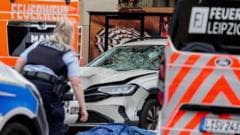
A car was deliberately driven into a crowd in Leipzig, Germany, killing two and injuring many others — another grim instance of the senseless violence against innocent civilians that Scripture identifies as a mark of lawless, darkened times.
Isaiah 59:7-8
Direct Principle“Their feet run to evil, and they are swift to shed innocent blood; their thoughts are thoughts of iniquity; desolation and destruction are in their highways. The way of peace they do not know, and there is no justice in their paths; they have made their crooked paths for themselves; whoever walks in them does not know peace.”
Why this passage
Isaiah 59 is a sweeping indictment of a society that has severed itself from God's moral order. The prophet describes the concrete, physical result of that severance: violence in the streets, bloodshed of the innocent, and the utter absence of peace in the public square.
The grammatical-historical sense addresses Israel's covenant failure, but the principle is universally applicable wherever a society turns from divine righteousness — 'their feet run to evil' describes not an individual pathology but a societal direction, which Paul himself confirms by quoting this passage in Romans 3:15-17 as a diagnosis of fallen humanity at large.
The prophet Isaiah warned of a day when society would call evil good and invert every moral order — and in such a climate, the innocent become targets of the wrathful and the unstable. When a driver turns a vehicle into a weapon against a crowd of neighbors, we glimpse the bitter fruit of hearts emptied of the fear of God.
Scripture does not counsel despair, but it does counsel sobriety. "Their feet run to evil, and they are swift to shed innocent blood" (Isaiah 59:7).
The believer is called to grieve rightly, to pray earnestly, and to hold fast to the One who is the same yesterday, today, and forever — even when the streets of the nations run with sorrow.
Today's Prayer
Pray for the families of the two killed in Leipzig, for the injured to recover, and for authorities to uncover the full truth of what drove this act — and pray that God would restrain the violence that increasingly marks our age.
Further Scripture
Additional passages that illuminate this event, each grounded in a distinct interpretive lens.
“But understand this, that in the last days there will come times of difficulty. For people will be lovers of self, lovers of money, proud, arrogant, abusive, disobedient to their parents, ungrateful, unholy, heartless, unappeasable, slanderous, without self-control, brutal, not loving good.”
Why this passage
Paul writes to Timothy with explicit eschatological framing — 'in the last days' — describing not a single event but a pattern of character that intensifies as history moves toward its close. The word translated 'brutal' (ἀνήμεροι) carries the sense of savage, untamed, feral — a person stripped of the civilizing restraint that comes from covenant community and the fear of God.
This is not a prediction of one specific attack but a description of a moral climate Paul says will characterize the closing age — a climate in which such attacks become increasingly unsurprising.
How it applies
The Leipzig attack — a deliberate act of lethal violence against unsuspecting civilians in a public space — embodies the 'brutal' and 'heartless' character Paul catalogues. Europe, once shaped by centuries of Christian moral formation, increasingly experiences the fruit of post-Christian moral dissolution.
The believer is instructed to 'understand this' — to read such events with scriptural clarity, neither numbed by repetition nor paralyzed by fear, but watchful and steadfast.
“Righteousness exalts a nation, but sin is a reproach to any people.”
Why this passage
The Hebrew word translated 'reproach' (חֶסֶד used negatively here — actually חֶרְפָּה, ḥerpāh) means shame, disgrace, a wound to dignity. The Proverb states a covenantal-wisdom pattern observable across all peoples and times: nations that cultivate righteous foundations flourish; those that abandon them experience the shame of social breakdown, including violence.
This is not a promise exclusively to Israel but a wisdom observation about the moral architecture of any human community — its plain sense is universally applicable.
How it applies
Germany, like much of the post-Christian West, has progressively marginalized the religious and moral frameworks that historically restrained public violence and cultivated civic trust. The recurring nature of vehicle-ramming attacks across European cities is part of the 'reproach' that follows the erosion of those foundations.
The Proverb does not allow fatalism — it implies that nations may yet turn, and that righteousness remains available — but it names honestly the trajectory when they do not.
Related by Scripture
Other events we've interpreted through the same passage or hermeneutical lens.
Why Americans Are Falling Out Of Love With LGBT ‘Pride’
Moral DeclineShares Proverbs 14:34Pope Leo rails against migrant deaths on visit to Spain’s ‘dock of shame’
Moral DeclineShares Proverbs 14:34Philippine bishop, ex-ICC judge lead new inquiry into thousands of Duterte-era killings
Moral DeclineShares Proverbs 14:34Tisza Backtracks on Proposal, Christian Culture Stays in Constitution
Moral DeclineShares Proverbs 14:34U.S. bishops praise Leo’s encyclical on AI, echo concern for human dignity, common good
Technology & SurveillanceShares Proverbs 14:34
Community launching soon
Get the invite by email when the Watchman's Wall opens
Share this article
Source: bbc— we link to the original for full context.