Sudan war enters fourth year as child hunger crisis deepens
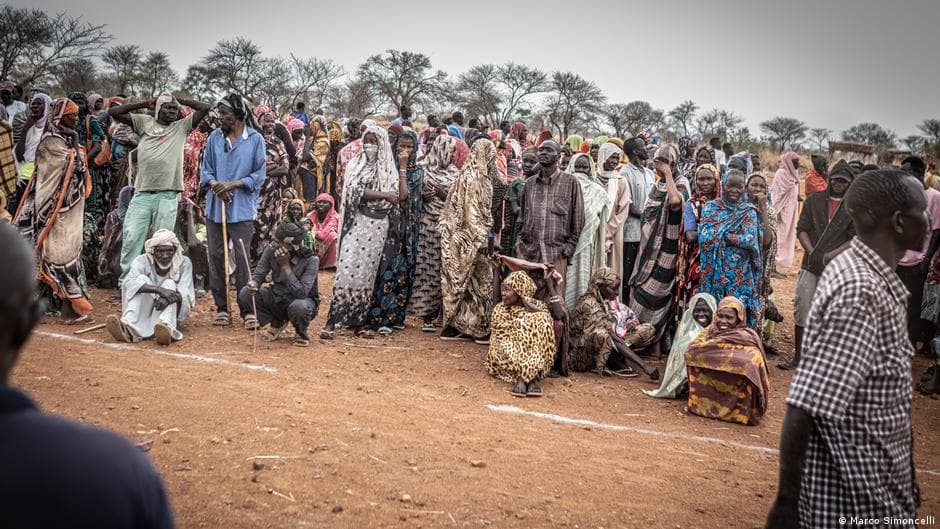
Sudan's civil war has entered its fourth year, producing one of the world's most severe hunger crises, with famine conditions spreading and children dying of starvation as humanitarian aid funding collapses — a convergence of war and famine Scripture repeatedly identifies as a mark of judgment and end-times distress.
Lamentations 4:4
Narrative Parallel“The tongue of the nursing infant sticks to the roof of its mouth for thirst; the children beg for food, but no one gives to them.”
Why this passage
Lamentations 4 is Jeremiah's eyewitness lament over Jerusalem's siege and fall, in which the covenant curses of Deuteronomy 28 — famine, siege, and the death of children — were literally enacted on the city. The nursing infant and begging child are not metaphors; they are the specific, observable human cost of war-induced starvation that Jeremiah records.
The structural pattern is identical: an armed conflict creates a siege economy, food supplies are severed, and the most defenseless — infants and children — bear the ultimate cost while surrounding nations and potential helpers look away.
The prophet Lamentations cried out, 'the children beg for food, but no one gives to them.' These ancient words echo with devastating freshness from Sudan, where children are dying of starvation not because the earth failed, but because armed men made food a weapon of war. When conflict deliberately starves the most vulnerable, it enacts one of Scripture's most grievous covenant-curse patterns — the sword and the famine arriving together as twin judgments on a land in upheaval.
For the watching Christian, this is not merely a geopolitical tragedy; it is a call to intercede, to give, and to hold fast to the God who hears the cry of hungry children even when governments and aid organizations fail.
Today's Prayer
Pray that God would break through the political and military blockades strangling humanitarian aid in Sudan, that children would be reached with food and care, and that the global Church would respond with urgent generosity.
Further Scripture
Additional passages that illuminate this event, each grounded in a distinct interpretive lens.
“A third part of you shall die of pestilence and be consumed with famine in your midst; a third part shall fall by the sword all around you; and a third part I will scatter to all the winds and will unsheathe the sword after them.”
Why this passage
Ezekiel 5 is an enacted prophetic sign directed at Jerusalem under Babylonian siege, but its theological content — the divine pattern of famine and sword arriving together as instruments of judgment on a nation given over to violence — recurs across the prophets as a recognizable signature of God's governance of history (cf. Jer 14:12; 21:9; Rev 6:8).
The original oracle established that war and famine are not independent disasters but paired judgments that compound one another, a principle the prophets apply broadly to the nations, not only to Israel. Ezekiel speaks to the pattern of divine providence working through historical catastrophe.
How it applies
Sudan's crisis is a textbook instance of sword and famine arriving together and multiplying their devastation: the civil war (sword) has directly caused the famine by destroying agricultural infrastructure, blocking aid corridors, and displacing millions. The article's description of famine conditions spreading as the war continues into a fourth year mirrors the prophetic pattern in which these twin judgments do not occur sequentially but simultaneously and mutually reinforce each other.
The pattern Scripture names is the pattern Sudan is living.
“And I looked, and behold, a pale horse! And its rider's name was Death, and Hades followed him. And they were given authority over a fourth of the earth, to kill with sword and with famine and with pestilence and by wild beasts of the earth.”
Why this passage
The fourth seal of Revelation 6 depicts a convergence of sword, famine, and pestilence acting together on a global scale as part of the escalating distress of the last days. John is drawing on the Ezekiel 14:21 formulation of God's four severe judgments, now projected onto an end-times horizon.
The original hearers understood this as a future intensification of patterns already visible in history — not a single discrete event, but a wave of compounding catastrophes affecting large populations. The 'authority over a fourth of the earth' signals the scope has become global and systemic rather than localized.
How it applies
Sudan currently hosts what the UN has called one of the worst humanitarian crises on earth, with famine and war operating together to produce mass death — precisely the sword-and-famine pairing the fourth seal names. While no interpreter should date-set or claim this is the literal opening of the fourth seal, the event is a clear instantiation of the pattern Revelation 6:8 describes as characteristic of the end-times period.
For Christians, this is a call to sober watchfulness: these convergences are exactly what Scripture said we would see intensifying before the Lord's return.
“I gave you cleanness of teeth in all your cities, and lack of bread in all your places, yet you did not return to me, declares the Lord.”
Why this passage
In Amos 4, God lists a series of covenant judgments — famine, drought, crop failure, plague, military defeat — each followed by the haunting refrain 'yet you did not return to me.' The theological principle Amos establishes is that God uses material catastrophe, including famine, as a summons to repentance; 'cleanness of teeth' is an idiom for hunger so acute the teeth have nothing to chew. This principle is not limited to Israel but reflects God's general governance of nations — he withholds sustenance to turn human hearts toward himself, and when nations persist in ignoring that call, the judgments intensify.
How it applies
Sudan's deepening famine, now entering its fourth year with no resolution in sight, reflects the Amos pattern of escalating crises that go unheeded. The international community's failure to adequately fund humanitarian response and the warring parties' indifference to civilian starvation represent a collective 'yet you did not return.' For the watching believer, this crisis is not merely a political failure — it is a moment when God's voice through suffering is being broadcast loudly, and the question Amos forces is whether anyone will hear it and act.
Related by Scripture
Other events we've interpreted through the same passage or hermeneutical lens.
Anthony Albanese says Australia’s first mainland case of deadly H5N1 bird flu ‘concerning’
Pestilence & PlaguesShares Revelation 6:8United Nations: Strait of Hormuz Disruption Could Trigger Global Food Price Crisis Within a Year
FaminesShares Amos 4:6Escalating Regional Conflict Impacts Supply Chains and Threatens Yemen's Aid Lifeline [EN/AR]
FaminesShares Lamentations 4:4WHO prequalifies first-ever malaria treatment for newborns and infants, adds new diagnostic tests
Pestilence & PlaguesShares Revelation 6:8US-Israeli war on Iran will push 30 million back into poverty, UN warns
FaminesShares Amos 4:6
Community launching soon
Get the invite by email when the Watchman's Wall opens
Share this article
Source: DW (English)— we link to the original for full context.