Sudan's three-year war deepens child and hunger crisis
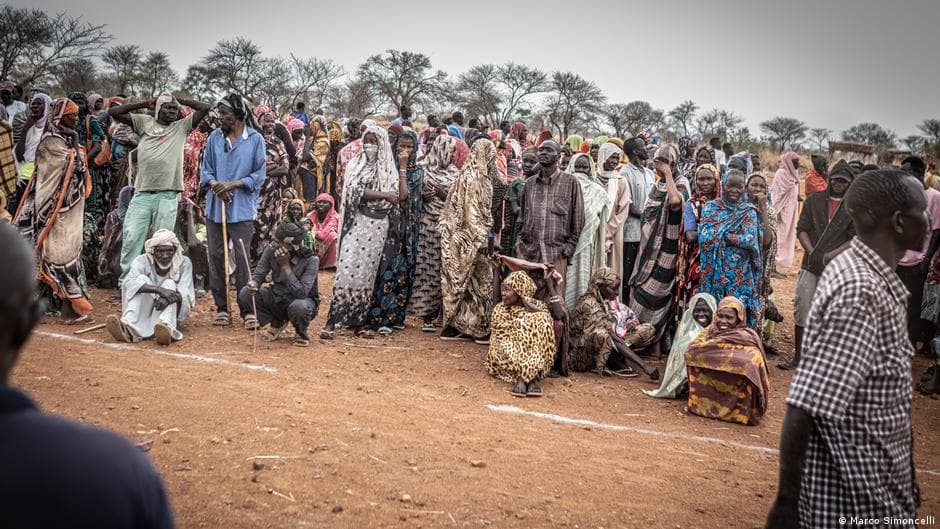
Sudan's three-year civil war has pushed millions to the brink of famine, with children suffering acute malnutrition as humanitarian aid collapses — a convergence of war and starvation that Scripture repeatedly identifies as a hallmark of the last days and divine judgment upon nations.
Lamentations 4:4
Narrative Parallel“The tongue of the nursing infant sticks to the roof of its mouth for thirst; the children beg for food, but no one gives to them.”
Why this passage
Lamentations 4 was composed in the immediate aftermath of Babylon's destruction of Jerusalem, recording the catastrophic famine conditions that accompanied siege warfare and forced displacement. The original hearers understood this as a vivid, eyewitness account of how war produces starvation — particularly for children — and how social structures collapse so completely that 'no one gives to them.' The parallel structure of the passage (war → displacement → famine → child suffering → humanitarian abandonment) is not vague; it is precise and structural.
The prophet Lamentations cried out, 'The tongue of the nursing infant sticks to the roof of its mouth for thirst; the children beg for food, but no one gives to them.' These words, written over the ruins of Jerusalem, echo with terrible freshness from Sudan today, where millions of displaced children face acute malnutrition as funding for humanitarian aid collapses around them. Scripture does not treat mass child hunger as a mere political failure — it treats it as a moral and spiritual indictment, a wound on the conscience of nations and the watching church.
For the Christian aged in wisdom, these images from Sudan are not distant news; they are a summons to intercession, to generosity, and to sober recognition that the suffering of the least among us is always near to the heart of God.
Today's Prayer
Pray that the global church would respond to Sudan's famine crisis with urgent generosity and intercession, and that God would raise up leaders and aid workers who can break through political barriers to bring food and medicine to starving children.
Further Scripture
Additional passages that illuminate this event, each grounded in a distinct interpretive lens.
“When he opened the third seal, I heard the third living creature say, 'Come!' And I looked, and behold, a black horse! And its rider had a pair of scales in his hand. And I heard what seemed to be a voice in the midst of the four living creatures, saying, 'A quart of wheat for a denarius, and three quarts of barley for a denarius, and do not harm the oil and wine!'”
Why this passage
The third seal in Revelation 6 introduces a rider on a black horse bearing scales — the universal ancient symbol of rationed, costly food distribution. The original vision to John portrayed famine as one of four sequential horsemen accompanying warfare and conquest in the last-days tribulation sequence.
The denarius price represents a full day's wage for a single quart of wheat — a picture of food scarcity so severe that survival consumes all available resources. Historically and prophetically, famine is inseparable from war in biblical eschatology.
How it applies
Sudan's crisis illustrates the black horse pattern with precision: civil war (the red horse preceding) has produced food scarcity so acute that basic nutrition is rationed or simply absent for millions. The collapse of humanitarian funding mirrors the vision's implication that market systems fail the poor most catastrophically in war-famine conditions.
While this event is not a direct claim of seal-opening fulfillment, it represents the recurring pattern Scripture describes as characteristic of the age leading to the Day of the Lord.
“I gave you cleanness of teeth in all your cities, and lack of bread in all your places, yet you did not return to me, declares the LORD.”
Why this passage
In Amos 4, God rehearses a litany of covenant judgments He sent upon Israel — famine, drought, blight, pestilence, and military defeat — each followed by the refrain 'yet you did not return to me.' The 'cleanness of teeth' is an idiom for famine: teeth that have nothing to chew are clean. Amos's theological principle is that God uses famine as a summons to national repentance, and that nations who persist in injustice and idolatry face escalating judgments.
This is a direct principle applicable to any nation or region, not merely to Israel under the Mosaic covenant.
How it applies
Sudan's famine is directly linked to political and military violence — the RSF and SAF prosecuting a brutal civil war while civilian populations starve. Amos's pattern of leaders prosecuting injustice while famine spreads among the population is structurally identical.
The deeper prophetic warning is that famine is not merely a logistical crisis but a spiritual signal — a moment of divine summons — and that the response of those with power determines whether judgment deepens or relents.
“For nation will rise against nation, and kingdom against kingdom, and there will be famines and earthquakes in various places.”
Why this passage
In the Olivet Discourse, Jesus explicitly pairs 'nation rising against nation' with famines as the 'beginning of birth pangs' — signs marking the period before the end. The grammatical-historical sense is that these are not isolated events but a convergent pattern of escalating suffering.
The discourse was addressed to disciples asking about the destruction of the Temple and the end of the age, and Jesus' answer spans both near (AD 70) and far (eschatological) horizons. The linkage of war and famine is explicit and intentional.
How it applies
Sudan presents precisely the convergence Jesus described: armed conflict between national and paramilitary forces directly producing famine conditions across multiple regions. While Matthew 24:7 is one of the more frequently cited prophetic passages, its inclusion here is warranted because the article itself describes the textbook combination — war producing famine — that this verse identifies.
It is included as a secondary confirmation behind the stronger, less-cited passages above.
Related by Scripture
Other events we've interpreted through the same passage or hermeneutical lens.
Seismic waves from big earthquake may have literally moved Japan
Earthquakes & Natural DisastersShares Matthew 24:7Big One fears erupt as San Andreas fault reaches highest stress level in 1,000 years
Earthquakes & Natural DisastersShares Matthew 24:7UN Warns Hunger Crisis Will Worsen In 13 Global Hotspots
FaminesShares Matthew 24:7Could this ancient burial site be the oldest lethal plague outbreak?
Pestilence & PlaguesShares Matthew 24:7New FAO-WFP report warns worsening hunger puts 13 hotspots at significant risk
FaminesShares Matthew 24:7
Community launching soon
Get the invite by email when the Watchman's Wall opens
Share this article
Source: DW (English)— we link to the original for full context.