Shipping firms question safety in strait of Hormuz despite Trump plan
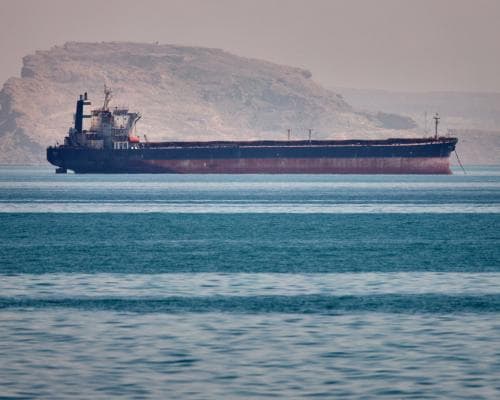
Shipping companies are questioning the safety of the Strait of Hormuz even as President Trump claims the US Navy will escort stranded vessels — while reports emerge that an American warship was struck by Iran, signaling active naval hostilities at one of the world's most strategic waterways.
Ezekiel 13:10
Direct Principle“Precisely because they have misled my people, saying, 'Peace,' when there is no peace, and because, when the people build a wall, these prophets smear it with whitewash,”
Why this passage
God rebukes the false prophets of Israel who proclaimed peace when the nation was structurally exposed to destruction. The whitewashed wall is a powerful image: it looks solid from a distance but offers no real protection.
The principle is clear and requires no reinterpretation — when leaders declare safety that does not correspond to the actual threat environment, they are building whitewashed walls.
This principle functions as a direct moral category applicable across history wherever political declarations diverge fatally from ground-level reality.
The prophet Jeremiah watched foreign powers threaten Israel's sea lanes and trade routes, and God declared through him: 'I am bringing disaster from the north, and great destruction.' The Strait of Hormuz is not the Jordan, but the pattern Scripture describes is unchanged — great nations posture and maneuver, while the machinery of war grinds forward regardless of declarations of safety.
When leaders cry 'peace, peace,' and sailors fear to sail, the believer is called not to panic but to watchfulness. 'Take heed,' our Lord instructed, 'that ye be not troubled' — not because the dangers are unreal, but because these things were foreknown by the One who holds every sea in His hand.
Today's Prayer
Pray that those in positions of naval command and international diplomacy would be restrained from actions that escalate this confrontation into open war, and that God's sovereignty over the waters would be recognized by the nations.
Further Scripture
Additional passages that illuminate this event, each grounded in a distinct interpretive lens.
“Behold, he comes up like clouds; his chariots like the whirlwind; his horses are swifter than eagles— woe to us, for we are ruined!”
Why this passage
Jeremiah 4 records an oracle of impending military catastrophe against Judah — an unstoppable foe approaching with speed and overwhelming force. The original near-horizon fulfillment was Babylon's advance, but the language of swift, overwhelming military power at strategic corridors has a far-horizon resonance with the category of nation-against-nation conflict described in Matthew 24.
The imagery of chariots and warships as engines of national destruction maps structurally to any age: the specific technologies change, but the pattern of great powers threatening strategic corridors and the cry of 'we are ruined!' from those caught in the middle — sailors, merchants, nations dependent on trade — is precisely what Scripture says will characterize the age before the Day of the Lord.
How it applies
Shipping firms sounding alarm about the Strait of Hormuz — the throat of global oil trade — while a US warship is reportedly struck by Iranian forces, embodies exactly this pattern: swift military action overwhelming diplomatic assurances, leaving those dependent on the waterway crying 'woe to us.'
Trump's promise to 'guide' stranded ships out rings against the backdrop of live hostilities, a credibility gap that echoes the false peace oracles Jeremiah consistently opposed.
“And they will say to you, 'How you have perished, you who were inhabited from the seas, O city renowned, who was mighty on the sea; she and her inhabitants imposed their terror on all her inhabitants! Now the coastlands tremble on the day of your fall, and the coastlands that are on the sea are dismayed by your passing.'”
Why this passage
Ezekiel's oracle against Tyre addresses the fragility of maritime commercial power — a city whose strength lay in controlling sea lanes. The text describes how nations dependent on that maritime power tremble when it is threatened or destroyed.
The grammatical-historical sense is Tyre's specific fall, but the pattern Ezekiel identifies — naval dominance, chokepoint control, the terror felt by seafaring peoples when that dominance is challenged — is a recurring biblical theme about the vulnerability of commerce built on controlled waters.
This is not a forced typology; Ezekiel is describing a principle about maritime power that applies whenever a strategic sea corridor is contested.
How it applies
The Strait of Hormuz is the modern world's foremost maritime chokepoint — roughly 20% of global oil passes through it. Shipping firms trembling over whether to send vessels through it while US and Iranian naval forces exchange fire is structurally identical to the 'coastlands trembling' when the power controlling the sea lane is under challenge.
The merchants of Ezekiel's day pulled back from Tyre; today's shipping companies are questioning whether Trump's naval escorts are real protection or political theater.
“For in a single hour all this wealth has been laid waste. And all shipmasters and seafaring men, sailors and all whose trade is on the sea, stood far off and cried out as they saw the smoke of her burning, 'What city was like the great city?'”
Why this passage
Revelation 18 describes the fall of Babylon the Great, with particular attention to the seafaring merchants who depended on her commerce — they 'stand far off' because the danger is too great to approach. The original context is the eschatological judgment of the global commercial system, and the specific actors named are shipmasters and sailors who can no longer safely conduct their trade.
While the full fulfillment of Revelation 18 remains future, the pattern of sailors and shipping companies withdrawing from dangerous waters due to military and political instability is a recognizable foretaste of the conditions that prophecy describes.
How it applies
Shipping firms 'questioning safety' in the Strait of Hormuz and effectively standing off from the waterway while smoke of conflict rises echoes the precise imagery of Revelation 18 — merchants of the sea crying out and pulling back as the stability of the global commercial order is shaken.
This is not the final fulfillment of Revelation 18, but it is a concrete, present-tense pattern of the kind of disruption that prophecy says will characterize the end of the age.
Related by Scripture
Other events we've interpreted through the same passage or hermeneutical lens.
Iran War Live Updates: Tehran Threatens U.S. Ships Over Trump Plan to Break Its Blockade in the Strait of Hormuz
Wars & Rumors of WarsShares Jeremiah 4:13CENTCOM: US destroys 6 Revolutionary Guard boats that attempted to attack commercial ships
Wars & Rumors of WarsShares Jeremiah 4:13Somali pirate and Houthi alliance targets $1T oil trade route with revived hijack tactic
Wars & Rumors of WarsShares Jeremiah 4:13Cargo ship attacked by small craft near Strait of Hormuz, UK maritime agency says
Wars & Rumors of WarsShares Jeremiah 4:13Ukraine shot down 33,000 Russian drones in 1 month: defence minister
Wars & Rumors of WarsShares Jeremiah 4:13
Community launching soon
Get the invite by email when the Watchman's Wall opens
Share this article
Source: The Guardian— we link to the original for full context.