Iran War Live Updates: Tehran Threatens U.S. Ships Over Trump Plan to Break Its Blockade in the Strait of Hormuz
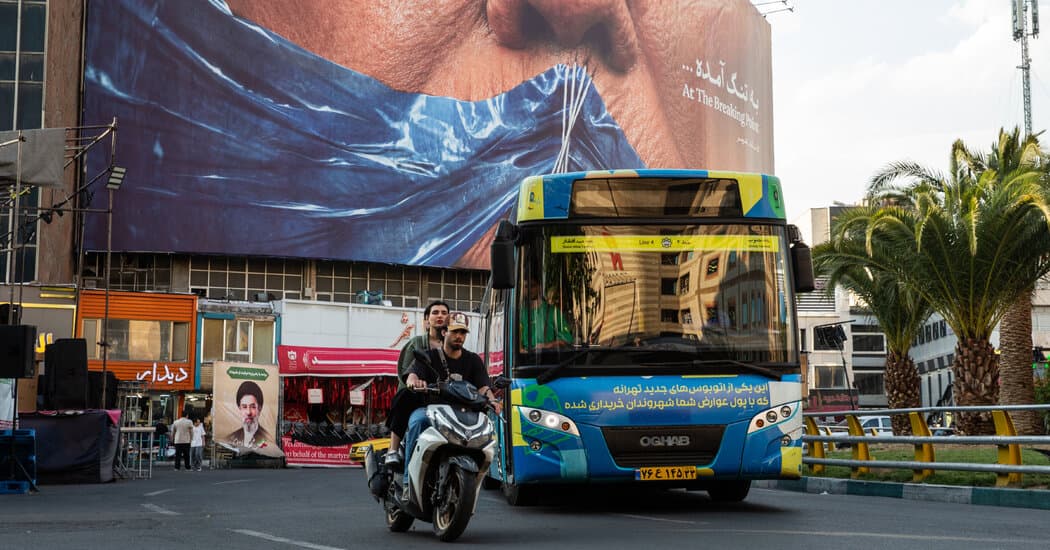
Iran has directly threatened U.S. ships as the Trump administration moves to break an Iranian blockade of the Strait of Hormuz, bringing two nuclear-capable powers to the edge of open naval warfare in one of the world's most strategic waterways.
Jeremiah 4:13
Prophetic Fulfillment“Behold, he comes up like clouds; his chariots like the whirlwind; his horses are swifter than eagles — woe to us, for we are ruined!”
Why this passage
Jeremiah 4:13 is part of a sustained oracle (4:5-31) in which Jeremiah, watching a northern foe mass against Judah, describes the terrifying speed and overwhelming force of approaching military catastrophe. The verse captures the existential dread that accompanies the mobilization of great military machines — chariots and cavalry that ancient readers would immediately recognize as unstoppable force projection.
The grammatical-historical sense is a lament over inevitable war brought on by political defiance and spiritual arrogance. While Jeremiah addressed Babylon advancing on Jerusalem, the pattern of nations posturing with overwhelming military hardware at a strategic corridor — threatening ruinous escalation — is precisely the pattern the oracle describes.
The prophet Jeremiah beheld armies rushing like storm-clouds and cried, 'My anguish, my anguish! I writhe in pain!' — for he understood that when great powers bare their swords at the chokepoints of commerce and sovereignty, the cost falls upon ordinary flesh and blood.
The Strait of Hormuz is no mere shipping lane; it is a flashpoint where the pride of nations collides. Scripture does not call the believer to panic but to vigilance and prayer, remembering that every sword lifted in the councils of the powerful is already seen by the One who holds the nations as a drop in a bucket.
Today's Prayer
Pray that God would restrain the hands of leaders on every side from reckless escalation, and that His people would stand as intercessors for peace in the gates before missiles are loosed across the Persian Gulf.
Further Scripture
Additional passages that illuminate this event, each grounded in a distinct interpretive lens.
“A stern vision is told to me; the traitor betrays, and the destroyer destroys. Go up, O Elam; lay siege, O Media; all the sighing she has caused I bring to an end.”
Why this passage
Isaiah 21 is the 'oracle concerning the wilderness of the sea' — widely understood by ancient and modern commentators to address the Persian Gulf region. Elam and Media are ancient geopolitical designations for the territory of modern Iran and its environs.
Isaiah's oracle speaks of military mobilization, siege, and destruction arising from that very geography.
The grammatical-historical horizon is the fall of Babylon to the Medo-Persian alliance, but the far horizon encompasses the recurring pattern of military conflict and suffering arising from the lands of ancient Elam and Media. It is remarkable that the Bible's most geographically specific oracle about military conflict in the Persian Gulf region concerns the very territory now at the center of this confrontation.
How it applies
Iran — heir to the territory of ancient Elam — is once again at the center of a military standoff in the sea lanes of the Persian Gulf, threatening naval warfare at the Strait of Hormuz.
Isaiah's vision of 'the traitor betrays and the destroyer destroys' captures the mutual accusations of provocation that characterize the U.S.-Iran standoff. The Scripture's geographic specificity here is not incidental: the Persian Gulf has been a theater of conflict and prophecy from the days of Isaiah forward.
“And I will bring upon Elam the four winds from the four quarters of heaven. And I will scatter them to all those winds, and there shall be no nation to which those driven out of Elam shall not come. I will terrify Elam before their enemies and before those who seek their life. I will bring disaster upon them, my fierce anger, declares the LORD.”
Why this passage
Jeremiah 49:34-39 is the only standalone prophetic oracle in the Hebrew Bible addressed exclusively to Elam — the ancient core of what is now southwestern Iran, including the region where Iran's nuclear and military infrastructure is concentrated today. God declares that Elam's military power ('the bow of Elam,' v.35) will be broken and its people scattered by disaster.
The oracle carries both a historical near-horizon (Elamite defeat by Babylon/Persia) and a far-horizon component: verse 39 promises restoration 'in the latter days,' implying a judgment-then-restoration arc that has not yet found complete fulfillment. The plain sense of the text is divine sovereignty over the military fortunes of the Iranian plateau.
How it applies
Iran's threats to destroy U.S. ships and escalate toward open naval war represent precisely the kind of aggressive military posture that Jeremiah's Elam oracle addresses — the pride of a nation trusting in its military bow even as it faces the prospect of overwhelming response.
For the believer, this oracle is not a gloating verdict but a sober reminder: God has spoken specifically about this geography and these peoples. The outcome of the Strait of Hormuz crisis, whatever it may be, does not catch the LORD of hosts by surprise.
“When he opened the second seal, I heard the second living creature say, 'Come!' And out came another horse, bright red. Its rider was permitted to take peace from the earth, so that people should slay one another, and he was given a great sword.”
Why this passage
The second seal of Revelation 6 describes a rider whose mission is to remove peace from the earth and ignite human slaughter on a massive scale — 'a great sword' being the instrument of great-power military violence. John's vision is addressed to the whole arc of human history leading to the consummation, not merely the first century.
The grammatical-historical sense is that wars of escalating devastation are not historical accidents but permitted events within God's sovereign plan. The Strait of Hormuz, through which roughly 20% of the world's oil transits, is precisely the kind of chokepoint whose seizure or warfare could 'take peace from the earth' across multiple continents simultaneously.
How it applies
The threatened confrontation between U.S. naval forces and Iranian missiles at the Strait of Hormuz is not merely a regional dispute — it is a potential ignition point for cascading global consequences that mirror the pattern of the red horse: peace removed, nations turning weapons upon one another.
The believer is not called to map the seals onto newspaper headlines with certainty, but to recognize that the pattern Scripture describes — great powers, great swords, peace removed — is exactly the pattern unfolding in the Persian Gulf today.
Related by Scripture
Other events we've interpreted through the same passage or hermeneutical lens.
CENTCOM: US destroys 6 Revolutionary Guard boats that attempted to attack commercial ships
Wars & Rumors of WarsShares Jeremiah 4:13Trump says the U.S. will 'guide' stranded ships from the Strait of Hormuz
Wars & Rumors of WarsShares Jeremiah 49:36-37Somali pirate and Houthi alliance targets $1T oil trade route with revived hijack tactic
Wars & Rumors of WarsShares Jeremiah 4:13Cargo ship attacked by small craft near Strait of Hormuz, UK maritime agency says
Wars & Rumors of WarsShares Jeremiah 4:13Ukraine shot down 33,000 Russian drones in 1 month: defence minister
Wars & Rumors of WarsShares Jeremiah 4:13
Community launching soon
Get the invite by email when the Watchman's Wall opens
Share this article
Source: Aaron Boxerman; Sanam Mahoozi; Ismaeel Naar; Eric Schmitt; Choe Sang-Hun; Peter Eavis; Gregory Schmidt; Vivian Nereim; The New York Times; Elian Peltier; Dan Watson— we link to the original for full context.