Netanyahu orders Iran strikes despite Trump claiming ‘I call all the shots’ | First Thing
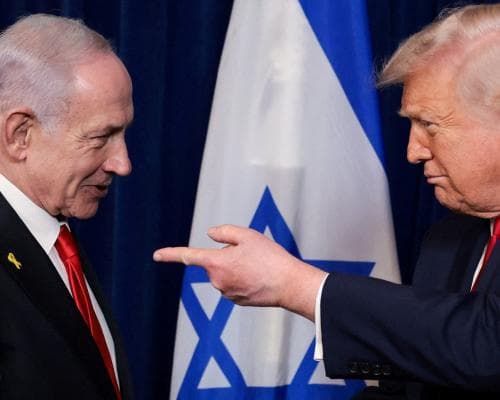
Israel's direct strikes on Iran, breaking a ceasefire and defying US diplomatic pressure, echo biblical prophecies of escalating conflict among nations in the last days, particularly concerning Israel and its neighbors.
Psalm 2:1-3
Prophetic Fulfillment“Why do the nations rage and the peoples plot in vain? The kings of the earth set themselves, and the rulers take counsel together, against the Lord and against his Anointed, saying, 'Let us burst their bonds apart and cast away their cords from us.'”
Why this passage
Psalm 2 is a royal coronation psalm that describes the rebellion of earthly rulers against Yahweh and His Messiah. In its original context, it celebrated the Davidic king's victory over surrounding nations.
The New Testament (Acts 4:25-28) applies this psalm directly to the opposition against Christ, and the broader prophetic tradition sees this pattern intensifying in the last days as nations reject God's authority.
The psalm's language of 'raging nations' and 'kings taking counsel together' perfectly describes the geopolitical defiance seen here: Israel's leadership acting against the counsel of the American president, and Iran responding with its own military counsel. This is not random violence but a deliberate rejection of the 'bonds' of international order that God Himself has permitted.
Behold, the nations rage and the kings of the earth set themselves against the Lord and His anointed. When a nation like Israel takes military action in defiance of a superpower's declared will, we witness the pride of man and the hardening of hearts that Scripture foretells.
Yet take heart, O believer. The Psalmist reminds us that He who sits in the heavens laughs; the Lord holds them in derision.
This is not chaos without a King, but the unfolding of a sovereign plan where every arrow and every ceasefire broken serves the purpose of the One who gathers the nations like a shepherd gathers lambs.
Today's Prayer
Pray for the peace of Jerusalem and for the restraint of the Spirit to fall upon leaders in the Middle East, that many souls might be saved before the final trumpet sounds.
Further Scripture
Additional passages that illuminate this event, each grounded in a distinct interpretive lens.
“Proclaim this among the nations: Consecrate for war; stir up the mighty men. Let all the men of war draw near; let them come up. Beat your plowshares into swords, and your pruning hooks into spears; let the weak say, 'I am a warrior.'”
Why this passage
Joel 3 is a prophecy of the final judgment of the nations in the Valley of Jehoshaphat, where God gathers all nations for war. The command to 'beat plowshares into swords' is the exact opposite of the peace prophecy in Isaiah 2:4 and Micah 4:3, indicating a time when peace is abandoned and war preparation becomes the priority.
In its original context, Joel was addressing the nations that had scattered Israel and divided God's land. The call to 'consecrate for war' is a divine summons, not a human initiative, but it describes the human response: nations willingly and eagerly preparing for conflict.
The phrase 'let the weak say, I am a warrior' captures the escalation of rhetoric and the militarization of even those who would normally seek peace.
How it applies
Israel's strike on Iran, breaking a ceasefire, is a direct fulfillment of Joel's prophecy: the nations are actively 'consecrating for war' rather than pursuing peace. The fact that Israel acted in apparent defiance of the US president shows that even the 'weak' (in geopolitical terms, a small nation relative to Iran or the US) are declaring themselves warriors.
This is not a random conflict but a step in the gathering of nations that Joel describes. Every missile launched and every ceasefire broken is a 'plowshare beaten into a sword,' a deliberate choice of war over peace that Scripture says will characterize the days before the Lord's judgment.
“My anguish, my anguish! I writhe in pain! Oh the walls of my heart! My heart is beating wildly; I cannot keep silent, for I hear the sound of the trumpet, the alarm of war. Crash follows hard on crash; the whole land is laid waste. Suddenly my tents are destroyed, my curtains in a moment.”
Why this passage
Jeremiah 4 is a lament over the coming judgment on Judah from the north, but its language of 'crash following hard on crash' and 'the alarm of war' is a general prophetic description of the experience of nations under escalating conflict. Jeremiah is describing a cascade of disasters where one blow follows another without respite.
The verse captures the psychological and spiritual reality of war: the prophet feels the anguish in his own body ('my heart is beating wildly') as he hears the trumpet. This is not a detached observation but an embodied experience of the terror of war.
The phrase 'crash follows hard on crash' describes a chain reaction of violence that cannot be stopped.
How it applies
The article describes a direct exchange of fire between Israel and Iran that 'breaks April's ceasefire'—a classic example of 'crash following hard on crash.' Each strike invites a response, and each response escalates the conflict. The ceasefire was supposed to be a moment of peace, but instead it has become another 'crash' in a series.
This pattern of escalating retaliation, where no ceasefire holds and no diplomatic solution prevails, is exactly what Jeremiah describes. The 'alarm of war' sounds again and again, and the nations cannot stop it.
This is the tragic rhythm of fallen humanity that Scripture warns will intensify before the Prince of Peace returns.
Related by Scripture
Other events we've interpreted through the same passage or hermeneutical lens.
Israeli attack on Tyre in Lebanon kills eight as evacuation ordered for Christian quarter
Wars & Rumors of WarsShares Joel 3:9-10Eight killed in south Lebanon strike as Israel warns entire city to evacuate
Wars & Rumors of WarsShares Joel 3:9-10Middle East crisis live: People flee Lebanese city of Tyre after Israel orders evacuation ahead of strikes
Wars & Rumors of WarsShares Joel 3:9-10NATO drills aimed at practicing coordination during potential anti-Russia operation — MP
Wars & Rumors of WarsShares Joel 3:9-10Will Iran give up on ceasefire talks as strait of Hormuz blockade continues?
Wars & Rumors of WarsShares Joel 3:9-10
Community launching soon
Get the invite by email when the Watchman's Wall opens
Share this article
Source: The Guardian— we link to the original for full context.