Middle East crisis live: Trump orders navy to attack any boats laying mines in strait of Hormuz
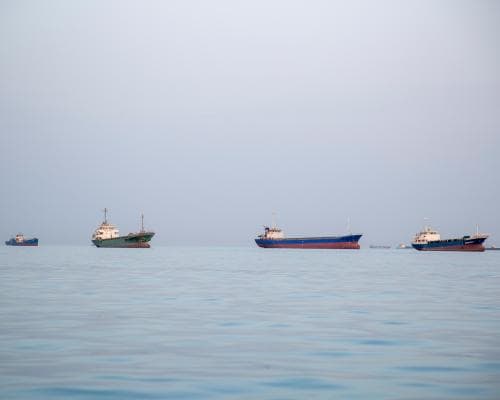
President Trump has ordered the US Navy to strike any vessels mining the Strait of Hormuz, bringing the United States and Iran to the edge of direct armed conflict over one of the world's most critical waterways — a sharp escalation echoing biblical warnings of nations drawn into conflict over strategic corridors.
Jeremiah 49:35-37
Prophetic Fulfillment“Thus says the LORD of hosts: Behold, I will break the bow of Elam, the mainstay of their might. And I will bring upon Elam the four winds from the four quarters of heaven. And I will scatter them to all those winds, and there shall be no nation to which those driven out of Elam shall not come.”
Why this passage
Jeremiah 49:34-39 is a specific oracle against Elam, the ancient region corresponding to the core of modern southwestern Iran — the very territory from which Iran today projects power into the Persian Gulf corridor. The oracle announces that God Himself will 'break the bow of Elam,' meaning shatter their primary military instrument.
In its near-horizon, this addressed Babylonian-era Elamite power; in its far horizon, many scholars observe an unfulfilled element since Elam was never fully 'scattered to all nations' in antiquity. The oracle is addressed to a specifically Persian/Iranian geographic entity, making it one of the most direct prophetic texts applicable to modern Iran's military confrontations.
The prophet Jeremiah watched from a distance as the war-horse and the chariot rushed like a whirlwind, and he cried, 'Woe to us, for we are ruined!' (Jeremiah 4:13). The Strait of Hormuz — a narrow chokepoint through which a fifth of the world's oil passes — has now become the flashpoint for potential direct armed conflict between the United States and Iran.
What Jeremiah saw in the foe from the north, we see in the pattern of nations maneuvering for dominance through threat of force, each move raising the stakes another notch. The speed with which 'rumors' become 'wars' is exactly the trajectory Scripture forewarns: not a slow fade, but a sudden rush like a whirlwind that leaves observers asking how it happened so fast.
Let the people of God watch with sober eyes, neither paralyzed by fear nor lulled into complacency.
Today's Prayer
Pray that God would restrain the hands of leaders on both sides from crossing the threshold into open warfare, and that His people would be found faithful intercessors for peace grounded in justice rather than mere absence of conflict.
Further Scripture
Additional passages that illuminate this event, each grounded in a distinct interpretive lens.
“And I will turn you about and put hooks into your jaws, and I will bring you out, and all your army, horses and horsemen, all of them clothed in full armor, a great host, all of them with buckler and shield, wielding swords.”
Why this passage
Ezekiel 38-39 describes a great end-times coalition that includes Persia (modern Iran, named explicitly in 38:5) being drawn into a climactic military confrontation. The text uses the image of God 'putting hooks in the jaws' to describe nations being drawn into conflict not entirely by their own strategic calculus but by a larger providential movement.
The plain grammatical-historical sense is that God sovereignly orchestrates the movements of nations — including Persia/Iran — toward a culminating geopolitical confrontation. While the full Gog/Magog scenario remains future and disputed in its details, the pattern of Iran being drawn into escalating military brinkmanship fits the trajectory Ezekiel describes.
How it applies
The Strait of Hormuz confrontation shows Iran and the United States being drawn toward direct armed conflict through a series of provocations and counter-orders that seem to escalate beyond what either party fully controls. The image of hooks in jaws — nations being pulled into confrontation — resonates with the dynamic where Iran's mining strategy invites a direct US military response, potentially locking both parties into an exchange neither planned to initiate.
“What causes quarrels and what causes fights among you? Is it not this, that your passions are at war within you? You desire and do not have, so you murder. You covet and cannot obtain, so you fight and quarrel.”
Why this passage
James 4:1-2 identifies the root cause of human conflict not in geopolitical necessity but in covetous desire — the coveting of what others possess or control. While James addresses interpersonal conflict within the community, the principle scales directly to the geopolitical: nations covet strategic control, resource access, and dominance.
The Strait of Hormuz conflict is fundamentally about who controls access to one-fifth of the world's oil — a contest of desire and dominance. James's diagnosis requires no reinterpretation to apply: the plain sense is that all human warfare traces back to ungoverned desire for what one cannot otherwise obtain.
How it applies
Both the United States (desiring freedom of navigation and energy market stability) and Iran (desiring geopolitical leverage and relief from sanctions) are engaged in precisely the pattern James describes: coveting strategic outcomes they cannot obtain through negotiation, and therefore escalating to force. The mining of the strait and the counter-order to strike mining vessels both flow from desires that 'fight and quarrel' when they cannot be satisfied peaceably.
“The great day of the LORD is near, near and hastening fast; the sound of the day of the LORD is bitter; the mighty man cries aloud there. A day of wrath is that day, a day of distress and anguish, a day of ruin and devastation, a day of darkness and gloom, a day of clouds and thick darkness.”
Why this passage
Zephaniah 1 describes the Day of the LORD as arriving with sudden, overwhelming force — 'near and hastening fast' — overtaking 'the mighty man,' meaning even military power provides no sanctuary. The original context addressed Judah but the text's own language universalizes it toward all nations in its latter sections (Zeph 2-3).
The phrase 'hastening fast' (Hebrew: maher me'od) captures the acceleration dynamic — escalation that moves faster than diplomacy can contain it. This is not merely a general 'things are bad' text; it addresses the specific military-geopolitical reality where human might fails and nations are overtaken.
How it applies
The rapid escalation from mining threats to a direct presidential military order in the Strait of Hormuz exemplifies exactly the 'hastening fast' quality Zephaniah describes — events accelerating past human ability to de-escalate. The fact that the world's most strategically sensitive waterway is now under direct military threat from the world's leading power illustrates how quickly the 'mighty man cries aloud' when strategic calculations collide.
Related by Scripture
Other events we've interpreted through the same passage or hermeneutical lens.
Middle East crisis live: Hegseth to give Iran war update amid growing tensions in strait of Hormuz
Wars & Rumors of WarsShares Jeremiah 49:35-37The UAE says Iran resumes attacks as the U.S. moves to reopen the Strait of Hormuz
Wars & Rumors of WarsShares Jeremiah 49:35-37Iran war: US says both military and merchant ships have passed through Strait of Hormuz
Wars & Rumors of WarsShares Jeremiah 49:35-37Strait of Hormuz stuck in limbo as Trump mulls Iran's latest offer
Wars & Rumors of WarsShares Jeremiah 49:35-37Analysis-Iran’s Guards seize wartime power, blunting Supreme Leader's role
Wars & Rumors of WarsShares Jeremiah 49:35-37
Community launching soon
Get the invite by email when the Watchman's Wall opens
Share this article
Source: The Guardian— we link to the original for full context.