Middle East crisis live: Israel hits Lebanon with huge bombing raid and kills senior Hamas leader in Gaza
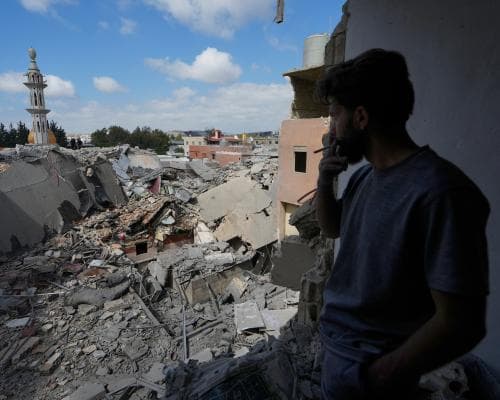
Israel's massive bombing raid on Lebanon and killing of a senior Hamas leader in Gaza, amid fragile ceasefires, echoes biblical warnings of nations rising against nations and the instability that precedes the end.
Joel 3:9-10
Prophetic Fulfillment“Proclaim this among the nations: Consecrate for war; stir up the mighty men. Let all the men of war draw near; let them come up. Beat your plowshares into swords, and your pruning hooks into spears; let the weak say, 'I am a warrior.'”
Why this passage
Joel 3:9-10 is part of a prophecy about the gathering of nations for judgment in the Valley of Jehoshaphat. In its original context, it describes a reversal of the peace of Micah 4:3—nations preparing for war rather than beating swords into plowshares.
The language is hyperbolic, calling even the weak to boast of strength.
This passage legitimately extends to the current Middle East crisis because it depicts a region where ceasefires collapse and nations actively prepare for conflict. Israel's bombing of Lebanon and killing of a Hamas leader in Gaza, alongside Iran's accusation against the US, mirrors the prophetic call to 'stir up the mighty men' and 'consecrate for war.' The pattern of escalating hostilities between Israel, Hezbollah, Hamas, and Iran fits the biblical motif of nations being summoned to battle.
The prophet Joel declared, 'Proclaim this among the nations: Prepare war; stir up the mighty men. Let all the men of war draw near; let them come up' (Joel 3:9).
This is not a call to panic but a call to watchfulness.
When ceasefires shatter and leaders are struck down, we are reminded that lasting peace belongs only to the Prince of Peace. Let these events drive us to prayer, not fear, for our redemption draws near.
Today's Prayer
Pray for the peace of Jerusalem and the peoples of Lebanon and Gaza, that the Lord would restrain the hand of violence and turn hearts toward the gospel.
Further Scripture
Additional passages that illuminate this event, each grounded in a distinct interpretive lens.
“Why do the nations rage and the peoples plot in vain? The kings of the earth set themselves, and the rulers take counsel together, against the LORD and against his Anointed, saying,”
Why this passage
Psalm 2 is a royal psalm describing the rebellion of earthly rulers against God's anointed king (ultimately Christ). The 'raging' of nations and 'plotting' of rulers is a recurring biblical principle: human governments, in their pride, resist God's authority.
The psalm's original hearers understood this as a pattern of Gentile opposition to Israel's God and king.
This principle applies directly to the article's events: Israel, Hezbollah, Hamas, and Iran are all 'raging' in a cycle of violence that defies God's command for peace. The 'kings of the earth'—whether political leaders or militant commanders—'set themselves' against God's order by pursuing war instead of righteousness.
The killing of a senior Hamas leader and the bombing of Lebanon are concrete examples of this rage.
How it applies
The article shows multiple parties 'raging': Israel strikes Lebanon and Gaza, Hezbollah threatens retaliation, Iran accuses the US. Each actor 'plots in vain' because their schemes cannot establish lasting peace apart from submission to God's Anointed.
Christians should recognize this as the futility of human power. The nations' rage will ultimately be broken by the return of Christ, the true King.
Until then, we are called to pray for peace and proclaim the gospel that alone reconciles enemies.
“For the day of the LORD is near upon all the nations. As you have done, it shall be done to you; your deeds shall return on your own head.”
Why this passage
Obadiah's prophecy against Edom declares a universal principle: the Day of the LORD will judge all nations, and the measure they use will be measured back to them. In its original context, Edom rejoiced over Judah's destruction and was promised retribution.
The verse extends beyond Edom to 'all the nations,' establishing a pattern of divine justice.
This applies to the Middle East crisis because the cycle of violence—Israel's bombing, Hamas's attacks, Hezbollah's strikes—illustrates the principle that 'your deeds shall return on your own head.' Each nation reaps what it sows in conflict. The 'day of the LORD' is 'near' in the sense that such escalating violence heralds the final judgment when God will settle all accounts.
How it applies
The article describes Israel killing a senior Hamas leader in Gaza and bombing Lebanon, while Iran accuses the US of violating a truce. This is a cycle of retaliation: each act of violence invites a response.
Obadiah warns that this pattern will culminate in God's justice.
Believers should see this as a reminder that no nation escapes divine judgment. The 'day of the LORD' is near for all who reject His rule.
Our hope is not in ceasefires or military victories, but in the return of Christ who will establish true peace.
Related by Scripture
Other events we've interpreted through the same passage or hermeneutical lens.
Israeli attack on Tyre in Lebanon kills eight as evacuation ordered for Christian quarter
Wars & Rumors of WarsShares Joel 3:9-10Eight killed in south Lebanon strike as Israel warns entire city to evacuate
Wars & Rumors of WarsShares Joel 3:9-10Middle East crisis live: People flee Lebanese city of Tyre after Israel orders evacuation ahead of strikes
Wars & Rumors of WarsShares Joel 3:9-10Israel and Iran trade strikes, threatening to drag the region back into full-scale war
Wars & Rumors of WarsShares Psalm 2:1-2NATO drills aimed at practicing coordination during potential anti-Russia operation — MP
Wars & Rumors of WarsShares Joel 3:9-10
Community launching soon
Get the invite by email when the Watchman's Wall opens
Share this article
Source: The Guardian— we link to the original for full context.