Israel Curbs Aid, Kills Civilians During Gaza Ceasefire as Famine Looms
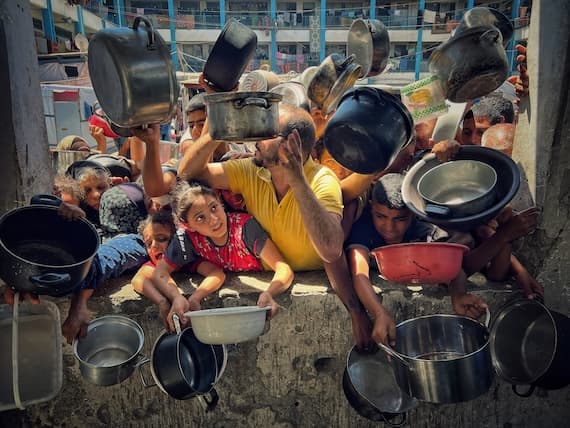
Israel's restriction of aid and continued civilian deaths during a Gaza ceasefire, with looming famine, echoes biblical warnings of judgment through famine and the failure of false peace.
Amos 8:11-12
Prophetic Fulfillment“"Behold, the days are coming," declares the Lord GOD, "when I will send a famine on the land—not a famine of bread, nor a thirst for water, but of hearing the words of the LORD. They shall wander from sea to sea, and from north to east; they shall run to and fro, to seek the word of the LORD, but they shall not find it."”
Why this passage
Amos 8:11-12 is a judgment oracle against Israel in the 8th century BC, warning of a coming spiritual famine—a withdrawal of God's prophetic word—as punishment for social injustice, oppression of the poor, and hollow religious observance. The original context was the northern kingdom's prosperity built on exploitation, where the rich trampled the needy (Amos 8:4-6).
This passage legitimately extends to the Gaza crisis because the pattern is identical: a people suffering under military conflict and economic strangulation, while the international community offers ceasefires that fail to address the root injustice. The physical famine looming in Gaza is a visible sign of a deeper spiritual famine—the absence of true peace that only God's righteousness can bring.
Scripture declares, "Behold, the days are coming, declares the Lord GOD, when I will send a famine on the land—not a famine of bread, nor a thirst for water, but of hearing the words of the LORD" (Amos 8:11). Yet here we see a literal famine of bread looming in Gaza, even as a ceasefire—a human attempt at peace—fails to protect the innocent.
Take heed: the famine of bread and the famine of God's word often travel together. When nations trust in broken treaties rather than the Lord, the land groans.
Pray that this physical hunger would drive hearts to the Bread of Life.
Today's Prayer
Pray that the Lord would open eyes to the spiritual famine behind the physical one, and that His church would be moved to both feed the hungry and proclaim the gospel.
Further Scripture
Additional passages that illuminate this event, each grounded in a distinct interpretive lens.
“"They have healed the wound of my people lightly, saying, ‘Peace, peace,’ when there is no peace."”
Why this passage
Jeremiah 6:14 is a direct prophetic indictment against false prophets in Judah who assured the people of peace while the nation was under divine judgment for its sin. The 'wound' was the nation's moral and spiritual corruption; the false prophets offered a superficial diagnosis and a comforting lie.
This principle applies directly to any ceasefire or peace declaration that ignores underlying injustice. The article's mention of a 'Board of Peace' that fails to stop civilian deaths or famine is a textbook example of 'healing the wound lightly'—offering a political solution that does not address the deep wounds of conflict, oppression, and unrighteousness.
How it applies
The ceasefire in Gaza, while intended to stop violence, has not prevented aid restrictions or civilian deaths. This is a 'peace, peace' declaration where there is no true peace—only a temporary pause that leaves the underlying crisis of hunger and insecurity intact.
Jeremiah's warning stands: God sees through empty peace agreements. The church must not be deceived by political ceasefires that do not produce justice, but must pray for the true peace that comes through repentance and righteousness.
“"Alas for the day! For the day of the LORD is near, and as destruction from the Almighty it comes. Is not the food cut off before our eyes, joy and gladness from the house of our God?"”
Why this passage
Joel 1 describes a locust plague and drought that devastate the land, cutting off food and drink offerings from the temple. The prophet interprets this as a harbinger of 'the day of the LORD'—a coming judgment that would be even more severe.
The immediate context was a literal agricultural catastrophe that disrupted worship and daily life.
This passage legitimately extends to the Gaza famine because Joel's pattern—food cut off, joy vanished, the land mourning—is precisely what the article describes: civilians unable to reach food or medical care, with famine looming. The 'day of the LORD' theme warns that such suffering is not merely political but has spiritual significance as a call to repentance.
How it applies
The article reports that 'Palestinians in Gaza are still hungry' and 'cannot reach medical care'—food cut off before their eyes. Joel's lament over the loss of joy and gladness applies to a people whose daily bread is denied.
This is not merely a humanitarian crisis; it is a sign that the day of the LORD is near. The church should see in Gaza's hunger a call to examine whether we have stored up treasure on earth while ignoring the needy, and to prepare our hearts for the coming Judge.
Related by Scripture
Other events we've interpreted through the same passage or hermeneutical lens.
Pope uses Spain speech to warn of global ‘spiritual and cultural crisis’
Moral DeclineShares Amos 8:11-12Trump Insists Deal Still 'Very Close' Even As Iran Launches Fresh Attack On Israel
Wars & Rumors of WarsShares Jeremiah 6:14Iran says 'low' possibility of return to war with US
Peace & Security DeclarationsShares Jeremiah 6:14‘Eid does not enter tents’: Palestinians in Gaza face grim holiday
Wars & Rumors of WarsShares Joel 1:15-16Report: Billions pledged for Trump Gaza plan still haven’t arrived
Peace & Security DeclarationsShares Jeremiah 6:14
Community launching soon
Get the invite by email when the Watchman's Wall opens
Share this article
Source: Juancole.com— we link to the original for full context.