Iran fires on 3 ships in the Strait of Hormuz, complicating efforts to resume U.S. ceasefire talks
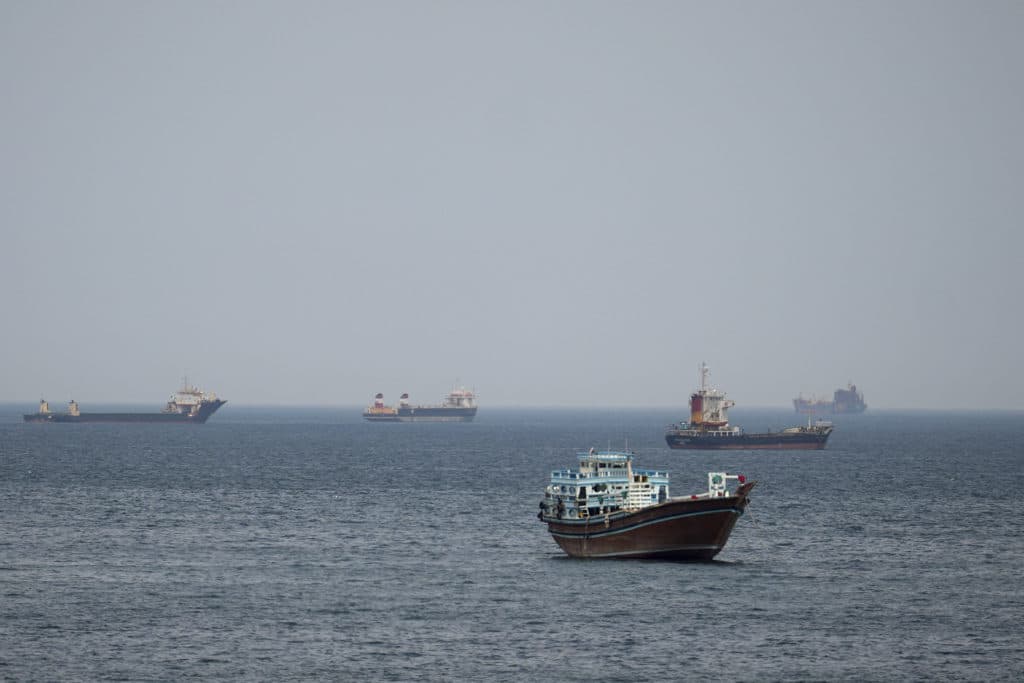
Iran's Revolutionary Guard fired on and seized ships in the Strait of Hormuz, escalating regional tensions and undermining ceasefire diplomacy — a pattern of militant aggression in the Middle East that Scripture repeatedly frames as characteristic of the tumult preceding the Day of the Lord.
Psalm 2:1-3
Direct Principle“Why do the nations rage and the peoples plot in vain? The kings of the earth set themselves, and the rulers take counsel together, against the LORD and against his Anointed, saying, 'Let us burst their bonds apart and cast away their cords from us.'”
Why this passage
Psalm 2 opens with a timeless theological question about the recurring pattern of nations conspiring and raging against divine order and the people who bear God's covenant purposes. The Psalm's original setting addressed the nations surrounding Israel who refused submission to God's established order.
The grammatical-historical sense is a sweeping declaration that human geopolitical rebellion — nations using force, plotting against stability, and rejecting restraint — is fundamentally a posture against the LORD's sovereign governance of history.
The prophet Jeremiah warned of a foe whose quiver is like an open tomb, whose violence devours nations, and who shows no mercy (Jeremiah 5:16-17). Iran's Revolutionary Guard firing on civilian vessels in one of the world's most critical shipping lanes is precisely the kind of predatory, destabilizing aggression Jeremiah described among the nations surrounding Israel — military power wielded not for justice but for intimidation and dominance.
When diplomacy is actively sabotaged by the sword, Scripture reminds us that no ceasefire negotiated by human hands can bring lasting peace apart from the Prince of Peace. The believer's anchor in this moment is not geopolitical calculation but the sovereign God who 'makes wars cease to the end of the earth' (Psalm 46:9) — and who has not abdicated His throne.
Today's Prayer
Pray that God restrains the aggression of those who destabilize peace in the Middle East, protects sailors and civilians caught in the crossfire, and opens the eyes of national leaders to the futility of violence as a path to security.
Further Scripture
Additional passages that illuminate this event, each grounded in a distinct interpretive lens.
“Behold, I am bringing against you a nation from afar, O house of Israel, declares the LORD. It is an enduring nation; it is an ancient nation, a nation whose language you do not know, nor can you understand what they say. Their quiver is like an open tomb; they are all mighty warriors. They shall eat up your harvest and your food; they shall eat up your sons and your daughters; they shall eat up your flocks and your herds; they shall eat up your vines and your fig trees; your fortified cities in which you trust they shall beat down with the sword.”
Why this passage
Jeremiah 5:15-17 describes an ancient, enduring nation of fierce warriors whose military aggression consumes the economic and agricultural life of the people they threaten. In its original context, Jeremiah spoke this oracle to Judah about the Babylonian threat — a powerful, hostile empire to the north and east that would systematically dismantle Israel's security, commerce, and trust in fortified defenses.
The structural pattern is unmistakable: a militarized, ancient civilization using overwhelming force to devour the economic vitality and security of neighboring peoples.
How it applies
Iran — one of the world's most ancient civilizations, speaking a language foreign to most of the region's neighbors — has now fired on commercial vessels in the Strait of Hormuz, the artery through which roughly 20% of global oil flows. This act directly threatens to 'eat up' the economic harvest of nations that depend on free passage.
The Revolutionary Guard's seizure of ships mirrors Jeremiah's image of a nation whose 'quiver is like an open tomb' — military capacity deployed not in defense but in consuming the commerce and security of others. The parallel is structural: ancient hostile power, economic disruption, and the collapse of trust in human fortifications (ceasefire talks).
“What causes quarrels and what causes fights among you? Is it not this, that your passions are at war within you? You desire and do not have, so you murder. You covet and cannot obtain, so you fight and quarrel. You do not have, because you do not ask.”
Why this passage
James 4:1-2 diagnoses the root cause of all human conflict at every scale — personal, communal, and geopolitical. James, writing to Jewish Christians dispersed among the nations, identifies that wars and fights arise from disordered desire (epithumia — coveting, craving) that cannot be satisfied through legitimate means and therefore erupts in violence.
The grammatical-historical sense is a universal principle about the interior engine of conflict: unmet desire escalates to aggression. This principle scales directly from interpersonal quarrels to international conflicts.
How it applies
Iran's seizure of ships in the Strait of Hormuz — a strategic chokepoint through which it seeks to project regional power — is animated by exactly the covetous desire James describes: desire for regional dominance, economic leverage, and geopolitical influence that Iran cannot obtain through legitimate diplomatic means. Unable to achieve these goals through negotiation (ceasefire talks are being actively disrupted), the Revolutionary Guard resorts to military seizure.
James names the mechanism precisely: 'you covet and cannot obtain, so you fight and quarrel.' The application is diagnostic and sobering — no lasting peace is possible when desire, rather than righteousness, drives statecraft.
“Thus says the Lord GOD: On that day, thoughts will come into your mind, and you will devise an evil scheme and say, 'I will go up against the land of unwalled villages. I will fall upon the quiet people who dwell securely, all of them dwelling without walls, and having no bars or gates,' to seize spoil and carry off plunder, to turn your hand against the waste places that are now inhabited, and the people who were gathered from the nations, who have acquired livestock and goods, who dwell at the center of the earth.”
Why this passage
Ezekiel 38 describes a coalition of nations in the latter days — led by a figure called Gog of the land of Magog — that devises a scheme to attack Israel and seize its wealth. In the near horizon, this oracle addressed the existential threat that northern and eastern powers historically posed to Israel.
The far-horizon reading, widely recognized across evangelical scholarship, anticipates a future multi-nation assault on a restored Israel. Persia (פָּרַס, Paras) is explicitly named in Ezekiel 38:5 as a member of this coalition — the ancient and modern name for Iran.
How it applies
While Ezekiel 38 describes a specific future military campaign against Israel rather than naval aggression in the Strait of Hormuz, Iran's pattern of destabilizing the region through its Revolutionary Guard — firing on ships, disrupting diplomacy, projecting power into strategic waterways — is consistent with the posture of a nation 'devising an evil scheme' to assert dominance and 'seize spoil.' Scripture explicitly names Persia/Iran as a participant in the end-times coalition against Israel. Every act of Iranian regional aggression is a data point in a trajectory that Ezekiel 38 foresaw.
This should be held carefully as echo rather than direct fulfillment.
Related by Scripture
Other events we've interpreted through the same passage or hermeneutical lens.
Report: US intelligence warns Netanyahu may sabotage Trump’s Iran deal
Wars & Rumors of WarsShares Psalm 2:1-3The End of the United Nations
One World Government / EconomyShares Psalm 2:1-3US strikes Iran for second day, as ceasefire appears close to collapse
Wars & Rumors of WarsShares Psalm 2:1-3United States Launches Renewed Attacks on Iran
Wars & Rumors of WarsShares Psalm 2:1-3Pope Leo tells Spanish parliament migrants must be respected
Moral DeclineShares Psalm 2:1-3
Community launching soon
Get the invite by email when the Watchman's Wall opens
Share this article
Source: PBS— we link to the original for full context.