Widespread Rationing And Global Energy Shortages Are Baked In No Matter When The War Ends Now
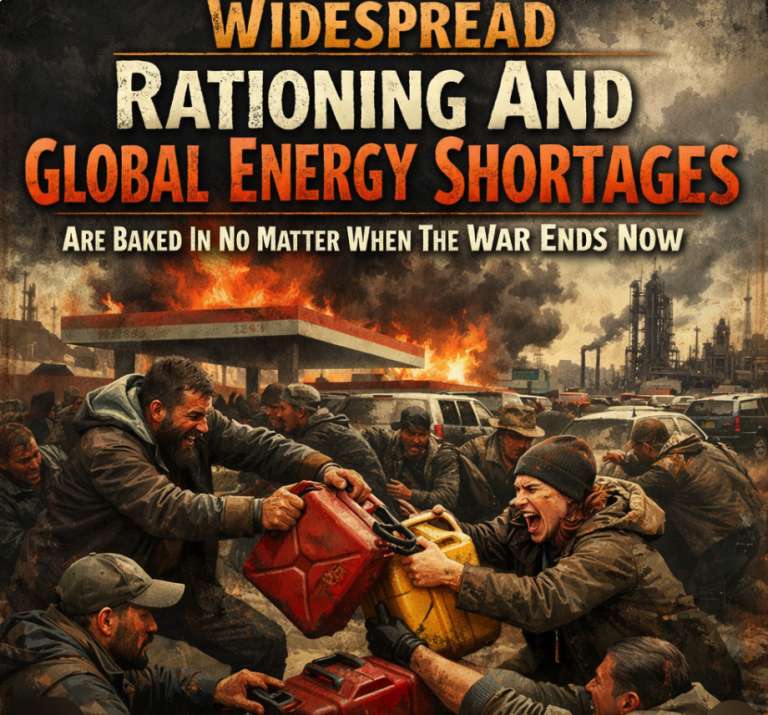
Ongoing geopolitical conflict has locked in widespread energy rationing and global resource shortages that will persist regardless of when hostilities end — a pattern Scripture consistently associates with the scarcity, economic disruption, and systemic breakdown characteristic of the last days.
Ezekiel 4:16-17
Prophetic Fulfillment“Moreover, he said to me, 'Son of man, behold, I will break the supply of bread in Jerusalem. They shall eat bread by weight and with anxiety, and they shall drink water by measure and in dismay. I will do this that they may lack bread and water, and look at one another in dismay, and rot away because of their punishment.'”
Why this passage
In Ezekiel 4, God commissions the prophet to perform a siege-sign against Jerusalem, enacting in visible form the coming Babylonian blockade. The 'breaking of the supply of bread' and rationed eating by weight and measure was both a near-horizon judgment on covenant-breaking Israel and a paradigmatic pattern — confirmed throughout the prophets — for how God brings scarcity upon nations that have rejected his order.
The phrase 'eat bread by weight and with anxiety' is the biblical definition of a rationing economy: not total famine, but enforced shortage producing social dread.
The prophet Ezekiel warned of a day when God would 'break the supply of bread' and send famine and shortage upon the nations as a direct consequence of their violence and rebellion (Ezekiel 4:16). What analysts now describe as 'baked-in' global energy shortages is precisely this pattern made visible: the cascading consequences of war and national rivalry rippling outward into the daily bread of ordinary families.
Rationing is not merely an economic phenomenon — Scripture consistently frames resource scarcity as the earthly shadow of deeper spiritual disorder. For believers, this is not a moment for panic but for confident, clear-eyed trust: the God who numbers the hairs of our heads also governs the pipelines, the harvest, and the supply chain.
We are called to hold material security loosely and to serve those around us who will feel these shortages most acutely.
Today's Prayer
Pray that God's people would respond to coming scarcity not with hoarding or fear but with the open-handed generosity that bears witness to a Kingdom where true abundance is found.
Further Scripture
Additional passages that illuminate this event, each grounded in a distinct interpretive lens.
“When he opened the third seal, I heard the third living creature say, 'Come!' And I looked, and behold, a black horse! And its rider had a pair of scales in his hand. And I heard what seemed to be a voice in the midst of the four living creatures, saying, 'A quart of wheat for a denarius, and three quarts of barley for a denarius, and do not harm the oil and the wine!'”
Why this passage
The third seal in Revelation 6 presents a rider with scales — the ancient instrument of rationing and market price-setting — against a backdrop of warfare (the red horse of the second seal precedes it). The voice announcing inflated prices for staple grains while luxury goods ('oil and wine') remain protected for the wealthy is a precise literary picture of war-driven resource scarcity that falls hardest on ordinary people.
John's original audience would have recognized this as the classic ancient pattern: siege and war collapsing food supply while the elite retain access.
How it applies
The article's core claim — that energy rationing is now structurally locked in regardless of when the war ends — maps directly onto the sequencing of the seals: war produces scarcity, and that scarcity is measured and distributed by economic power. The detail about oil and wine being protected mirrors the modern reality that wealthy nations and corporations will absorb energy shortfalls far better than vulnerable populations, precisely the asymmetry Revelation's third seal depicts.
“For behold, the Lord God of hosts is taking away from Jerusalem and from Judah support and supply, all support of bread, and all support of water.”
Why this passage
Isaiah 3:1 opens a judgment oracle in which the Lord himself acts as the agent who removes the structural supports of a society — bread and water being synecdoche for all material provision. The grammatical-historical context is the removal of every pillar of social stability (leaders, prophets, craftsmen, warriors) as a divine act of governance over nations that have become corrupt.
The principle is theological: God governs the infrastructure of civilization, and its removal is never merely accidental or purely geopolitical.
How it applies
The energy infrastructure of the modern world functions precisely as 'support and supply' for civilization in Isaiah's sense. The article argues that this support is now being systematically removed through the compounding effects of geopolitical conflict.
Whether or not one reads this as direct divine judgment, Isaiah's framework insists that behind the geopolitical mechanics, there is a sovereign Lord who holds the supply chains of nations in his hand — a sobering call to theological seriousness about what is unfolding.
“What causes quarrels and what causes fights among you? Is it not this, that your passions are at war within you? You desire and do not have, so you murder. You covet and cannot obtain, so you fight and quarrel. You do not have, because you do not ask.”
Why this passage
James 4:1-2 is addressed to a community, but James explicitly universalizes the principle by applying it to the wars and conflicts of the human community at large. The causal chain James identifies — desire, deprivation, conflict, further deprivation — is not a metaphor but an analysis of the mechanism by which human covetousness generates social violence.
The plain sense is that wars are driven by the disordered desire for resources and power, and that those wars in turn produce the very scarcity that provoked them.
How it applies
The article describes precisely this feedback loop at global scale: wars over geopolitical leverage produce energy scarcity, which will in turn generate further resource competition. James's diagnosis — that fighting and quarreling arise from coveting what cannot be obtained — is not a pious platitude here but an accurate structural description of how the current crisis was generated and why it will persist.
The world's energy crisis is, at root, a James 4 problem.
Related by Scripture
Other events we've interpreted through the same passage or hermeneutical lens.
Malawi fuel crisis deepens as oil shortages spread
FaminesShares Ezekiel 4:16-17U.S.-Iran War’s Next Casualty: Global Food
FaminesShares Revelation 6:5-6World Bank expects fertilizer prices to rise by 31% this year
FaminesShares Revelation 6:5-6The Fertilizer Shock of 2026-2027: A Man-Made Famine in the Making
FaminesShares Revelation 6:5-6The Weapon of Starvation in Gaza: The Loaf of Bread Becomes a Tool of Political Blackmail and Human Suffering
FaminesShares Ezekiel 4:16-17
Community launching soon
Get the invite by email when the Watchman's Wall opens
Share this article
Source: Activistpost.com— we link to the original for full context.