US tells visa applicants to deny fear of return or risk visa refusal
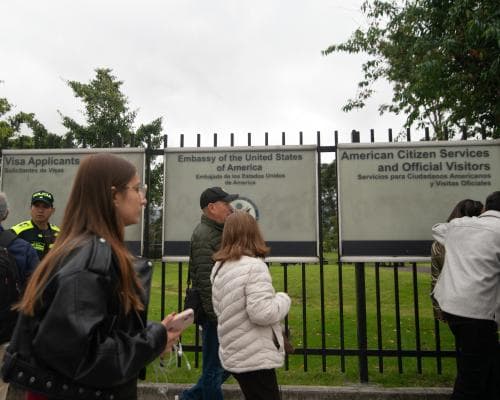
A new US visa policy requiring applicants to formally deny any fear of returning home effectively bars persecuted Christians — fleeing violence in Nigeria, Pakistan, China, and elsewhere — from ever presenting their cases for safety, shutting the door on refuge before it can be sought.
Isaiah 10:1-2
Direct Principle“Woe to those who decree iniquitous decrees, and the writers who keep writing oppression, to turn aside the needy from justice and to rob the poor of my people of their right, that widows may be their spoil, and that they may make the fatherless their prey!”
Why this passage
Isaiah 10:1-2 is a formal prophetic woe-oracle addressed to lawmakers and scribes who craft legal instruments that deny justice to the vulnerable. The original context targets Israelite officials who used the legal apparatus to dispossess widows and orphans — the most defenseless members of the covenant community.
The principle is not limited to Israel's covenant administration. It identifies a recurring pattern in human governance: the deliberate encoding of injustice into law so that the powerful are shielded from accountability while the helpless are systematically excluded from the courts of appeal.
That pattern is on full display here.
The prophet Isaiah declared of the suffering servant and the broken: 'a bruised reed he will not break, and a faintly burning wick he will not quench' (Isaiah 42:3). Where earthly powers design systems that extinguish the flickering hope of the persecuted before they can speak, Scripture calls the Church to bear witness against such silence.
This policy does not merely inconvenience applicants — it demands that the hunted deny their own peril as the price of consideration. Let the people of God remember that Christ's own family fled as refugees to Egypt (Matthew 2:13-14), and that the welcome of the stranger has always been the measure of a nation's fear of God.
Today's Prayer
Pray that persecuted Christians fleeing violence and death — in Nigeria, Pakistan, Iran, China, and beyond — would find open doors of refuge, and that governments would not require the vulnerable to deny their danger as the cost of protection.
Further Scripture
Additional passages that illuminate this event, each grounded in a distinct interpretive lens.
“Rescue those who are being taken away to death; hold back those who are stumbling to the slaughter. If you say, 'Behold, we did not know this,' does not he who weighs the heart perceive it? Does not he who keeps watch over your soul know it, and will he not repay man according to his work?”
Why this passage
Proverbs 24:11-12 addresses the moral culpability of deliberate inaction in the face of known danger. The Solomonic wisdom tradition here is unusually direct: ignorance is not a permissible defense before God when knowledge of the danger was available and action was withheld.
The verse is addressed not to persecutors but to bystanders and gatekeepers — those with the power to intervene who choose not to. This makes it precisely applicable to institutional actors who design policies that foreclose rescue.
How it applies
When a government constructs a visa regime that requires the persecuted to deny their own danger as the precondition for consideration, it cannot later claim it 'did not know' those applicants faced death. The policy encodes the knowledge of risk into the very question it forces applicants to answer falsely.
Proverbs 24:12 — 'does not he who weighs the heart perceive it?' — stands as a solemn warning to every official who authors, approves, or enforces such a rule: the One who weighs hearts is not deceived by procedural language.
“Now when they had departed, behold, an angel of the Lord appeared to Joseph in a dream and said, 'Rise, take the child and his mother, and flee to Egypt, and remain there until I tell you, for Herod is about to search for the child, to destroy him.' And he rose and took the child and his mother by night and departed to Egypt.”
Why this passage
The flight of the holy family to Egypt is the NT's most direct narrative of a refugee family fleeing state-sanctioned lethal persecution. The parallel actors are precise: a hostile ruling power seeking to destroy a specific people, and a family compelled to cross a border under threat of death.
Under the policy described in this article, had Joseph and Mary presented themselves at a border crossing and been asked to deny any fear of return to Judea, they would have faced automatic refusal — or been forced to lie about the very threat that was actively seeking the child's life.
How it applies
The irony — and the moral weight — of a self-described Christian nation designing a policy that would have turned away the Christ child is not subtle. This narrative parallel is not a rhetorical flourish; it is a genuine structural echo: governmental power requiring the denial of real danger as the price of safety.
The Church is called to remember that the refugee status of Jesus is not incidental to the gospel story — it is inscribed within it, and policies that systematically close the door on the persecuted stand in the shadow of Herod's decree.
“They were stoned, they were sawn in two, they were killed with the sword. They went about in skins of sheep and goats, destitute, afflicted, mistreated — of whom the world was not worthy — wandering about in deserts and mountains, and in dens and caves of the earth.”
Why this passage
Hebrews 11 catalogues the great cloud of witnesses who suffered precisely because of their faith — not as historical curiosity but as the pattern the author expects will continue until the consummation. The phrase 'of whom the world was not worthy' is the author's editorial verdict: the world's rejection of the persecuted is a moral indictment of the world, not a verdict on the worth of the sufferers.
The author of Hebrews writes to a community facing persecution, explicitly framing contemporary suffering as continuous with the OT witness — making this a living prophetic frame, not merely a historical retrospective.
How it applies
Christians currently being killed, imprisoned, and driven from their homes in Nigeria, Pakistan, Iran, and China are the living continuation of this Hebrews 11 procession. When a policy closes the door of refuge to them before their case can even be heard, it enacts the world's ancient verdict: 'the world was not worthy of them' — and so the world shuts them out.
The Church reads this verse not as defeat but as recognition: these are the very people Scripture honors above the powers that reject them.
Related by Scripture
Other events we've interpreted through the same passage or hermeneutical lens.
Eroding Legitimacy: The UN Taps Brutal Dictator Regimes To Oversee NGOs
One World Government / EconomyShares Isaiah 10:1-2El Salvador holds mass trial for 486 alleged members of notorious MS-13 gang
One World Government / EconomyShares Isaiah 10:1-2Progress in reducing child deaths slows as 4.9 million children die before age five
FaminesShares Proverbs 24:11-12
Community launching soon
Get the invite by email when the Watchman's Wall opens
Share this article
Source: The Guardian— we link to the original for full context.