UK to pay France another £660m to curb Channel crossings
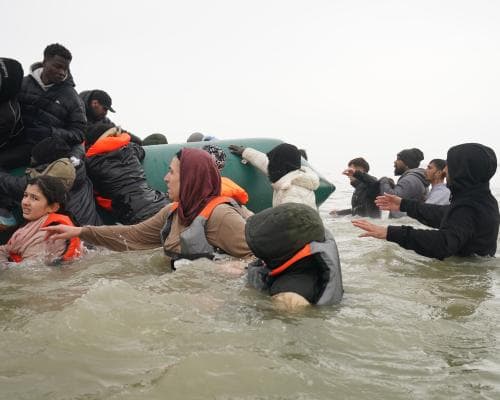
The UK is paying France £660 million to deploy riot squads and deter migrants from crossing the English Channel, reflecting the mounting global crisis of mass human displacement and the desperate measures nations are taking to manage borders — a pattern Scripture links to the restlessness and displacement of peoples in the last days.
Luke 21:25
Prophetic Fulfillment“And there will be signs in sun and moon and stars, and on the earth distress of nations in perplexity because of the roaring of the sea and the waves,”
Why this passage
In the Olivet Discourse, Jesus describes one of the signs preceding his return as 'distress of nations in perplexity' — the Greek word for perplexity (aporia) means being at a loss with no way out. The 'roaring of the sea and waves' in Luke 21:25 is widely understood by commentators as a metaphor for the restless, surging movement of peoples and nations in crisis — drawing on the OT use of 'sea' as a symbol for the Gentile nations in tumult (cf.
Ps 65:7; Isa 17:12). Nations in perplexity describes governments that face a problem they cannot solve.
Historical context, theological significance, application today — denomination-neutral, ~1,000-word walk-through.
Isaiah 17:12 warns, 'Ah, the thunder of many peoples; they thunder like the thundering of the sea!' The prophet envisioned a world convulsing with the movement and roaring of nations — peoples in upheaval, borders under pressure, governments grasping for control. Today, the sight of riot squads deployed against desperate families in small boats on the Channel is a vivid, sobering image of exactly that upheaval.
The nations are not merely negotiating policy; they are reacting to a tide of human desperation that no payment can fully stem. This is a moment for the Church to hold two truths together: the legitimate order of nations and borders, and the image of God in every displaced person.
Today's Prayer
Pray that governments wrestling with mass migration would pursue both just border order and genuine compassion for the displaced, and that the Church would be a prophetic voice for the dignity of all people made in God's image.
Further Scripture
Additional passages that illuminate this event, each grounded in a distinct interpretive lens.
“Ah, the thunder of many peoples; they thunder like the thundering of the sea! Ah, the roar of nations; they roar like the roaring of mighty waters! The nations roar like the roaring of many waters, but he will rebuke them, and they will flee far away, chased like chaff on the mountains before the wind and whirling dust before the storm.”
Why this passage
Isaiah 17 is an oracle against Damascus that expands into a vision of nations in general upheaval and restless mass movement. The 'thunder of many peoples' and 'roar of nations' in its grammatical-historical sense describe the destabilizing surge of peoples across borders as a recurring, eschatologically significant pattern.
The passage describes human masses in motion that governments cannot ultimately contain — only God can rebuke and scatter them. This is not a forced application; Isaiah is explicitly addressing the phenomenon of national and ethnic populations in uncontrolled movement.
How it applies
The English Channel crisis — with tens of thousands attempting dangerous crossings and the UK paying hundreds of millions simply to slow the tide — is a concrete image of exactly this pattern: the 'roaring' of displaced peoples that no political arrangement fully stops. The three-year, £660 million deal with riot squads is itself evidence that human governmental power cannot ultimately resolve the surge.
God alone, says Isaiah, is the one who rebukes and settles the nations.
“Righteousness exalts a nation, but sin is a reproach to any people.”
Why this passage
This proverb states a covenantal principle about national life: the moral character of a nation's policies — its justice, its integrity — determines its honor or its shame. The principle applies to all nations, not only Israel, as the universal 'any people' makes clear.
It judges the policies of governments by whether they reflect moral righteousness — including the treatment of the vulnerable, the maintenance of order, and the integrity of agreements between nations.
How it applies
The UK-France arrangement raises a genuine moral question this proverb presses: Is deploying a riot squad to 'disperse' people attempting to flee danger in small boats righteous policy or reproach? The verse does not answer that policy question for us, but it insists the question matters eternally.
Nations that handle the desperate and displaced with contempt rather than justice accumulate reproach; those who uphold both order and dignity are exalted. Christians should bring this standard to bear in their evaluation of immigration policy.
Related by Scripture
Other events we've interpreted through the same passage or hermeneutical lens.
Why Americans Are Falling Out Of Love With LGBT ‘Pride’
Moral DeclineShares Proverbs 14:34Pope Leo rails against migrant deaths on visit to Spain’s ‘dock of shame’
Moral DeclineShares Proverbs 14:34Philippine bishop, ex-ICC judge lead new inquiry into thousands of Duterte-era killings
Moral DeclineShares Proverbs 14:34Tisza Backtracks on Proposal, Christian Culture Stays in Constitution
Moral DeclineShares Proverbs 14:34U.S. bishops praise Leo’s encyclical on AI, echo concern for human dignity, common good
Technology & SurveillanceShares Proverbs 14:34
Community launching soon
Get the invite by email when the Watchman's Wall opens
Share this article
Source: The Guardian— we link to the original for full context.