U.S. military says it seizes another oil tanker associated with Iran
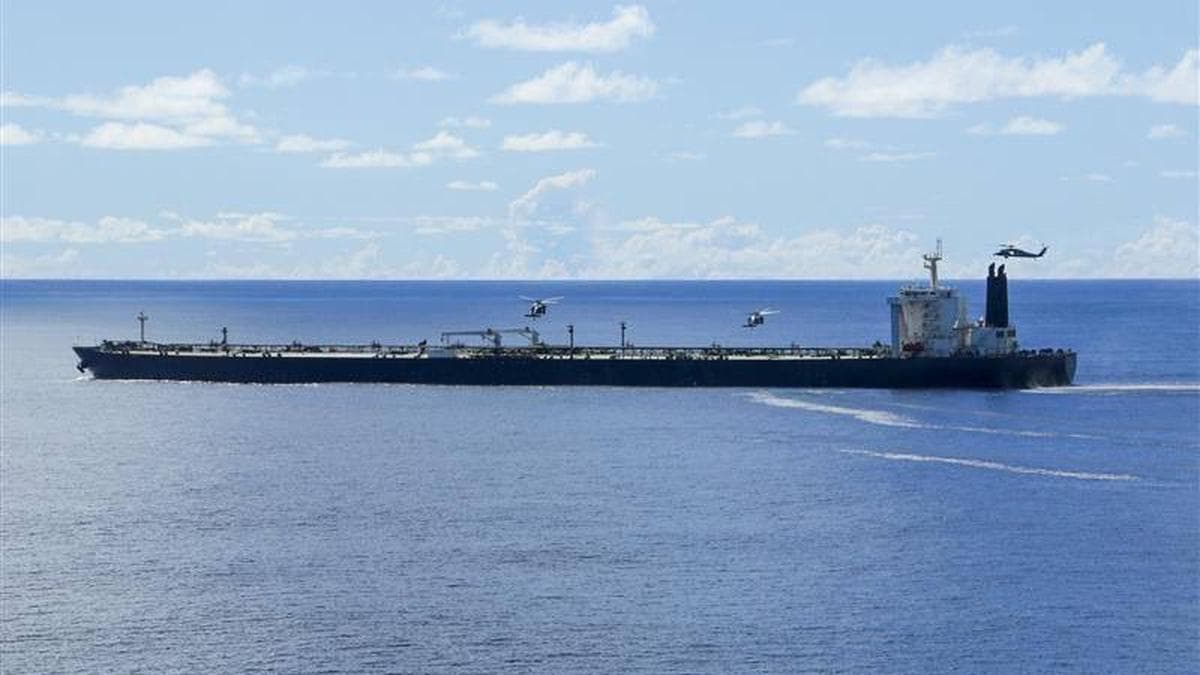
The U.S. military's seizure of Iranian oil tankers in the Strait of Hormuz, amid Iran's own seizures of cargo ships, marks a dangerous military escalation in a waterway through which roughly a fifth of the world's oil flows — a pattern of nation rising against nation with global economic consequences.
Amos 9:5-6
Direct Principle“The Lord God of hosts, he who touches the earth and it melts, and all who dwell in it mourn, and all of it rises like the Nile, and sinks again, like the Nile of Egypt; who builds his upper chambers in the heavens and founds his vault upon the earth; who calls for the waters of the sea and pours them out upon the surface of the earth— the Lord is his name.”
Why this passage
Amos 9:5-6 is a doxology affirming Yahweh's absolute sovereign authority over the physical forces of the earth — including the seas — and over the nations that depend on them. The original context addressed Israel's false security: no geopolitical arrangement, no trade route, no military alliance is beyond the Lord's authority to disrupt.
The phrase 'calls for the waters of the sea' is not merely poetic; it asserts that the Lord commands and redirects the commercial and military realities of maritime existence. This principle applies directly whenever nations contest control over strategic bodies of water, because the text asserts that such waters are ultimately under His governance, not theirs.
Amos declared that the Lord 'stirs up the sea so that its waves roar' as a sign of His sovereign judgment moving through the nations. Today, the Strait of Hormuz — the narrow throat through which a fifth of the world's oil passes — has become a flashpoint between the United States and Iran, with warships and seized tankers replacing fishing vessels on ancient waters.
What Amos saw was not random chaos but purposeful divine movement: the Lord 'of hosts is his name,' the one who governs the restless ambitions of empires. When we see powerful nations seizing each other's ships on strategic seas, we are not watching a news cycle — we are watching the Lord of hosts overseeing the restless churn of human kingdoms according to His own timetable.
Today's Prayer
Pray that American military and civilian leaders would act with wisdom and restraint in the Strait of Hormuz, and that the church would not grow numb to these escalations but would intercede fervently before the Lord of hosts who alone controls the outcome of nations.
Further Scripture
Additional passages that illuminate this event, each grounded in a distinct interpretive lens.
“Why do the nations rage and the peoples plot in vain? The kings of the earth set themselves, and the rulers take counsel together, against the Lord and against his Anointed.”
Why this passage
Psalm 2 opens with a rhetorical question that frames all geopolitical conflict as ultimately futile maneuvering against the sovereign purposes of God. The psalmist's point is not that the nations are powerless in the immediate term — they clearly are powerful — but that their strategies, alliances, and seizures of strategic assets are finally 'vain.' The psalm was originally a coronation text affirming the Davidic king's authority over the nations, but the NT (Acts 4:25-26; Rev 19) establishes its universal eschatological scope: all rulers who resist God's purposes ultimately fail.
How it applies
The U.S. and Iran both claim strategic and legal justification for their tanker seizures, each positioning itself as the legitimate actor in the Strait of Hormuz. Psalm 2 reframes this: both are 'kings of the earth' taking counsel against one another in a contest that, however real and dangerous, is ultimately vain before the One who holds the nations as 'a drop from a bucket' (Isa 40:15).
The raging of nations in one of the world's most sensitive waterways is precisely the kind of geopolitical turbulence the psalmist saw as a mark of the age before God's final vindication.
“For in a single hour all this wealth has been laid waste. And all shipmasters and seafarers, sailors and all whose trade is on the sea, stood far off and cried out as they saw the smoke of her burning, 'What city was like the great city?'”
Why this passage
Revelation 18 describes the collapse of Babylon the Great as a global commercial system, and the specific imagery is maritime: shipmasters, sailors, and merchants who trade on the sea mourn the sudden destruction of the system that enriched them. The original apocalyptic vision addressed the Roman imperial economy centered on sea-borne trade, but with a clear far-horizon horizon pointing to the end-time collapse of global commerce.
The Strait of Hormuz is the single most critical maritime chokepoint for global oil trade — its disruption would immediately impair the global commercial order that Revelation 18 anticipates will ultimately fail.
How it applies
Every act of aggression in the Strait of Hormuz — including the tit-for-tat seizure of oil tankers between the U.S. and Iran — is a rehearsal of the fragility of the global commercial system that Revelation 18 prophesies will one day collapse in 'a single hour.' The shipmasters and sailors of Revelation 18 are a direct echo of the tanker crews and energy markets watching this confrontation with fear. This does not mean fulfillment is immediate, but the structural vulnerability is exactly what the prophecy foresaw.
“Behold, he comes up like clouds; his chariots like the whirlwind; his horses are swifter than eagles— woe to us, for we are ruined!”
Why this passage
Jeremiah 4 delivers oracles about the 'foe from the north' descending on Judah with overwhelming military force, using imagery of chariots and swift advance to depict the terror of unstoppable military power moving through strategic corridors. The original near-horizon fulfillment was Babylonian invasion, but the oracle established a pattern in prophetic literature: military confrontations in strategic corridors escalate beyond the capacity of those involved to control, producing the cry 'woe to us, for we are ruined.' The language of speed, shock, and helplessness before military escalation echoes repeatedly in prophetic accounts of end-time distress among the nations.
How it applies
The seizure of tankers in the Strait of Hormuz — with U.S. naval vessels and Iranian forces directly confronting one another in one of the narrowest and most explosive theaters on earth — carries precisely the character Jeremiah describes: rapid escalation, sudden danger, and the dawning recognition that events may outpace human control. The cry 'woe to us' reflects how quickly a tanker seizure can tip toward a wider military exchange with global consequences.
Related by Scripture
Other events we've interpreted through the same passage or hermeneutical lens.
Saudi Arabia launched numerous covert attacks on Iran as war expands, sources say
Wars & Rumors of WarsShares Psalm 2:1-2Beijing calls Paraguay leaders willing ‘chess pieces’ after disputed Taiwan trip
Wars & Rumors of WarsShares Psalm 2:1-2Why is Iran increasingly targeting the UAE in its war messaging?
Wars & Rumors of WarsShares Psalm 2:1-2Putin hails Russia’s test of new nuclear-capable ICBM, calls it world’s most powerful
Wars & Rumors of WarsShares Psalm 2:1-2War in Iran: Despite Iranian attacks, Doha steps up mediation efforts
Wars & Rumors of WarsShares Psalm 2:1-2
Community launching soon
Get the invite by email when the Watchman's Wall opens
Source: The Hindu— we link to the original for full context.