Trump to host bash for crypto investors tied to his coin sales
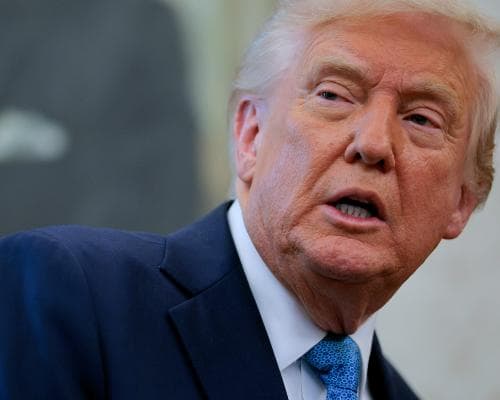
President Trump's offer of exclusive access to top purchasers of his personal cryptocurrency constitutes a formal pay-to-play structure that watchdogs warn is outright corruption — a pattern Scripture repeatedly identifies as the perversion of justice by leaders who treat their office as a commodity.
Isaiah 1:23
Direct Principle“Your princes are rebels and companions of thieves. Everyone loves a bribe and runs after gifts. They do not bring justice to the fatherless, and the widow's cause does not come to them.”
Why this passage
Isaiah 1 is the LORD's covenant lawsuit against Jerusalem's leadership — not a mere political critique but a formal indictment that leaders who monetize their offices have broken covenant with the God of justice. The specific charge is that those entrusted with the scales of power 'run after gifts,' meaning they have restructured their governance around who pays most.
The grammatical-historical sense is unambiguous: Isaiah identifies bribe-chasing rulers as the direct cause of the vulnerable being denied justice. The principle extends to any governing authority that formally tiers access to power based on financial contribution.
Proverbs warns that 'a wicked man accepts a bribe in secret to pervert the ways of justice' — and the prophet Isaiah thundered against rulers who 'run after gifts' and 'do not bring justice to the fatherless.' When a head of state openly rewards the wealthiest buyers of his personal coin with privileged access to government, the mechanism of corruption is not hidden but institutionalized.
This is not merely a political scandal; it is the ancient sin of the unjust judge wearing modern dress. The reader is called not to despair but to sobriety: when those entrusted with the scales of justice sell them openly, the people of God are reminded that their hope is not in princes, but in the Lord who 'does not take bribes' and 'executes justice for the fatherless and the widow.'
Today's Prayer
Pray that God would raise up leaders at every level who fear Him above financial gain, and that the people of this nation would demand and model the justice that Proverbs declares 'exalts a nation.'
Further Scripture
Additional passages that illuminate this event, each grounded in a distinct interpretive lens.
“The wicked accepts a bribe in secret to pervert the ways of justice.”
Why this passage
The Solomonic wisdom tradition identifies bribery not merely as financial misconduct but as a structural attack on justice itself — the verb 'pervert' (Hebrew: nātāh) means to bend or turn aside what is straight. The proverb's point is that money paid to those holding power does not merely enrich them; it bends the instrument of justice out of true.
The phrase 'in secret' is noteworthy: traditional corruption at least wore the disguise of shame. The situation described in this article removes even that veil, offering access openly and publicly as a purchasable commodity.
How it applies
The sale of presidential access through cryptocurrency purchases makes Proverbs 17:23 even more alarming in one respect: the perversion of justice is no longer secret but proudly advertised. Those with the most crypto holdings are formally promised the ear of power — a transactional arrangement that Proverbs declares the mark of the wicked.
This pattern, repeated across history in every culture, is what wisdom literature exists to name and warn against.
“Its heads give judgment for a bribe; its priests teach for a price; its prophets practice divination for money; yet they lean on the LORD and say, 'Is not the LORD in the midst of us? No disaster shall come upon us.'”
Why this passage
Micah 3 is one of the sharpest prophetic indictments of a society in which every tier of leadership — judicial, priestly, prophetic — has been monetized. The original context is Judah's ruling class, but the pattern Micah identifies is structural: when those who hold power treat it as a revenue stream, and then invoke divine favor as though corruption has no consequence, judgment is imminent.
The phrase 'yet they lean on the LORD' captures the theological danger specific to nations with Christian heritage: the assumption that divine blessing is guaranteed regardless of systemic injustice in governance.
How it applies
The formal sale of governmental access described in this article mirrors precisely the structure Micah condemned: leadership monetized, justice gatekept by wealth, and the whole arrangement conducted in a nation that still officially invokes God's blessing. The watchdogs warning of 'pay-to-play corruption' are naming the same dynamic Micah named in Judah.
Micah's warning is that such a society does not receive the divine protection its leaders assume — 'disaster shall come upon' the nation whose rulers sell what was entrusted to them.
“For the love of money is a root of all kinds of evils. It is through this craving that some have wandered away from the faith and pierced themselves with many pangs.”
Why this passage
Paul's warning to Timothy is not merely personal financial counsel but a theological diagnosis: the love of money (philarguria — not money itself, but the disordered desire for it) is the generative root from which 'all kinds of evils' branch. The Greek 'panta ta kaka' is comprehensive — not some evils or financial evils specifically, but the full range of moral corruption.
The context in 1 Timothy 6 is explicitly about those who use godliness or position as 'a means of gain' — which maps directly onto the use of a presidential platform to generate personal cryptocurrency revenue.
How it applies
The cryptocurrency arrangement described in this article is a case study in what Paul called using one's position as 'a means of gain' — the very pattern he warned Timothy would produce cascading moral corruption. When the highest office in a nation becomes a vehicle for personal financial enrichment through the sale of access, the root Paul identified has borne its fruit openly.
The 'many pangs' Paul describes are not merely personal consequences but national ones: institutions lose legitimacy, the vulnerable lose advocates, and the moral fabric that distinguishes governance from racketeering is torn.
Related by Scripture
Other events we've interpreted through the same passage or hermeneutical lens.
Community launching soon
Get the invite by email when the Watchman's Wall opens
Share this article
Source: The Guardian— we link to the original for full context.