Third Ukrainian strike hits Russian oil refinery and prompts evacuations
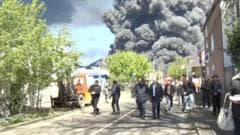
Ukraine's third strike on a Russian oil refinery at Tuapse has forced civilian evacuations and prompted Moscow to accuse Kyiv of destabilizing global energy markets — a sign of how modern warfare reaches deep into civilian and economic life, echoing Scripture's portrait of war as a consuming fire that no nation can contain.
Jeremiah 4:13-14
Prophetic Fulfillment“Behold, he comes up like clouds; his chariots like the whirlwind; his horses are swifter than eagles— woe to us, for we are ruined! O Jerusalem, wash your heart from evil, that you may be saved. How long shall your wicked thoughts lodge within you?”
Why this passage
Jeremiah 4 records the prophet's vision of a devastating enemy advance from the north sweeping through the land with speed and destructive force — chariots like the whirlwind, horses swifter than eagles. The near-horizon referent is Babylon's advance against Judah, but the oracle's language is deliberately cosmic, describing the universal pattern of God's judgment moving through violent human agencies.
The far horizon is the recurring reality that no nation is immune from the fire of war reaching its interior — its cities, its infrastructure, its civilians. The Tuapse refinery strikes represent exactly this pattern: a war initially conceived on frontlines has become a whirlwind consuming the deep rear of a nation, displacing families and threatening global stability.
Jeremiah beheld the foe from the north and cried, 'Behold, he shall come up like clouds, and his chariots like the whirlwind' — a vision not of one war but of the relentless pattern of violent nations devouring one another's strength and safety.
The burning refinery at Tuapse, the families ordered to flee, the accusations flying across capitals about energy markets — this is precisely what Jeremiah saw: war that does not stay at the front but consumes the land itself. Let the church pray with urgency, and let no believer mistake the stability of nations for the stability of God's throne.
Today's Prayer
Pray that the civilians displaced by the fires of this conflict — and all caught in the grinding machinery of the Russia-Ukraine war — would find refuge, and that God's people would intercede with fasting and earnestness for His mercy to restrain the consuming spread of this war.
Further Scripture
Additional passages that illuminate this event, each grounded in a distinct interpretive lens.
“Behold, the LORD will empty the earth and make it desolate, and he will twist its surface and scatter its inhabitants. And it shall be, as with the people, so with the priest; as with the slave, so with his master; as with the maid, so with her mistress; as with the buyer, so with the seller; as with the lender, so with the borrower; as with the creditor, so with the debtor. The earth shall be utterly empty and utterly plundered; for the LORD has spoken this word.”
Why this passage
Isaiah 24 opens the so-called 'Isaiah Apocalypse' with a declaration that the LORD is the sovereign agent behind the unraveling of earth's stability — economic, social, and geographic. The plain grammatical sense is that no tier of society escapes: buyer and seller alike, lender and borrower, the great and the small are all subject to the same stripping away.
The verse does not require a singular end-times fulfillment to apply truthfully — it states a principle of divine sovereignty over the destabilization of nations and markets that recurs throughout history as a witness to God's governance.
How it applies
Moscow's accusation that Kyiv is 'destabilising global energy markets' is precisely the language of Isaiah 24 in modern dress: the networks of buyer, seller, lender, and borrower — the entire interlocking architecture of oil markets — shaken by fire and war.
Isaiah declares this stripping of earthly stability is never outside God's sovereign hand. The church should neither panic nor grow numb, but recognize in these disruptions the voice of the One who holds all economies in His governance.
“There the fire will devour you; the sword will cut you off. It will devour you like the locust. Multiply yourselves like the locust; multiply like the grasshopper!”
Why this passage
Nahum's oracle against Nineveh — once the supreme military and economic power of its age — uses the image of devouring fire as the emblem of a proud empire's irreversible unraveling. The historical referent is Nineveh's fall in 612 BC, but the inspired language captures a recurring truth: military and industrial might, however vast, is vulnerable to fire that no power can ultimately prevent.
The wisdom principle embedded in Nahum's oracle is that the strength nations build to dominate — including the energy and industrial infrastructure that fund their wars — becomes the very thing consumed.
How it applies
Russia's Tuapse refinery, a pillar of the energy infrastructure that funds its military campaign, now burns for the third time. Nahum's ancient image of fire devouring the industrial and military sinews of a proud power finds an honest echo here.
This is not a prediction of Russia's fate — Scripture forbids that presumption — but it is a clear warning the church has always carried: no nation's strength is beyond the reach of the fire that God permits.
“The first angel blew his trumpet, and there followed hail and fire, mixed with blood, and these were thrown upon the earth. And a third of the earth was burned up, and a third of the trees were burned up, and all green grass was burned up.”
Why this passage
The trumpet judgments of Revelation 8 depict successive waves of devastation touching the earth's natural and man-made systems. Whether one reads these as sequential eschatological events or as symbolic patterns of God's judgments recurring across history, the imagery is unmistakable: fire thrown upon the earth, burning up the productive and economic fabric of civilization.
The key hermeneutical caution here is that this verse must not be mapped directly onto any single news event as a specific 'fulfillment' — but it does establish that Scripture anticipates fire-driven destruction of infrastructure and landscape as part of the pattern of this age's unraveling.
How it applies
A burning refinery, mandatory civilian evacuations, energy markets threatened — these carry the texture of the trumpet-judgment pattern John recorded: fire that touches not just soldiers but the economic and natural systems that sustain civilian life.
The church is to hold these images not as sensationalism but as the quiet confirmation that history is moving, as Scripture declared it would, toward its appointed close — and that prayer and faithful witness are the believer's calling in every such hour.
Related by Scripture
Other events we've interpreted through the same passage or hermeneutical lens.
UAE official tells CNN: US-Israeli attack on Iran expected within the next 24 hours
Wars & Rumors of WarsShares Jeremiah 4:13-14UAE reports missile and drone strikes incoming from Iran
Wars & Rumors of WarsShares Jeremiah 4:13-14Soldiers prepare for NATO deployment near Russian border with urban combat drills
Wars & Rumors of WarsShares Jeremiah 4:13-14Crude back above $110 on Strait stalemate fears
Wars & Rumors of WarsShares Jeremiah 4:13-14Bahrain sentences five to life over photographing ‘vital facilities’ for Iran
Wars & Rumors of WarsShares Jeremiah 4:13-14
Community launching soon
Get the invite by email when the Watchman's Wall opens
Share this article
Source: bbc— we link to the original for full context.