The Welsh church claimed by spiders and ivy: what do Britain’s derelict churches say about our health and happiness?
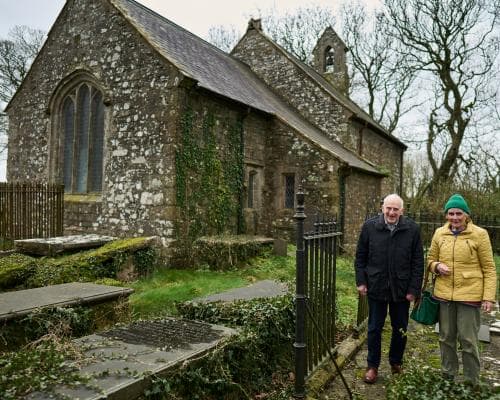
Churches across Britain are closing and falling into physical ruin as congregations disappear, with beloved historic sanctuaries like St Tyfrydog's in Wales being reclaimed by nature — a tangible sign of the broader apostasy gripping the Western church.
Amos 8:11-12
Direct Principle“Behold, the days are coming, declares the Lord GOD, when I will send a famine on the land — not a famine of bread, nor a thirst for water, but of hearing the words of the LORD. They shall wander from sea to sea, and from north to east; they shall run to and fro, to seek the word of the LORD, but they shall not find it.”
Why this passage
Amos delivered this oracle to northern Israel at a moment of outward prosperity but inward spiritual corruption. The 'famine of hearing the words of the LORD' was God's covenantal judgment on a people who had progressively ignored His voice — not the absence of prophets per se, but the withdrawal of divine illumination from a people no longer seeking it.
The grammatical-historical sense is that spiritual abandonment precedes and produces a divinely imposed silence where sacred spaces and words lose their power over a people.
The prophet Amos warned of a day when the Lord would send 'a famine on the land — not a famine of bread, nor a thirst for water, but of hearing the words of the LORD.' The empty, ivy-choked pews of St Tyfrydog's are not merely an architectural tragedy; they are a spiritual portrait. What once gathered saints for prayer and proclamation now gathers only spiders and silence.
When a people abandon the living God, the very stones cry out — not with praise, but with ruin. This decay invites every believer to ask: is the faith we hold a living flame or a heritage we merely curate?
Today's Prayer
Pray that God would send revival to Britain and the Western world, rekindling genuine faith where only empty buildings remain, and that His Church would be known not by the grandeur of its structures but by the reality of its living witness.
Further Scripture
Additional passages that illuminate this event, each grounded in a distinct interpretive lens.
“For the time is coming when people will not endure sound teaching, but having itching ears they will accumulate for themselves teachers to suit their own passions, and will turn away from listening to the truth and wander off into myths.”
Why this passage
Paul wrote to Timothy as a warning about the last days of the church age, predicting a trajectory of doctrinal abandonment. The phrase 'will not endure sound teaching' describes a volitional rejection — not ignorance but active preference for something else.
In its grammatical-historical context, Paul anticipated a visible, institutional drift away from apostolic Christianity. The near horizon was the Ephesian church; the far horizon was the church broadly in the last days.
How it applies
The closure of hundreds of British churches represents the institutional endpoint of exactly this trajectory. The article notes that congregations 'fell away' — not that they were driven out by persecution, but that the appetite for biblical Christianity evaporated.
The churches did not close because of famine or war; they closed because the people Paul described finally stopped attending altogether, leaving beautiful buildings with no spiritual purpose behind them.
“And to the angel of the church in Sardis write: The words of him who has the seven spirits of God and the seven stars. I know your works. You have the reputation of being alive, but you are dead.”
Why this passage
Christ's letter to Sardis addressed a church that maintained all external appearances of Christian life — structures, reputation, forms — while being spiritually dead within. The grammatical-historical context is a specific church in Asia Minor known for its wealth and cultural prestige.
The structural pattern is: outward religious form persists long after inner spiritual vitality has ceased.
How it applies
The derelict churches of Britain carry this same haunting pattern at a national scale. Many of these buildings were full within living memory; they carry plaques, stained glass, and centuries of Christian heritage — the 'reputation of being alive.' Yet the congregations are gone, the worship has ceased, and ivy now does the work that saints once did.
The article's focus on preserving the buildings as 'community hubs' rather than as houses of living worship captures the Sardis dynamic precisely: heritage without resurrection.
Related by Scripture
Other events we've interpreted through the same passage or hermeneutical lens.
‘I’ve finally found God without all the extras’: behind the surge in people converting to Progressive Judaism
Apostasy & Falling AwayShares 2 Timothy 4:3-4Pope uses Spain speech to warn of global ‘spiritual and cultural crisis’
Moral DeclineShares Amos 8:11-12Israel Curbs Aid, Kills Civilians During Gaza Ceasefire as Famine Looms
FaminesShares Amos 8:11-12As Biblical Christianity Weakens In The West, More People Turn To The Occult To Fill The Gap
False Prophets & DeceptionShares 2 Timothy 4:3-4Georgian Orthodox Church elects new leader at fraught time for the influential institution
Apostasy & Falling AwayShares 2 Timothy 4:3-4
Community launching soon
Get the invite by email when the Watchman's Wall opens
Share this article
Source: The Guardian— we link to the original for full context.