Sudan war fuels child hunger crisis
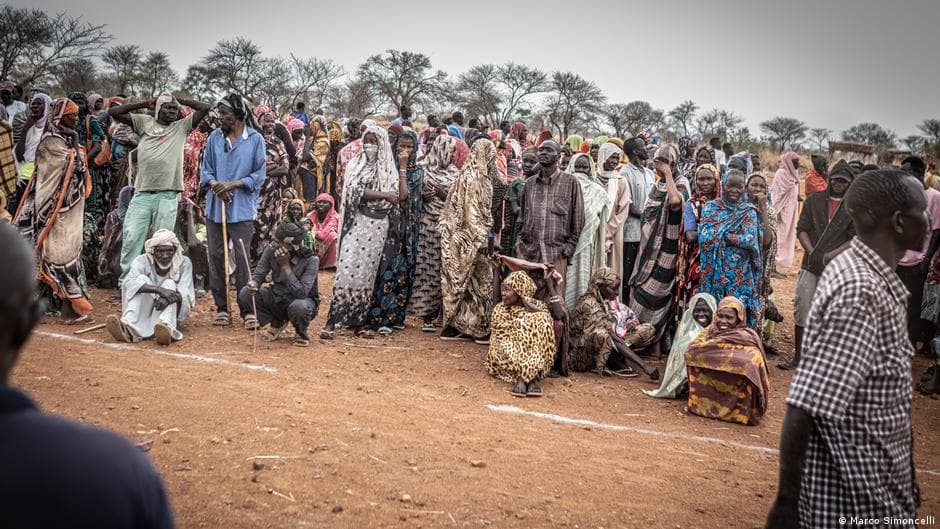
Sudan's four-year civil war has triggered declared famine conditions and acute child malnutrition as millions are displaced and humanitarian aid funding collapses — a convergence of war, displacement, and starvation that Scripture repeatedly identifies as a sign of the age's end and divine judgment on nations.
Lamentations 2:11-12
Narrative Parallel“My eyes are spent with weeping; my stomach churns; my bile is poured out to the ground because of the destruction of the daughter of my people, because infants and babies faint in the streets of the city. They cry to their mothers, 'Where is bread and wine?' as they faint like a wounded man in the streets of the city, as their life is poured out on their mothers' bosom.”
Why this passage
Jeremiah composed Lamentations in the aftermath of Babylon's siege of Jerusalem, describing the precise pattern of war-induced urban famine: military conflict cutting off supply lines, civilian infrastructure collapsing, and children suffering most acutely as the visible and most vulnerable victims. The grammatical-historical sense is eyewitness lament over a concrete siege-famine, not metaphor.
The pattern — extended armed conflict producing food denial, with infants and children bearing the sharpest consequences — is structurally identical across history wherever siege warfare and civil conflict intersect with humanitarian blockades.
The prophet Lamentations cried out, 'My eyes are spent with weeping; my stomach churns; my bile is poured out to the ground because of the destruction of the daughter of my people, because infants and babies faint in the streets of the city.' These ancient words describe exactly what relief workers witness today in Sudan — children wasting away while funding dries up and gunfire blocks supply routes. God is not indifferent to this suffering; His Word recorded it centuries before Sudan existed as a nation, testifying that He sees every faint infant.
For those of us watching from comfort, this image should break us to prayer and generosity, knowing that the same Lord who wept over Jerusalem weeps over Khartoum.
Today's Prayer
Pray that the Church worldwide would respond to Sudan's famine crisis with tangible generosity and urgent intercession, and that God would supernaturally open humanitarian corridors to reach starving children before it is too late.
Further Scripture
Additional passages that illuminate this event, each grounded in a distinct interpretive lens.
“A third part of you shall die of pestilence and be consumed with famine in your midst; a third part shall fall by the sword around you; and a third part I will scatter to all the winds and will unsheathe the sword after them.”
Why this passage
God's oracle against Jerusalem through Ezekiel announces a three-fold judgment pattern that recurs in Scripture's prophetic framework as a paradigmatic consequence for nations under divine judgment: famine, sword, and exile (scattering). This triad is not unique to Israel — Ezekiel uses Jerusalem as the representative case of what divine judgment looks like when it falls on any nation that has exhausted its covenant protections.
The pattern was near-horizon for Jerusalem in 586 BC, but the triad recurs in Revelation's seal and trumpet sequences precisely because it describes God's recurring instruments of historical judgment.
How it applies
Sudan presents all three elements simultaneously: famine is declared in multiple regions, the sword of civil war has killed hundreds of thousands, and millions are scattered as refugees across Chad, Egypt, and internally displaced. This is not coincidental clustering — it is the exact triad Scripture identifies as the shape of catastrophic national judgment.
Whether one reads this as divine judgment on Sudan's warring factions or as the kind of multi-layered suffering Scripture consistently attributes to the breakdown of human governance under sin, Ezekiel's triad maps precisely onto the current crisis.
“There will be great earthquakes, and in various places famines and pestilences. And there will be terrors and great signs from heaven.”
Why this passage
In Luke's parallel account of the Olivet Discourse, Jesus explicitly names famines ('limoi') occurring 'in various places' (kata topous) as a sign characterizing the period between His ascension and His return. The phrase 'in various places' is significant: Jesus does not describe a single global famine but a recurring, geographically distributed pattern of famine events — exactly the kind of regional, war-driven famine now declared in Sudan.
The near-horizon fulfillment included the famine of Acts 11 and the siege of Jerusalem in AD 70; the far-horizon application encompasses the entire inter-advent age as Jesus describes a pattern, not a single event.
How it applies
Sudan's declared famine is precisely the kind of localized, war-compounded famine Jesus described — appearing in 'various places,' driven by human violence, and affecting the most vulnerable. It joins a global pattern of declared famine conditions (Gaza, Yemen, parts of sub-Saharan Africa) that fits Luke 21:11's 'kata topous' framing.
This is not the first such famine and will not be the last, but each one fulfills the pattern Jesus described and calls the watching Church to sobriety.
“Behold, the days are coming, declares the Lord God, when I will send a famine on the land— not a famine of bread, nor a thirst for water, but of hearing the words of the Lord.”
Why this passage
Amos 8:11 is often cited metaphorically in isolation, but its immediate context (8:4-10) is a sustained oracle against those who exploit the poor, trample the needy, and manipulate economic systems — with physical famine explicitly preceding the spiritual famine as part of the same judgment sequence. The oracle in 8:5-6 describes merchants who sell 'the refuse of the wheat' and make 'the ephah small and the shekel great' — economic exploitation of the food supply.
The spiritual famine in verse 11 arrives in the wake of, not instead of, physical famine.
How it applies
In Sudan, the collapse of humanitarian funding — international donors pulling resources while children starve — reflects exactly the economic indifference Amos indicted: those with the power to feed the needy choosing other priorities. The 'famine of hearing the words of the Lord' is also visible in the absence of any coherent moral voice calling the warring parties to account.
When physical bread and spiritual truth both disappear from a land, Amos warns, judgment has fully arrived. Sudan's crisis invites the Church to ask whether its own voice is being raised clearly on behalf of the perishing.
Related by Scripture
Other events we've interpreted through the same passage or hermeneutical lens.
Earthquake Shakes Tehran, Where Nerves Are Already Strained by Iran War
Earthquakes & Natural DisastersShares Luke 21:11Urgent warning as 'Victorian' disease tuberculosis rises in California
Pestilence & PlaguesShares Luke 21:11Two hantavirus cases confirmed, five more suspected on stranded cruise ship
Pestilence & PlaguesShares Luke 21:11Human-to-human hantavirus transfer suspected on cruise
Pestilence & PlaguesShares Luke 21:11What is hantavirus, the disease that has killed 3 cruise ship passengers?
Pestilence & PlaguesShares Luke 21:11
Community launching soon
Get the invite by email when the Watchman's Wall opens
Source: DW (English)— we link to the original for full context.