Pope Leo XIV meets archbishop of Canterbury amid deepening church divides
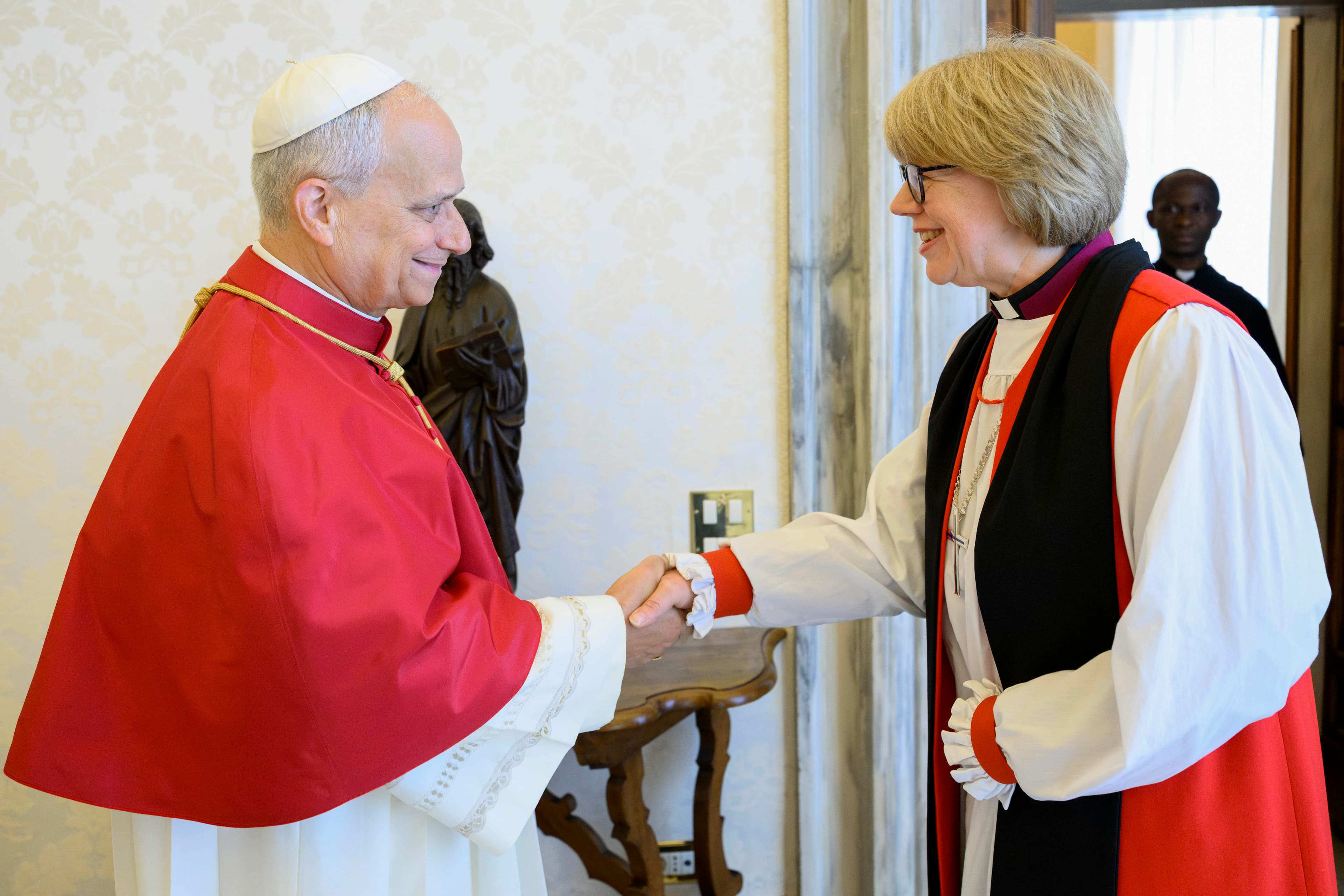
The meeting between Pope Leo XIV and the first female Archbishop of Canterbury signals deepening fractures between Rome and Canterbury, with the ordination of women standing as a concrete doctrinal barrier — a pattern Scripture associates with the abandonment of sound teaching in the last days.
2 Timothy 4:3-4
Prophetic Fulfillment“For the time is coming when people will not endure sound teaching, but having itching ears they will accumulate for themselves teachers to suit their own passions, and will turn away from listening to the truth and wander off into myths.”
Why this passage
Paul wrote to Timothy as a pastoral charge about the condition of the visible church in the last days — not about pagan culture outside, but about professing believers and their teachers inside. The phrase "accumulate for themselves teachers" describes an institutional dynamic: the community selects leadership that validates its preferred direction rather than submitting to apostolic teaching.
The grammatical-historical sense is a warning about progressive doctrinal drift within the church that replaces revealed truth with culturally acceptable substitutes. That pattern has a legitimate prophetic horizon extending to any era in which churches restructure themselves around contemporary passions rather than received apostolic order.
The apostle Paul warned Timothy plainly: the time would come when men would "not endure sound teaching" but would accumulate teachers to suit their own passions. That hour has not merely approached — it has settled into the institutional life of some of the oldest churches in Christendom.
When ecumenical dialogue is strained not by persecution from without but by doctrinal revision from within, the watchman must name what he sees: the reordering of church office according to the spirit of the age rather than the pattern of Scripture. Faithful believers are called not to despair but to hold fast, knowing that the Lord of the Church has never surrendered His authority over her.
Today's Prayer
Pray that pastors and church leaders would have the courage to hold fast to the pattern of sound words delivered in Scripture, even as institutional pressures mount to conform the Church to the shifting values of the age.
Further Scripture
Additional passages that illuminate this event, each grounded in a distinct interpretive lens.
“The saying is trustworthy: If anyone aspires to the office of overseer, he desires a noble task. Therefore an overseer must be above reproach, the husband of one wife, sober-minded, self-controlled, respectable, hospitable, able to teach,”
Why this passage
The Pastoral Epistles articulate a specific pattern for church office using the phrase "husband of one wife" — a qualification that, at the grammatical-historical level, presupposes a male elder-overseer in the apostolic churches. This is not merely a cultural accommodation; Paul roots the male-female distinctions in office elsewhere in the same letters in the order of creation (1 Tim 2:13), not in Roman social custom.
The plain sense of the verse establishes a direct principle about the qualifications for the office of overseer — one that directly bears upon the question of whether a woman may rightly occupy the highest episcopal office of a major Christian communion.
How it applies
The appointment of Archbishop Sarah Mullally as the spiritual head of the Anglican Communion stands in direct tension with the qualifications Paul set forth under the apostolic pattern. This is not a secondary dispute about style or governance — it is a disagreement about whether Scripture's stated criteria for church office remain binding.
That this very disagreement is now identified as a central "new problem" in Catholic-Anglican relations confirms that the fracture runs to first-order doctrinal ground, not merely to political preference.
“Beloved, although I was very eager to write to you about our common salvation, I had to write appealing to you to contend for the faith that was once for all delivered to the saints.”
Why this passage
Jude's appeal to "the faith once for all delivered" carries a pointed claim: the content of Christian faith was delivered in a completed, bounded act — not as a living tradition open to indefinite revision by each generation's sensibilities. The urgency of the letter arises precisely because certain people had "crept in" and were distorting that deposit.
The principle directly judges any ecclesiastical movement that treats the received apostolic pattern as a starting point for progressive revision rather than a boundary to be guarded.
How it applies
Ecumenical dialogue between Rome and Canterbury is now formally strained because one communion has treated the "faith once for all delivered" as subject to revision on the question of holy orders. The deepening divide described in this article is the institutional evidence of what Jude warned: when the delivered faith is not contended for, fracture follows.
For faithful believers watching these developments, Jude's word is not cause for triumphalism but for sober intercession — and for personal resolve to hold the line where their own communities face the same pressures.
“Son of man, prophesy against the shepherds of Israel; prophesy, and say to them, even to the shepherds, Thus says the Lord God: Ah, shepherds of Israel who have been feeding yourselves! You have not strengthened the weak, you have not healed the sick, you have not bound up the injured, you have not brought back the strayed, you have not sought the lost, but with force and harshness you have ruled them.”
Why this passage
Ezekiel 34 is a formal prophetic indictment of Israel's shepherds — those entrusted with the spiritual care of the community who instead served their own interests and led the flock into confusion. The oracle's original horizon addressed the failures of Israel's priestly and royal leadership before the exile, but the principle it encodes about unfaithful shepherds is structurally applicable wherever leaders of God's people prioritize institutional agendas over the revealed word.
The parallel is not that any modern figure is "Ezekiel's bad shepherd" — it is that the pattern of leadership that drifts from revealed standards while managing institutional relationships is the same pattern the oracle judges.
How it applies
When the senior leaders of major Christian communions meet to manage the relational fallout of doctrinal departures, the flock beneath them — millions of ordinary Anglican and Catholic believers — bears the cost of that confusion. The "new problems" Pope Leo XIV referenced are in large part the consequence of shepherds who have not held the line of the delivered faith.
Ezekiel's oracle reminds both leaders and laity that the Chief Shepherd Himself takes account of how His flock is led, and that institutional diplomacy is no substitute for faithfulness to His Word.
Related by Scripture
Other events we've interpreted through the same passage or hermeneutical lens.
‘I’ve finally found God without all the extras’: behind the surge in people converting to Progressive Judaism
Apostasy & Falling AwayShares 2 Timothy 4:3-4As Biblical Christianity Weakens In The West, More People Turn To The Occult To Fill The Gap
False Prophets & DeceptionShares 2 Timothy 4:3-4Georgian Orthodox Church elects new leader at fraught time for the influential institution
Apostasy & Falling AwayShares 2 Timothy 4:3-4Historic and Divisive: Pope Leo Hosts First Female Archbishop of Canterbury at the Vatican
Apostasy & Falling AwayShares 2 Timothy 4:3-4Maryland Supreme Court: State cannot reveal names of individuals who allegedly hid Church abuse
Apostasy & Falling AwayShares Ezekiel 34:2-4
Community launching soon
Get the invite by email when the Watchman's Wall opens
Share this article
Source: ewtnnews— we link to the original for full context.