On centenary of Cristero War, bishop invites Catholics to ‘defend your faith by knowing it better’
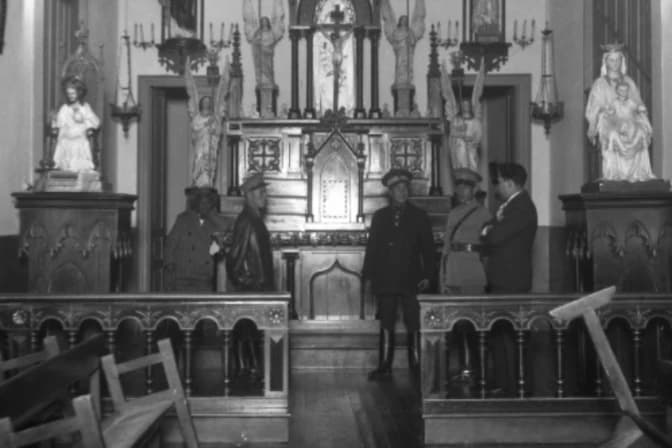
On the centenary of Mexico's Cristero War — in which the state violently suppressed the Catholic Church — a Mexican bishop calls the faithful to honor martyrs not with mere sentiment but with deeper knowledge of the faith they died to defend. Scripture's consistent witness is that persecution does not destroy the Church; it purifies and emboldens her.
Hebrews 11:36-38
Narrative Parallel“Others suffered mocking and flogging, and even chains and imprisonment. They were stoned, they were sawn in two, they were killed with the sword. They went about in skins of sheep and goats, destitute, afflicted, mistreated— of whom the world was not worthy—wandering about in deserts and mountains, and in dens and caves of the earth.”
Why this passage
The 'Hall of Faith' in Hebrews 11 catalogues a cloud of witnesses who endured state and social violence precisely because of their allegiance to God. The original hearers were Jewish Christians facing imperial pressure, warned that faithfulness has always come at mortal cost.
The structural pattern — a government that sees religious conviction as a threat, enacts violent suppression, and produces a generation of witnesses the world cannot silence — is precisely the pattern of 1920s Mexico under the Calles laws and precisely the pattern this centenary commemorates.
Historical context, theological significance, application today — denomination-neutral, ~1,000-word walk-through.
Hebrews 11:36-38 describes those who 'suffered mocking and flogging, and even chains and imprisonment,' and declares of them that 'the world was not worthy' of such witnesses. The Cristero martyrs — priests shot at altars, farmers who cried 'Viva Cristo Rey!' before firing squads — stand squarely in that ancient company.
The bishop's charge to 'defend your faith by knowing it better' is the living answer to their sacrifice. Those who do not know what they believe cannot stand when pressure comes; those who do have already begun to live the martyr's readiness.
Today's Prayer
Pray that the memory of the Cristero martyrs would move the Church in Mexico — and every church — from ceremonial commemoration to courageous, well-grounded faith that can endure whatever the age demands.
Further Scripture
Additional passages that illuminate this event, each grounded in a distinct interpretive lens.
“Indeed, all who desire to live a godly life in Christ Jesus will be persecuted,”
Why this passage
Paul's statement in 2 Timothy 3:12 is categorical and universal — not 'some who desire godly life' but 'all.' It is a direct-principle assertion: godliness and persecution are inseparable in a fallen world. The verse was written to Timothy as he faced pressure from a hostile culture, but its scope is covenantal and cross-generational.
The plain grammatical sense leaves no room for the notion that persecution is an anomaly or a failure of strategy. It is the predictable cost of the godly life.
How it applies
The Cristero War was not an accident of Mexican politics; according to this principle it was the inevitable collision between a state determined to expunge God from public life and a Church determined to worship openly. The centenary memorial, and the bishop's call to deeper faith-formation, implicitly acknowledge that the same collision is always latent — and that the best preparation is to know, with Paul and the Cristeros, what one is willing to die for.
“When he opened the fifth seal, I saw under the altar the souls of those who had been slain for the word of God and for the witness they had borne. They cried out with a loud voice, 'O Sovereign Lord, holy and true, how long before you will judge and avenge our blood on those who dwell on the earth?' Then they were each given a white robe and told to rest a little longer, until the number of their fellow servants and their brothers should be complete, who were to be killed as they had been.”
Why this passage
The fifth seal vision in Revelation presents a heavenly reality: the martyrs are held, honored, and told that their blood-witness is part of a deliberate, numbered completion ordained by God — not a tragedy without meaning. John's original hearers, under Domitian's persecution, received this as assurance that martyrdom serves a divine economy.
The phrase 'until the number of their fellow servants… should be complete' implies that martyrdom is a continuing feature of church history up to the consummation — not a closed chapter of early Christianity.
How it applies
The Cristero dead are among those 'slain for the word of God and for the witness they had borne.' The centenary does not merely recall the past; in Revelation's framework it reminds the living Church that the total number of martyrs is not yet complete, and that fidelity — the very fidelity the bishop calls Catholics to strengthen through knowledge — is the calling of every generation until the Lord returns.
“Precious in the sight of the LORD is the death of his saints.”
Why this passage
Psalm 116 is a personal hymn of deliverance, but verse 15 extends beyond the individual to a covenantal declaration about how God regards the death of those who belong to him. 'Precious' (yaqar) in Hebrew carries the sense of costly, of high worth — God does not view the martyrdom of His people as waste.
This is not a prediction but a revealed disposition of God — one that directly addresses how the Church should interpret, remember, and proclaim the deaths of those who died for faith.
How it applies
A centenary commemoration risks becoming hollow sentiment unless it is grounded in the conviction that God Himself assigns infinite weight to what was suffered. The bishop's invitation — to honor the Cristero dead by knowing the faith they died for — is pastorally sound precisely because it treats their deaths as precious in the same way God does: not as curiosities of history, but as costly seed that obligates the living to bear fruit.
Related by Scripture
Other events we've interpreted through the same passage or hermeneutical lens.
Systemic anti-Christian violence laid bare at public hearing in India
Persecution of ChristiansShares Revelation 6:9-11Cardinal Koch: ‘Today there are more martyrs than in the early centuries of the Church’
Persecution of ChristiansShares 2 Timothy 3:12Justice Delayed: The 13-Year Struggle of the Peshawar Church Blast Survivors
Persecution of ChristiansShares Revelation 6:9-11Christian Man Dies Doing Forced Labor in Pakistan
Persecution of ChristiansShares Hebrews 11:36-38Pushback in Nigeria over ex-Boko Haram fighter reintegration
Persecution of ChristiansShares Revelation 6:9-11
Community launching soon
Get the invite by email when the Watchman's Wall opens
Share this article
Source: Catholic News Agency— we link to the original for full context.