Middle East crisis live: Trump claims Iran wants US to open strait of Hormuz as soon as possible
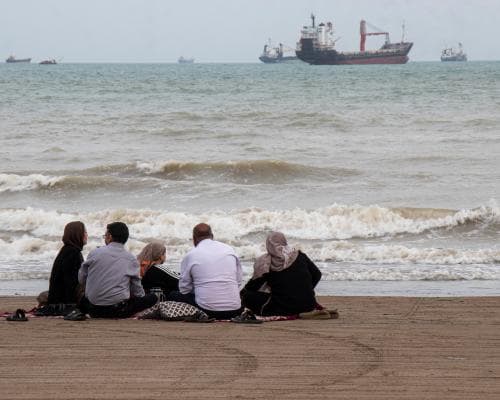
President Trump claims Iran has signaled it wants the Strait of Hormuz reopened and acknowledged being in a state of collapse — unverified assertions that nonetheless reflect escalating pressure on Tehran amid ongoing Middle East crisis and the strategic vulnerability of one of the world's most critical chokepoints.
Proverbs 21:1
Direct Principle“The king's heart is a stream of water in the hand of the LORD; he turns it wherever he will.”
Why this passage
Solomon's proverb states an absolute theological principle: the sovereign God directs the inclinations of rulers as effortlessly as a farmer channels irrigation water. The 'king' here is not a specific monarch but a representative of all human authority — the principle is universal and covenantal.
The plain grammatical-historical sense is that no ruler's decision, however powerful he believes himself to be, escapes the overarching governance of God. This is not a prophecy about any specific nation but a wisdom claim about the nature of political power under divine sovereignty.
The prophet Jeremiah looked upon a destabilized Near East and wrote of a foe descending 'like clouds' and chariots 'like the whirlwind,' nations in upheaval, their counsel confounded (Jeremiah 4:13). What he described was not merely military movement but the unraveling of a proud people's confidence in their own strength — the moment when a nation that has long defied God finds its foundations shaking.
When a regime long defined by hostility and bravado signals — even quietly — that it stands on the edge of collapse, the watchman does not gloat. He prays.
The Lord of nations holds every government in His hand (Proverbs 21:1), and He is no less sovereign over the Persian Gulf than He was over the Euphrates.
Today's Prayer
Pray that the Lord of nations would restrain further bloodshed in the Middle East, grant wisdom to those who hold power over war and peace, and open hearts in Iran to the gospel of Jesus Christ in this hour of national vulnerability.
Further Scripture
Additional passages that illuminate this event, each grounded in a distinct interpretive lens.
“The word of the LORD that came to Jeremiah the prophet concerning Elam, in the beginning of the reign of Zedekiah king of Judah. Thus says the LORD of hosts: Behold, I will break the bow of Elam, the mainstay of their might. And I will bring upon Elam the four winds from the four quarters of heaven. And I will scatter them to all those winds, and there shall be no nation to which those driven out of Elam shall not come.”
Why this passage
Jeremiah 49:34-39 is an oracle specifically against Elam — the ancient heartland of what is today southwestern Iran (Khuzestan province), and by extension the Persian empire's core. The original hearers understood this as divine judgment upon a proud military power symbolized by its 'bow' — its offensive strength.
The oracle's near horizon was the Babylonian-era subjugation of Elamite power; its far horizon, acknowledged even in Jewish and early Christian interpretation, points to a future reckoning with the descendants of that territory. The language of 'four winds' scattering and a regime broken at 'the mainstay of their might' maps strikingly onto a government publicly reported to be near collapse under external military and economic pressure.
How it applies
Trump's claim — whether precisely accurate or diplomatically shaped — that Iran has privately signaled collapse echoes the biblical portrait of Elam's 'bow' being broken: a nation whose military posturing is suddenly outmatched and whose internal confidence has crumbled.
The Strait of Hormuz, Iran's primary lever of global economic threat, is precisely the 'mainstay of their might' in the modern context. That Tehran would reportedly beg for its reopening rather than threaten its closure is a dramatic inversion of the power dynamic Iran has long projected.
“And I will stir up Egyptians against Egyptians, and they will fight, each against his brother and each against his neighbor, city against city, kingdom against kingdom; and the spirit of the Egyptians will be emptied out within them, and I will confound their counsel. And they will inquire of the idols and the sorcerers, and the mediums and the necromancers.”
Why this passage
Isaiah 19 is an oracle against Egypt, but the structural pattern God announces — internal collapse, confounded counsel, a proud regional power whose 'spirit is emptied out within them' — is a recurring template for how God judges nations that have set themselves against His purposes.
The parallel is not a claim that Iran is Egypt, but that the pattern of divine judgment on a proud Near Eastern power follows a recognizable biblical shape: first the internal spirit breaks, then counsel fails, then the nation seeks any counsel it can find. The original hearers saw this pattern confirmed in Egypt's Assyrian-era collapse.
How it applies
A regime that has publicly projected invincibility for decades — funding proxy armies, threatening to 'wipe Israel off the map,' closing strategic waterways — now reportedly signaling that it is 'in a state of collapse' fits the Isaiah 19 template with uncomfortable precision.
The confounding of counsel and the emptying of a nation's spirit are, in Scripture's witness, not accidental geopolitical misfortunes. They are the signature of a sovereign God withdrawing His patience from a people whose leadership has defied Him.
“Persia, Cush, and Put are with them, all of them with shield and helmet;”
Why this passage
Ezekiel 38 names Persia (the biblical designation for the Iranian plateau) as a named participant in the great end-time coalition that moves against Israel. This is one of the most textually direct connections between a modern nation-state and biblical prophecy because the ancient name Persia directly corresponds to modern Iran geographically and partially ethnically.
The original near horizon of this prophecy has no clear historical fulfillment — no ancient coalition matching this description ever invaded Israel in the manner described — which leads most conservative scholars to view this as an eschatological oracle still awaiting complete fulfillment. A weakened or collapsing Persia/Iran does not negate this prophecy; it may reshape the timeline and circumstances under which it unfolds.
How it applies
Watchful readers of Ezekiel 38 note that Iran's current military and economic pressure, reportedly bringing it to the edge of collapse, raises serious questions about the geopolitical conditions under which the Gog-Magog prophecy eventually comes to pass.
Scripture does not tell us whether Persia enters that coalition as a strong power or a desperate one — but the ongoing Middle East crisis is a reminder that the nations named in Ezekiel 38 are real, active players in today's headlines, and the God who named them then governs them still.
Related by Scripture
Other events we've interpreted through the same passage or hermeneutical lens.
Community launching soon
Get the invite by email when the Watchman's Wall opens
Share this article
Source: The Guardian— we link to the original for full context.