Middle East crisis could cost world $1tn while oil firms make ‘obscene’ profit, analysis finds
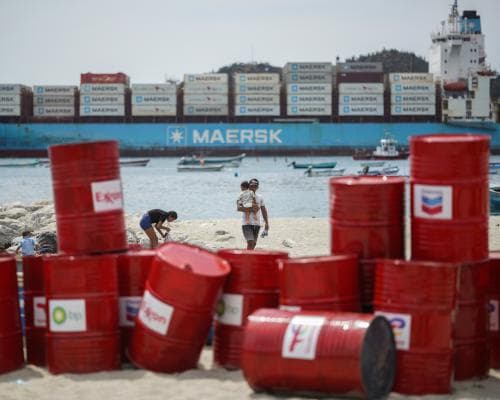
Analysis reveals the Middle East crisis may cost the global economy $1 trillion while fossil fuel companies reap enormous profits, as poorer nations report devastating economic suffering — a pattern Scripture plainly addresses as the wealthy prospering on the misery of the many.
James 5:1-4
Direct Principle“Come now, you rich, weep and howl for the miseries that are coming upon you. Your riches have rotted and your garments are moth-eaten. Your gold and silver have rusted, and their rust will be evidence against you and will eat your flesh like fire. You have laid up treasure in the last days. Behold, the wages of the laborers who mowed your fields, which you kept back by fraud, cry out, and the cries of the harvesters have reached the ears of the Lord of hosts.”
Why this passage
James writes to a first-century audience experiencing sharp class division, where wealthy landowners withheld rightful wages while laborers suffered. The principle is not limited to agricultural contexts — it is a covenantal moral declaration: wealth accumulated through systemic advantage while the vulnerable cry out constitutes fraud before God, and 'the cries have reached the ears of the Lord of hosts.'
The phrase 'laid up treasure in the last days' is especially pointed — James is not merely describing ancient greed but identifying it as a mark of the age preceding judgment. The principle applies without reinterpretation to any era in which concentrated profit is extracted from conditions of crisis.
James 5:3 declares of hoarded wealth gained while the poor cry out: "Your gold and silver have rusted, and their rust will be evidence against you." The spectacle of corporations recording 'obscene' profits while delegates from suffering nations testify of trillion-dollar losses is not merely an economic irony — it is a moral indictment Scripture anticipated with precision.
The herald's word to the reader is this: the world's systems of wealth will not escape the accounting. Take heed that your own trust is not placed in the prosperity of those whose gold is already rusting in the sight of God.
Today's Prayer
Pray that the nations suffering under the economic shockwaves of war and crisis would find just relief, and that those in power over great wealth would fear the God before whom all accounts are rendered.
Further Scripture
Additional passages that illuminate this event, each grounded in a distinct interpretive lens.
“Whoever oppresses the poor to increase his own wealth, or gives to the rich, will only come to poverty.”
Why this passage
This Solomonic proverb identifies a recurring human pattern in two parallel forms: extracting gain from those with less power, and channeling benefit toward those already wealthy. Both actions are declared self-defeating — the wisdom tradition of Israel understood that economies built on such foundations carry the seeds of their own collapse.
The proverb does not require a geopolitical frame to apply; it speaks to any structural arrangement where the concentrated gain of the powerful is financed by the diminishment of the poor.
How it applies
The $1 trillion cost of the Middle East crisis falls disproportionately on smaller, less powerful economies whose delegates are testifying at the Colombia conference, while the financial benefit flows to fossil fuel corporations already operating at massive scale.
Proverbs names this arrangement plainly — it is not sustainable, and the wisdom of God declares its terminus. The call for a windfall tax reflects, at minimum, a secular recognition of the same moral imbalance Proverbs identified three thousand years ago.
“Hear this, you who trample on the needy and bring the poor of the land to an end, saying, 'When will the new moon be over, that we may sell grain? And the Sabbath, that we may offer wheat for sale, that we may make the ephah small and the shekel great and deal deceitfully with false balances, that we may buy the poor for silver and the needy for a pair of sandals and sell the chaff of the wheat?'”
Why this passage
Amos delivers God's indictment against merchants in Israel's northern kingdom who viewed sacred time as interruption to profit, and who manipulated measures and prices to extract maximum gain from those with the least economic power. 'False balances' and 'making the shekel great' are not merely ancient commercial practices — they represent the universal temptation to design economic systems that harvest wealth from vulnerability.
The prophet speaks for God to those who structure commerce so that crisis conditions become profit opportunities at the expense of 'the needy and the poor of the land.'
How it applies
The characterization of fossil fuel profits as 'obscene' during a crisis that is impoverishing smaller nations is a modern instance of the pattern Amos confronts — markets structured so that geopolitical disruption, which devastates the poor, simultaneously enriches those already holding the dominant economic position.
The nations sending delegates to Colombia are, in Amos's framing, 'the poor of the land' — and the analysis suggests the scales of global energy markets have not been balanced in their favor.
“In you they take bribes to shed blood; you take interest and profit and make gain of your neighbors by extortion; but me you have forgotten, declares the Lord God. Behold, I strike my hand at the dishonest gain you have made, and at the blood that has been shed in your midst.”
Why this passage
Ezekiel's oracle against Jerusalem indicts an entire economic and political class for profiting from violence and crisis — 'interest and profit and make gain of your neighbors by extortion.' The charge is not simply personal greed but systemic extraction embedded in a society that has 'forgotten' God as the moral anchor of economic life.
While the original context is Jerusalem's internal corruption, the principle God articulates — that profiteering from bloodshed and crisis carries His active judgment ('I strike my hand') — is a theological constant, not a geographically bounded decree.
How it applies
The framing of fossil fuel profits as 'obscene' in the context of a crisis driven by armed conflict is precisely the pattern Ezekiel identifies: gain made from neighbors in the context of bloodshed and geopolitical violence.
The oracle's warning that God 'strikes His hand' against such gain is a sobering word for any who assume that legal profit in crisis conditions is morally neutral. Scripture disagrees.
Related by Scripture
Other events we've interpreted through the same passage or hermeneutical lens.
Community launching soon
Get the invite by email when the Watchman's Wall opens
Share this article
Source: The Guardian— we link to the original for full context.