Lebanese journalist killed in Israeli attack had spoken of death threat
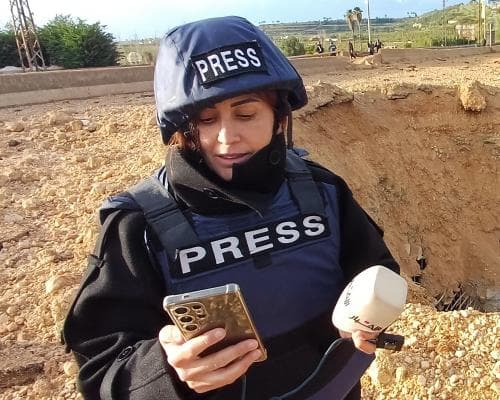
A Lebanese journalist killed in an Israeli strike had previously reported receiving a death threat from an 'Israeli enemy,' illustrating the intensifying and lethal character of the Israel-Lebanon conflict and the human cost borne by civilians caught in the crossfire.
Amos 1:3
Prophetic Fulfillment“Thus says the LORD: 'For three transgressions of Damascus, and for four, I will not revoke the punishment, because they have threshed Gilead with threshing sledges of iron.'”
Why this passage
Amos 1–2 is a structured series of divine indictments against the nations surrounding Israel for specific war crimes: excessive brutality, the crushing of civilian populations, and the erasure of human dignity in armed conflict. The 'threshing sledge' imagery in 1:3 depicts the systematic, mechanical destruction of people — not merely military defeat but the grinding down of the vulnerable.
God's judicial response ('I will not revoke the punishment') establishes that He holds nations accountable for how they conduct war, especially when the powerless are destroyed. The original near-horizon was eighth-century Aram, but the oracular pattern — God naming and judging war crimes committed by powerful states against weaker peoples — is structurally intended as an enduring theological framework.
The prophet Amos declared that God 'does nothing without revealing his secret to his servants the prophets' — and through those same prophets He indicted nations that 'sell the righteous for silver, and the needy for a pair of sandals' and that turn justice to wormwood. The death of a journalist who publicly named her threat before it was carried out is a sobering emblem of what Amos 1:3 calls the relentless 'threshing' of peoples caught between warring powers.
Wars grind down not only soldiers but witnesses — those whose only weapon is a pen and whose only crime is bearing witness. As believers we are called to grieve with those who grieve, to pray for the innocent crushed in the machinery of nations, and to hold fast to the God who hears the cry of every life extinguished before its time.
Today's Prayer
Pray that God would protect journalists, aid workers, and civilians trapped in the Israel-Lebanon conflict, that He would restrain the violence consuming the innocent, and that His justice would ultimately prevail where human courts fall silent.
Further Scripture
Additional passages that illuminate this event, each grounded in a distinct interpretive lens.
“My anguish, my anguish! I writhe in pain! Oh the walls of my heart! My heart is beating wildly; I cannot keep silent, for I hear the sound of the trumpet, the alarm of war. Crash follows hard on crash; the whole land is laid waste. Suddenly my tents are laid waste, my curtains in a moment.”
Why this passage
Jeremiah 4:19–20 is the prophet's own lament over the cascading destruction that war brings upon an entire land — not a prophecy about one nation's guilt but a raw theological statement about what sustained armed conflict does: it does not stop with soldiers, it consumes 'the whole land,' tent by tent, life by life, in rapid succession. The grammar is present and personal: the prophet himself feels the horror of what he is witnessing as a moral and spiritual wound.
This passage establishes a canonical emotional and ethical response to warfare's civilian toll.
How it applies
The killing of Amal Khalil — a journalist, not a combatant — while Lebanon absorbs ongoing Israeli strikes is a precise instance of what Jeremiah describes: 'crash follows hard on crash,' each one carrying away another life. Believers reading this account are implicitly invited into the prophetic posture of verse 19: the appropriate response to such news is not detached analysis alone, but anguish on behalf of those crushed.
The verse also validates the grief of media rights organizations condemning the killing as morally serious, not merely political.
“Why do the nations rage and the peoples plot in vain?”
Why this passage
Psalm 2 opens with a rhetorical question that frames all geopolitical violence within the sovereign gaze of God. The 'raging' of nations (Hebrew: ragash — a tumultuous, conspiratorial commotion) is not just military activity but the chaotic collision of competing powers that believe their own violence settles ultimate questions.
The psalm's point is that no nation's war strategy, however overwhelming, operates outside divine oversight. The psalmist's question implies that such raging is both real and ultimately futile — 'in vain' — because God enthroned in the heavens is not displaced by human military campaigns.
How it applies
The Israel-Lebanon conflict, in which a journalist publicly named a death threat and was killed anyway, illustrates the grinding, relentless character of nations at war — the kind of 'raging' Psalm 2 describes. The death of a press witness amid that raging reminds readers that the conflict has moved well beyond military-on-military engagement into the destruction of civilian infrastructure, including the human infrastructure of a free press.
For believers, Psalm 2:1 is both lament and anchor: the nations rage, but God watches, and His purposes are not frustrated.
Related by Scripture
Other events we've interpreted through the same passage or hermeneutical lens.
UK on verge of joining EU's £78bn loan for Ukraine as Starmer seeks reset with Brussels
Wars & Rumors of WarsShares Jeremiah 4:19-20Sirens in Misgav Am: Interceptors launched at suspicious aerial objects
Wars & Rumors of WarsShares Jeremiah 4:19-20Lebanon family 'feared they would die' and think Israel could bomb at any moment
Wars & Rumors of WarsShares Jeremiah 4:19-20In Tehran, money is short and a return to war looms over daily life
Wars & Rumors of WarsShares Jeremiah 4:19-20
Community launching soon
Get the invite by email when the Watchman's Wall opens
Share this article
Source: The Guardian— we link to the original for full context.