Journalist Andrzej Poczobut freed as part of US-brokered Polish-Belarusian prisoner swap – as it happened
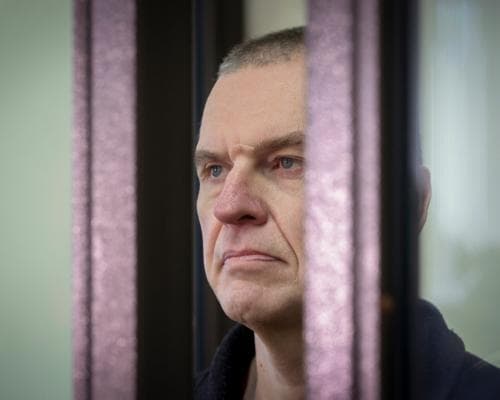
Belarusian journalist Andrzej Poczobut, imprisoned eight years for his reporting under the Lukashenko regime, was released through a US-brokered prisoner swap — a vivid illustration of the cost borne by those who bear witness under authoritarian power, and of Scripture's promise that such suffering does not go unseen.
Hebrews 13:3
Direct Principle“Remember those who are in prison, as though in prison with them, and those who are mistreated, since you also are in the body.”
Why this passage
This verse is a direct apostolic command to the gathered community: the imprisonment of any member of the body of Christ is not a distant abstraction but a shared bodily reality. The Greek construction 'as though in prison with them' (hōs syndedemenoi) is visceral — it calls for imaginative solidarity, not mere awareness.
The command assumes that imprisonment of those bearing witness will be a recurring feature of the age, not an exceptional crisis. The exhortation therefore functions as standing instruction for every generation of the Church.
Historical context, theological significance, application today — denomination-neutral, ~1,000-word walk-through.
Hebrews 11 names the faithful who "suffered mocking and flogging, and even chains and imprisonment" — not as footnotes to history, but as the great cloud of witnesses surrounding us still. Andrzej Poczobut spent years in a Belarusian penal colony for the crime of truthful reporting, embodying exactly the pattern the author of Hebrews describes: those of whom the world was not worthy.
His release is a mercy, but the pattern itself endures. Authoritarian states have always found the truth-teller intolerable.
Let the Church mark these names, pray over these lives, and take courage — the same God who superintends history superintended this man's survival.
Today's Prayer
Pray that the Church worldwide would remember those still in chains for bearing witness to truth, interceding with the boldness of Hebrews 13:3 — remembering prisoners as though imprisoned with them.
Further Scripture
Additional passages that illuminate this event, each grounded in a distinct interpretive lens.
“Others suffered mocking and flogging, and even chains and imprisonment. They were stoned, they were sawn in two, they were killed with the sword. They went about in skins of sheep and goats, destitute, afflicted, mistreated— of whom the world was not worthy—wandering about in deserts and mountains, and in dens and caves of the earth.”
Why this passage
The author of Hebrews catalogs the suffering of the faithful not to evoke despair but to establish a theological principle: that those who bear witness to truth in a hostile world will face exactly this — chains, imprisonment, destitution, mistreatment. The phrase 'of whom the world was not worthy' is the author's own editorial verdict: the world's judgment of these people as criminals is precisely inverted by heaven's accounting.
This principle is not limited to explicitly Christian martyrs in its application — it describes the structural reality that truth-bearing under tyranny has always cost. Poczobut, a journalist imprisoned for accurate reporting under a regime that cannot tolerate witness, fits this pattern with striking precision.
How it applies
The Lukashenko government sentenced Poczobut to eight years in a penal colony — not for violence, but for words. The world's verdict called him a criminal; Scripture's pattern calls him one of those 'of whom the world was not worthy.'
His release through diplomatic pressure is cause for gratitude, but the principle stands unrepealed: authoritarian power and truthful witness are irreconcilable, and the faithful should expect the former to punish the latter.
“that he looked down from his holy height; from heaven the LORD looked at the earth, to hear the groans of the prisoners, to set free those who were doomed to die,”
Why this passage
Psalm 102 is a prayer of the afflicted — a lament that simultaneously confesses God's eternal sovereignty over the nations. Verses 19-20 assert a specific divine disposition: God looks down from His holy height precisely to hear the groans of prisoners and to act for those condemned to death.
This is not a general humanitarian sentiment but a covenantal declaration about the character of the God who governs history.
The Psalmist's theology insists that no prison in any regime falls outside God's sight or His capacity to act.
How it applies
Poczobut's freedom, brokered through diplomacy, does not obscure the theological reality the Psalm names: behind every opened prison door stands the God who inclines His ear to the groaning of the captive.
The Church should receive news of prisoner releases not merely as political wins but as occasions to acknowledge the God who heard what penal colony walls could not silence.
“Beloved, do not be surprised at the fiery trial when it comes upon you to test you, as though something strange were happening to you. But rejoice insofar as you share Christ's sufferings, that you may also rejoice and be glad when his glory is revealed. If you are insulted for the name of Christ, you are blessed, because the Spirit of glory and of God rests upon you.”
Why this passage
Peter writes to communities already experiencing state hostility, and his instruction is calibrated to counter the natural human instinct to treat persecution as an anomaly. 'Do not be surprised' is apostolic realism: suffering for bearing witness is the expected pattern of life in a world that has not yet bowed to Christ's lordship.
The phrase 'fiery trial' (pyrōsis) evokes the refiner's fire — suffering that tests and reveals, not suffering that is merely punitive. Peter frames it as participation in Christ's own suffering, which reorients its meaning entirely.
How it applies
Poczobut's eight-year sentence for journalism under an authoritarian state is precisely the 'fiery trial' Peter describes — not something strange, but something the apostle told the Church to expect and to interpret rightly.
His release is a mercy; the pattern that produced his imprisonment is not resolved. The Church is called neither to despair nor to naive surprise, but to the sober expectation Peter commands.
Related by Scripture
Other events we've interpreted through the same passage or hermeneutical lens.
Christian Man Dies Doing Forced Labor in Pakistan
Persecution of ChristiansShares Hebrews 11:36-38For Christians in Israel and Jerusalem, intolerance is becoming normal - Al Jazeera
Persecution of ChristiansShares 1 Peter 4:12-14Egypt Placed on 'Special Watch List' for Persecuting Christians - Elizabeth Delaney - Crosswalk.com
Persecution of ChristiansShares 1 Peter 4:12-14What Country of Particular Concern status could mean for persecuted Christians in Pakistan - Mission Network News
Persecution of ChristiansShares 1 Peter 4:12-14Belarus frees journalist Andrzej Poczobut in prisoner swap, a possible step in warming relations with the West
Persecution of ChristiansShares Hebrews 11:36-38
Community launching soon
Get the invite by email when the Watchman's Wall opens
Share this article
Source: The Guardian— we link to the original for full context.