Iran says ships being ‘guided’ by US through Hormuz must work with its armed forces
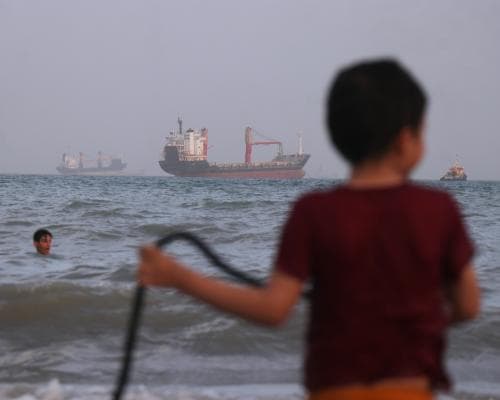
Iran has declared it will attack any foreign military vessel entering the Strait of Hormuz under a US escort plan, raising the specter of direct naval confrontation at one of the world's most critical chokepoints — a flashpoint Scripture long forewarned would characterize the tumult of the last days.
Jeremiah 25:31-32
Prophetic Fulfillment“A clamor will come to the ends of the earth, for the LORD has an indictment against the nations; he is entering into judgment with all flesh, and the wicked he will put to the sword, declares the LORD. Thus says the LORD of hosts: Behold, disaster is going forth from nation to nation, and a great tempest is stirring from the farthest parts of the earth!”
Why this passage
Jeremiah 25 is an oracle of universal divine judgment in which God summons the nations to drink the cup of his wrath. The 'clamor to the ends of the earth' and 'disaster going forth from nation to nation' describe a cascading pattern of geopolitical hostility that originates in God's sovereign controversy with a rebellious world order.
The plain grammatical-historical sense is a near-horizon fulfillment in Babylon's conquest of the ancient Near East, but the far horizon — made explicit in the universal scope ('all flesh,' 'the farthest parts of the earth') — points to the consummation of the age when no nation is exempt from the shaking.
The prophet Jeremiah described the coming of God's judgments upon the nations as a roaring sea of armies: 'A noise shall come even to the ends of the earth; for the LORD hath a controversy with the nations' (Jeremiah 25:31, KJV). Iran's threat to strike any military vessel daring to escort ships through Hormuz under American protection is precisely the kind of sword-rattling 'controversy among nations' Jeremiah foresaw — the great powers of the earth drawing lines in the water, each daring the other to cross.
Child of God, these are not signs of a world out of control — they are signs of a world moving exactly as the Scriptures said it would. Take heed, stand firm, and lift up your eyes.
Today's Prayer
Pray that sailors, shipowners, and military personnel in these contested waters would be kept from harm, and that world leaders would be restrained from the spark that ignites open war.
Further Scripture
Additional passages that illuminate this event, each grounded in a distinct interpretive lens.
“When he opened the second seal, I heard the second living creature say, 'Come!' And out came another horse, bright red. Its rider was permitted to take peace from the earth, so that people should slay one another, and he was given a great sword.”
Why this passage
The second seal in Revelation 6 depicts a rider authorized to remove peace from the earth through the instrumentality of nations threatening and making war on one another. The 'great sword' is not one nation's weapon but the systemic condition of international hostility that makes the whole earth a battlefield.
The plain apocalyptic sense is that the removal of peace is a divinely permitted process unfolding progressively across the age, culminating at the end — not a single event but a gathering storm.
How it applies
Iran's threat to attack any foreign military in Hormuz — a waterway through which roughly 20% of global oil flows — is precisely the kind of move that 'takes peace from the earth': a single flashpoint capable of igniting naval war, global energy disruption, and cascading regional conflict.
The great sword of Revelation 6 is being unsheathed incrementally in waters like these, as nations draw lines and dare one another to cross them.
“A stern vision is told to me; the traitor betrays, and the destroyer destroys. Go up, O Elam; lay siege, O Media; all the sighing she has caused I bring to an end.”
Why this passage
Isaiah 21 is the 'burden of the desert of the sea' — an oracle concerning ancient Persia (Elam and Media) and its role as an instrument of judgment on Babylon. The original hearers understood Elam as the heartland of what is today southwestern Iran, and the passage captures Persia as an assertive, threatening power on the move.
While the near-horizon fulfillment is Persia's conquest of Babylon in 539 BC, the structural parallel — the Persian/Iranian power asserting dominance over a critical waterway and threatening surrounding nations — is genuine, not merely a vague vibe.
How it applies
Modern Iran (heir to ancient Elam and Persia geographically and culturally) now threatens to dominate the Strait of Hormuz, the 'sea passage' at the edge of the ancient Persian world, and to strike any foreign military that contests that dominance.
The pattern of Isaiah 21 — Elam on the move, stirring international alarm — echoes in Iran's posture today, reminding readers that Scripture's witness to this region's volatility spans millennia.
“Persia, Cush, and Put are with them, all of them with shield and helmet;”
Why this passage
Ezekiel 38 names Persia (modern Iran) explicitly as one of the coalition powers arrayed for the great end-times conflict against Israel and her allies. While scholarly debate continues on the precise identification of Gog and Magog, there is broad consensus that 'Persia' in Ezekiel's day maps directly onto the ancient Persian empire centered in modern Iran.
The oracle's far horizon is a climactic gathering of nations; the near horizon would have resonated with Israel's awareness of Persian power to their east.
How it applies
Iran's aggressive posture at Hormuz — threatening military confrontation with the United States over the passage of ships — reflects the same assertive, militarized Persia that Ezekiel foresaw as a key actor in end-times geopolitical conflict.
Readers need not speculate about timelines; they need only observe that the biblical actors are in position, moving in the directions Scripture described.
Related by Scripture
Other events we've interpreted through the same passage or hermeneutical lens.
Watch: Israel’s new next-gen strategic aircraft lands at Nevatim Airbase
Israel & JerusalemShares Ezekiel 38:5Watch Live: Hegseth, Caine give Iran war update after U.S. and Iran trade fire in Strait of Hormuz
Wars & Rumors of WarsShares Jeremiah 25:31-32Trump suggests Iran war could last ‘another two weeks,’ ‘maybe three weeks’
Wars & Rumors of WarsShares Jeremiah 25:31-32Iran: We fired missiles and drones due to the activity of US destroyers
Wars & Rumors of WarsShares Jeremiah 25:31-32Can King Charles save the ever-fracturing ‘special relationship’ after Trump anger at Starmer over Iran war?
Wars & Rumors of WarsShares Jeremiah 25:31-32
Community launching soon
Get the invite by email when the Watchman's Wall opens
Share this article
Source: The Guardian— we link to the original for full context.