Hunted by drones it should have seen coming, Israel now sees its Lebanon strategy at risk
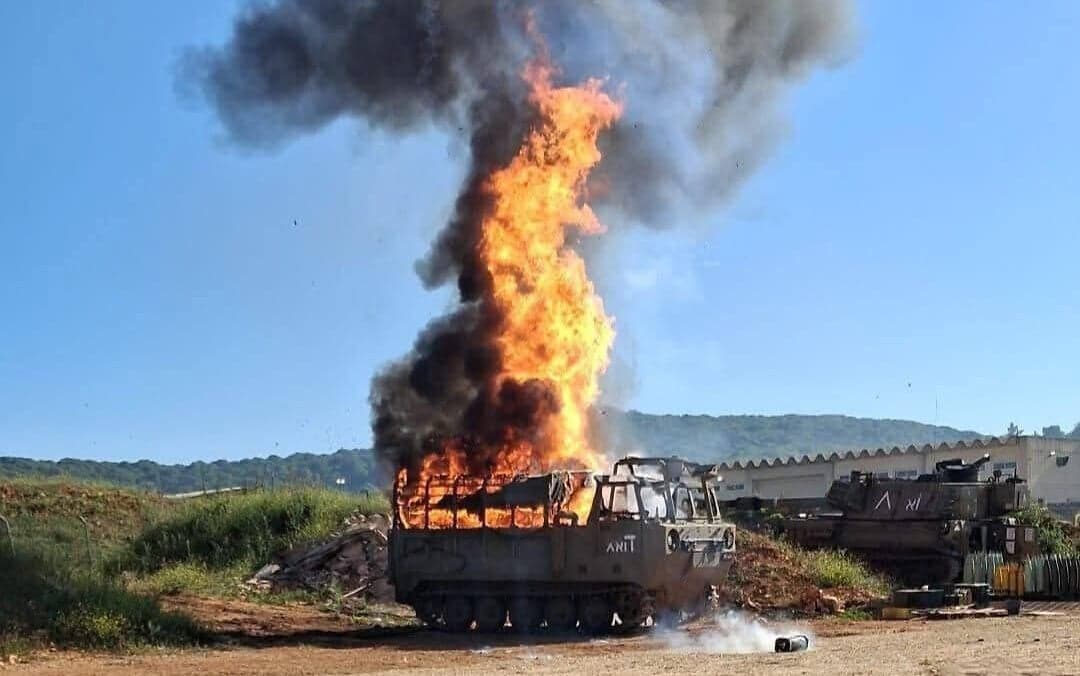
Israel's military finds itself exposed in southern Lebanon as Hezbollah deploys sophisticated fiber-optic and first-person-view drones to hunt IDF troops — a vulnerability that signals a dangerous shift in the ongoing conflict on Israel's northern front, echoing biblical warnings of siege and pressure against the land of Israel from surrounding enemies.
Zechariah 12:2-3
Prophetic Fulfillment“Behold, I am about to make Jerusalem a cup of staggering to all the surrounding peoples. The siege of Jerusalem will also be against Judah. On that day I will make Jerusalem a heavy stone for all the peoples. All who lift it will surely hurt themselves. And all the nations of the earth will gather against it.”
Why this passage
Zechariah 12 is an eschatological oracle concerning the final pressure campaign against Jerusalem and the land of Israel by surrounding nations and peoples. The grammatical-historical sense is clear: in the latter days, Israel will be encircled by adversarial forces who find it an irresistible but ultimately ruinous target.
The near horizon was the post-exilic period's geopolitical precariousness; the far horizon points to an escalating, sustained military and political siege of Israel as a prophetic pattern leading to divine intervention. Hezbollah — operating from Lebanon, Israel's northern neighbor — represents exactly the category of 'surrounding peoples' Zechariah names, pressing against the land with escalating military sophistication.
Historical context, theological significance, application today — denomination-neutral, ~1,000-word walk-through.
The prophet Zechariah declared that Jerusalem and the land of Israel would become 'a cup of staggering to all the surrounding peoples' (Zechariah 12:2) — a burden that no military strategy, however sophisticated, can simply engineer away.
Today's headlines from southern Lebanon bear witness to that ancient word: Israel's enemies press in with new weapons and new cunning, and the nation finds its carefully laid plans shaken. The faithful are reminded that Israel's ultimate security has never rested in chariots or drones, but in the LORD who neither slumbers nor sleeps (Psalm 121:4).
Today's Prayer
Pray that God's sovereign hand would protect the innocent caught in this conflict, that Israel's leaders would seek wisdom beyond military strategy, and that the Church would remain watchful and interceding as the prophetic pressure on the land of Israel intensifies.
Further Scripture
Additional passages that illuminate this event, each grounded in a distinct interpretive lens.
“Some trust in chariots and some in horses, but we trust in the name of the LORD our God.”
Why this passage
Psalm 20 is a royal psalm of intercession before battle, contrasting the nations' reliance on military hardware with Israel's covenantal trust in the LORD. The principle is stated with crystalline directness: military technology — however advanced — is a broken reed when set against divine sovereignty.
The psalm's wisdom-principle is not anti-military; it is a calibration of ultimate trust. It speaks to every generation that has watched a nation believe its weapons guaranteed its security, only to find the enemy adapted.
How it applies
Israel's intelligence and military communities are described in this article as 'caught off guard' by drone technology they themselves helped pioneer — a textbook illustration of Psalm 20:7's warning that those who trust in their technological 'chariots' find those chariots insufficient.
The devotional challenge to the reader is the same one ancient Israel faced before battle: in what, ultimately, does confidence rest? The article's unsettling answer from a human perspective — nowhere certain — is exactly where Scripture directs eyes upward.
“Behold, he comes up like clouds; his chariots like the whirlwind; his horses are swifter than eagles — woe to us, for we are ruined!”
Why this passage
Jeremiah 4 is a vivid oracle of invasion from the north, describing an enemy whose advance is overwhelming in speed and terror — chariots like whirlwinds, horses swifter than eagles. The grammatical-historical referent is the Babylonian army sweeping down on Judah from the north.
The structural parallel to the present moment is striking: the threat to Israel comes again from the north (Lebanon), and the weapon described — swift, airborne, impossible to outrun — finds a modern echo in the first-person-view drones that strike before defenders can react. The pattern of a foe from the north using speed-of-war superiority to expose Israel's military vulnerability recurs across history as a prophetic type.
How it applies
Hezbollah's drone campaign operates precisely on the principle Jeremiah's oracle captures: swiftness and surprise that leave defenders crying 'woe to us.' IDF troops in southern Lebanon are described as 'exposed' — the same condition Jeremiah's audience faced before Babylon.
This is not to equate Hezbollah with Babylon, but to recognize that God's Word describes a recurring pattern of northern threat against Israel that Scripture uses to call both Israel and the watching world to sobriety and dependence on God rather than military confidence.
“After many days you will be mustered. In the latter years you will go against the land that is restored from war, the land whose people were gathered from many peoples upon the mountains of Israel, which had been a continual waste. Its people were brought out from the peoples and now dwell securely, all of them.”
Why this passage
Ezekiel 38-39 describes a coalition assault on a regathered Israel in the latter days. The grammatical-historical context involves a prophetic vision given to Israel in exile, projecting a future assault on a restored Jewish homeland after centuries of desolation — which matches the modern state of Israel with remarkable precision.
The broader Gog-Magog oracle in Ezekiel 38 lists Persia (modern Iran) among the coalition forces — and Hezbollah is directly funded, armed, and directed by Iran. While this article does not describe the full Gog-Magog scenario, it represents the ongoing military pressure from Iran's proxy network against the very land Ezekiel's oracle names.
How it applies
Iran's fingerprints are on Hezbollah's drone program; the fiber-optic UAVs menacing IDF soldiers in Lebanon are extensions of Iranian strategic intent against the land of Israel.
Students of Ezekiel 38 will recognize the pattern: a regathered Israel dwelling in its ancient mountains, pressed upon by a coalition in which Persia plays a leading role. The escalation in Lebanon is one front in a broader prophetic contest that Ezekiel foresaw millennia before drone warfare existed.
Related by Scripture
Other events we've interpreted through the same passage or hermeneutical lens.
Netanyahu Announces Step-by-Step Annexation of Gaza as Ceasefire Stalls, Officials Say
Israel & JerusalemShares Zechariah 12:2-3Trump-Netanyahu tensions: Have Israeli and US leaders clashed before?
Israel & JerusalemShares Zechariah 12:2-3Congress moves to integrate US/Israeli defence
Israel & JerusalemShares Zechariah 12:2-3UN warns Israeli settlers could join blacklist for violations against children By Reuters
Israel & JerusalemShares Zechariah 12:2-3Itamar Ben-Gvir appoints bereaved family members as inspectors for death penalty law | The Jerusalem Post
Israel & JerusalemShares Zechariah 12:2-3
Community launching soon
Get the invite by email when the Watchman's Wall opens
Share this article
Source: timesofisrael— we link to the original for full context.