Guyana and Venezuela return to UN court to settle historic dispute over valuable border region
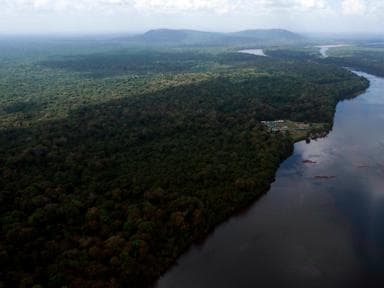
Guyana and Venezuela have brought their centuries-old territorial dispute over the resource-rich Essequibo region before the International Court of Justice, a supranational body claiming authority to redraw national borders — a pattern Scripture anticipates in its vision of nations increasingly yielding sovereignty to centralized global power.
Acts 17:26
Direct Principle“And he made from one man every nation of mankind to live on all the face of the earth, having determined allotted periods and the boundaries of their dwelling place,”
Why this passage
Paul's Areopagus address contains a deliberately universal claim: God is the architect of national geography. The word translated 'boundaries' (horothesias) refers specifically to territorial limits, and Paul places their determination not in conquest or treaty but in divine appointment.
This is the New Testament's explicit theological statement about the origin and legitimacy of national borders.
The verse does not imply that every colonial-era boundary is divinely perfect, but it does insist that the disposition of peoples and territories is ultimately God's domain — a truth directly relevant wherever two nations fight over a border.
The prophet Daniel watched as earthly kingdoms were weighed, measured, and handed to other powers — not by human courts, but by the decree of the Most High, who declares that 'the Most High rules the kingdom of men and gives it to whom he will' (Daniel 4:32). Today, two nations present their claims not before each other but before a court that transcends both, a body whose rulings carry binding force over sovereign borders.
The believer is not to fear this gathering of global authority, but to observe it with clear eyes. God's sovereignty is not threatened by the ICJ's docket.
Yet Scripture does call us to mark the slow migration of national power toward centralized human institutions — and to hold our hope not in international courtrooms, but in the King whose kingdom alone is eternal.
Today's Prayer
Pray that the people of Guyana and Venezuela — and their leaders — would recognize that lasting justice flows not from any human court, but from the God who holds every border and every nation in His sovereign hand.
Further Scripture
Additional passages that illuminate this event, each grounded in a distinct interpretive lens.
“Do not move the ancient landmark that your fathers have set.”
Why this passage
The 'ancient landmark' in Proverbs is a physical boundary marker whose removal constituted theft of land — a violation not merely of property law but of the moral order God embedded in human community. The wisdom tradition assumes that stable boundaries are a creational good, protecting families, tribes, and peoples from the predatory appetite of the stronger neighbor.
The Essequibo dispute is precisely a contest over whether a 19th-century arbitral boundary — established in 1899 — constitutes a legitimate 'ancient landmark' or an unjust imposition. Venezuela's long-standing refusal to accept that ruling is, in the terms of Proverbs, a generations-long challenge to move the landmark.
How it applies
Venezuela has contested the 1899 boundary for over a century, and Guyana now defends it before the ICJ, arguing that 70% of its territory depends on that line holding. The wisdom of Proverbs warns that the removal of ancient landmarks — however argued in legal briefs — carries consequences that human courts cannot fully adjudicate.
The reader is invited to see beneath the legal proceedings a timeless moral dynamic: the powerful neighbor seeking to redraw what was settled, and the smaller nation appealing to a higher authority for protection.
“you shall be driven from among men, and your dwelling shall be with the beasts of the field. And you shall be made to eat grass like an ox, and seven periods of time shall pass over you, until you know that the Most High rules the kingdom of men and gives it to whom he will.”
Why this passage
Daniel 4 records the divine decree that humbled Nebuchadnezzar, but the theological principle embedded in that decree is universal: earthly sovereignty — the control of territory, resources, and peoples — is not ultimately in human hands. No court, no treaty, and no military conquest confers permanent title; God alone disposes of kingdoms according to His counsel.
This is not a prophecy about the ICJ specifically, but a covenantal truth that applies wherever nations dispute dominion. The text states the principle in the broadest terms — 'the kingdom of men' — and the present dispute, involving 70% of Guyana's territory and vast oil wealth, sits squarely within the scope of that principle.
How it applies
Venezuela and Guyana are placing the fate of the Essequibo — one of the most resource-rich contested regions on earth — into the hands of a supranational body, effectively acknowledging that no human power can settle the matter unilaterally. The irony Scripture illuminates is that both parties are appealing to human institutions for what only divine sovereignty actually controls.
For the watchful believer, this case is a reminder that national borders are not accidents of geography but instruments of God's ordering of the nations — and that any earthly court's ruling, however binding in law, remains subordinate to the decree of the Most High.
Related by Scripture
Other events we've interpreted through the same passage or hermeneutical lens.
Community launching soon
Get the invite by email when the Watchman's Wall opens
Share this article
Source: abcnews— we link to the original for full context.