European leaders converge on Armenia as Russia looks on
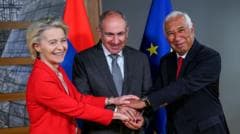
European powers are holding dual summits in Armenia, a traditional Russian ally, signaling a dramatic geopolitical realignment in the South Caucasus — a region historically marked by conflict — as Moscow watches its sphere of influence contract.
Jeremiah 18:7-8
Direct Principle“If at any time I declare concerning a nation or a kingdom, that I will pluck up and break down and destroy it, and if that nation, concerning which I have spoken, turns from its evil, I will relent of the disaster that I intended to do to it.”
Why this passage
Jeremiah 18 establishes God's sovereign authority over all nations as the divine Potter — He raises and breaks kingdoms according to His purposes, not theirs. The plain grammatical-historical sense is that no nation's political destiny is ultimately determined by its alliances or summits, but by God's moral governance of history.
This principle applies to both Armenia and the great powers contending around her: the realignment of nations remains under divine superintendence, not merely under the calculations of Brussels or Moscow.
Jeremiah declared of the nations: 'I am shaping disaster against you and devising a plan against you.' The contest for Armenia is not merely diplomatic maneuvering — it is the churning of kingdoms that Scripture repeatedly identifies as the prelude to judgment, as great powers reorder the ancient corridors between Europe and Asia.
The believer need not fear such realignments. God rules over the nations as clay in the potter's hand.
When empires contend for influence, the Church fixes her eyes on the King whose kingdom cannot be shaken.
Today's Prayer
Pray that Armenian believers would stand firm in faith amid the geopolitical pressures reshaping their nation, and that the Gospel would advance regardless of which earthly power claims influence there.
Further Scripture
Additional passages that illuminate this event, each grounded in a distinct interpretive lens.
“At the time of the end, the king of the south shall attack him, but the king of the north shall rush upon him like a whirlwind, with chariots and horsemen, and with many ships. And he shall come into countries and shall overflow and pass through.”
Why this passage
Daniel 11 describes in remarkable detail the titanic clash of northern and southern powers across the corridor of the ancient Near East — a geographic axis that runs precisely through the Caucasus region. The plain historical sense addressed the Seleucid and Ptolemaic empires, but the 'time of the end' framing extends the pattern to eschatological fulfillment.
The structural pattern — a dominant northern power (historically Russia occupies the north) facing a challenging western coalition for influence in the intervening lands — echoes the geopolitical architecture Daniel describes.
How it applies
The contest between European powers and Russia over Armenia fits the broad prophetic pattern of northern and southern/western powers contending over the strategic lands between them.
This is not a claim that any modern nation is the exact fulfillment of Daniel's kings, but the pattern of great-power rivalry over this ancient corridor is consistent with the prophetic framework Scripture establishes for the last days.
“Why do the nations rage and the peoples plot in vain? The kings of the earth set themselves, and the rulers take counsel together, against the LORD and against his Anointed.”
Why this passage
Psalm 2 addresses the recurring spectacle of nations conspiring, holding summits, and forming alliances — all while imagining they are the ultimate architects of history. The psalmist's point is that such counsel, however sophisticated, is ultimately vain apart from the LORD.
The dual European summits in Yerevan represent exactly this pattern: rulers taking counsel together, reconfiguring alliances, while the ultimate King of nations is unaddressed in any diplomatic communiqué.
How it applies
Heads of state converging on Yerevan, recalculating regional power, and redrawing spheres of influence is a vivid tableau of what Psalm 2 describes — kings of the earth setting themselves.
The Church watches these summits with sober clarity: the raging of nations is real, but it is not ultimate. God 'sits in the heavens and laughs' at the pretension of powers who forget they govern on borrowed time.
Related by Scripture
Other events we've interpreted through the same passage or hermeneutical lens.
Iran war day 114: US, Iranian delegations in Switzerland for key talks
Wars & Rumors of WarsShares Psalm 2:1-2What lessons will Iran’s new leadership draw from the 110-day war?
Wars & Rumors of WarsShares Psalm 2:1-2US, Iran envoys head for talks, Israeli strikes continue after ceasefire
Wars & Rumors of WarsShares Psalm 2:1-2'Bibi Is A Warrior PM': Trump Backs Netanyahu Despite US Intel That He May 'Undermine' Iran Deal
Wars & Rumors of WarsShares Psalm 2:1-2Iran re-closes Strait of Hormuz days after signing Trump-backed peace pact
Wars & Rumors of WarsShares Psalm 2:1-2
Community launching soon
Get the invite by email when the Watchman's Wall opens
Share this article
Source: bbc— we link to the original for full context.