EU approves €90bn loan for Ukraine and fresh Russia sanctions – Europe live
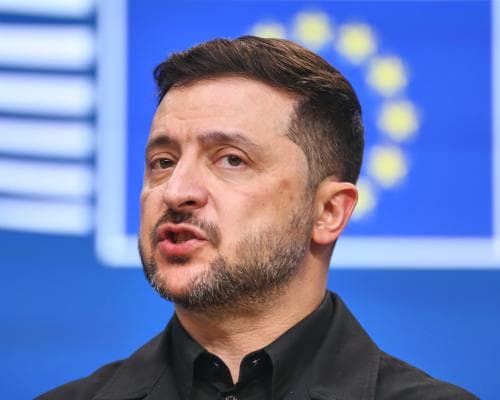
The EU's approval of a €90 billion war loan to Ukraine and fresh sanctions against Russia signals a deepening global economic entanglement in the Russia-Ukraine conflict, drawing the world's major powers into what may become an irreversible collective commitment — a pattern Scripture describes as the nations being drawn into cascading conflict.
Jeremiah 25:29-32
Prophetic Fulfillment“For behold, I begin to work disaster at the city that is called by my name, and shall you go unpunished? You shall not go unpunished, for I am summoning a sword against all the inhabitants of the earth, declares the LORD of hosts. You, therefore, shall prophesy against them all these words, and say to them: The LORD will roar from on high, and from his holy habitation utter his voice; he will roar mightily against his fold, and shout, like those who tread grapes, against all the inhabitants of the earth. The clamor will resound to the ends of the earth, for the LORD has an indictment against the nations; he is entering into judgment with all flesh, and the wicked he will put to the sword, declares the LORD. Thus says the LORD of hosts: Behold, disaster is going forth from nation to nation, and a great tempest is stirring from the farthest parts of the earth!”
Why this passage
Jeremiah 25 addresses a moment when the prophet declares that God's judgment, beginning in Judah, will cascade outward through the nations in a sequence of escalating conflict — 'disaster is going forth from nation to nation.' The grammatical-historical sense describes a divine sovereignty over geopolitical entanglement: no nation remains insulated once the spiral begins. The passage is not merely about Babylon's ancient conquests; its theological horizon encompasses any era when the nations are drawn by incremental steps into a common catastrophe they cannot reverse.
The 'great tempest stirring from the farthest parts of the earth' captures precisely the dynamic of distant powers being drawn in.
Jeremiah watched his own generation rationalize step after step toward catastrophe, and in Jeremiah 4:19 he cried, 'My anguish, my anguish! I writhe in pain!
Oh the walls of my heart! My heart is beating wildly; I cannot keep silent, for I hear the sound of the trumpet, the alarm of war.' The prophet's grief was not merely personal — it was prophetic sight into how nations, through incremental decisions each seeming reasonable in isolation, arrive at irreversible destruction.
The EU's €90 billion commitment and tightening sanctions represent exactly this kind of incremental entanglement: each vote, each concession, each sanction binding more of the world's economic architecture to a war that shows no sign of resolution. The walls of commitment are rising, and the trumpet sound grows louder.
As believers, we are called not to panic but to pray with clear eyes, recognizing in these cascading entanglements the very patterns the prophets mourned.
Today's Prayer
Pray that the leaders of nations entangling themselves in this conflict would possess the wisdom to seek genuine peace rather than economic and military escalation, and that the Church would be a voice of prophetic clarity in a moment when the world's powers are being drawn toward consequences they cannot fully foresee.
Further Scripture
Additional passages that illuminate this event, each grounded in a distinct interpretive lens.
“What causes quarrels and what causes fights among you? Is it not this, that your passions are at war within you? You desire and do not have, so you murder. You covet and cannot obtain, so you fight and quarrel. You do not have, because you do not ask.”
Why this passage
James 4:1-2 addresses the root cause of conflict at every level — from interpersonal quarrels to, by extension, geopolitical warfare. The Greek word 'polemoi' (wars) and 'machai' (fights) are the same words used for national conflicts.
James's diagnosis is that covetousness — the desire to possess what one does not have — drives conflict. The grammatical-historical context is a community fracturing under economic and social pressures, but the principle James articulates is universal: resource competition and unchecked desire are the engine of war.
How it applies
The EU's energy concessions required to secure unanimity reveal precisely the dynamic James describes: nations fighting and negotiating based on what they 'desire and do not have.' Energy security — a resource competition — was the lever that moved holdout nations. The entire apparatus of the €90 billion loan and sanctions regime is built on competing national interests and desires, not merely principled solidarity.
James's diagnosis cuts through the institutional language to the covetous heart beneath.
“When he opened the second seal, I heard the second living creature say, 'Come!' And out came another horse, bright red. Its rider was permitted to take peace from the earth, so that people should slay one another, and he was given a great sword.”
Why this passage
The second seal of Revelation 6 describes a rider permitted to 'take peace from the earth' — the Greek 'labein ten eirenen ek tes ges' indicates a comprehensive removal of peace, not merely one localized war. John's vision presents a divine permission that progressively withdraws the conditions that allow nations to coexist without war.
The plain grammatical-historical sense is an eschatological escalation in which warfare becomes global in character, not contained. The 'great sword' given to the rider connotes both military and economic instruments of destruction.
How it applies
The cascading nature of the EU's entanglement — holdout nations yielding, energy leverage applied, a €90 billion financial commitment made, fresh sanctions tightening — reflects what Revelation 6 describes as peace being taken 'from the earth,' not from one country. Economic warfare through sanctions and financial commitments of this scale are instruments of the 'great sword,' extending the conflict's reach far beyond the battlefield and making de-escalation structurally more difficult with every new commitment.
“And I will turn you about and put hooks into your jaws, and I will bring you out, and all your army, horses and horsemen, all of them clothed in full armor, a great host, all of them with buckler and shield, wielding swords.”
Why this passage
Ezekiel 38 describes a future coalition drawn into conflict not entirely by its own volition — God places 'hooks in the jaws' of the lead aggressor and its alliance, compelling their movement. The plain grammatical sense is divine sovereignty overriding the free choices of nations to draw them toward a climactic confrontation in the region of Israel.
While Ezekiel 38's ultimate fulfillment concerns a specific end-times invasion, the theological principle embedded in the imagery — that nations can be drawn irreversibly into conflicts by forces larger than their own political calculations — is structurally present in the text and applies as a warning pattern.
How it applies
The EU article explicitly uses the language of 'irreversible entanglement,' echoing the hook-in-jaw imagery of Ezekiel 38. Nations yielding only under energy concessions did not choose freely — they were pulled in by economic and political pressure.
While we must not claim this is the Ezekiel 38 fulfillment (the geographic and eschatological context is distinct), the pattern of reluctant nations being drawn into a conflict they cannot easily exit mirrors the coercive divine sovereignty Ezekiel describes in the last days.
Related by Scripture
Other events we've interpreted through the same passage or hermeneutical lens.
Community launching soon
Get the invite by email when the Watchman's Wall opens
Share this article
Source: The Guardian— we link to the original for full context.