Dozens of Gaza children arrive in Jordan for medical care
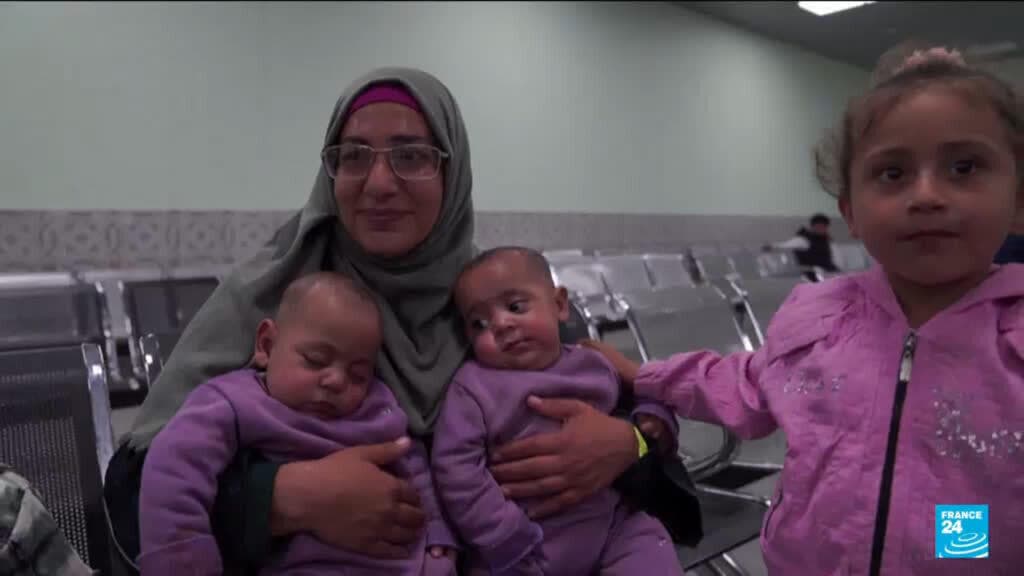
Eighty-one wounded and ill Palestinian children from Gaza have arrived in Jordan for medical treatment — the 26th such group since the war began in October 2023 — a stark witness to the unrelenting human toll of protracted urban warfare on the most vulnerable.
Lamentations 2:19-20
Narrative Parallel“Arise, cry out in the night, at the beginning of the night watches! Pour out your heart like water before the presence of the Lord! Lift your hands to him for the lives of your children, who faint for hunger at the head of every street. Look, O Lord, and see! With whom have you dealt thus? Should women eat the fruit of their womb, the children of tender age?”
Why this passage
Lamentations 2 is Jeremiah's inspired witness to the catastrophe that fell on Jerusalem under Babylonian siege — a sustained urban assault that killed, maimed, and starved its children. The grammatical-historical meaning is devastatingly concrete: children collapse in the public streets; mothers cry through the night watches; the poet demands that God look at what war does to the smallest.
The structural parallel to the current Gaza situation is genuine and sobering — not a forced spiritualization. Both involve a densely populated urban center under prolonged military siege, children unable to receive basic medical care within their own city, and desperate family members seeking help across borders.
The Lamentations poet does not explain away the suffering; he holds it up before God. That posture is the warranted response here.
The prophet Jeremiah, surveying Jerusalem's devastation, wrote: 'infants and babies faint in the streets of the city' — a lament that echoes across centuries wherever war consumes those least able to defend themselves. These 81 children, transported through a border crossing for medical care they cannot receive at home, are the living face of what Scripture has always called the fruit of a world at war with itself.
Yet even in that same chapter Jeremiah cries, 'Is it nothing to you, all you who pass by?' The question falls on every generation of witnesses. The follower of Christ is not permitted to pass by; he is called to feel the weight of infant suffering and to carry it to the throne of the One who said, 'Let the little children come to me.'
Today's Prayer
Pray that the God who sees every wounded child would raise up healers, open humanitarian corridors, and move the hearts of warring parties toward the protection of civilians, while granting His people compassion that is not numbed by the repetition of suffering.
Further Scripture
Additional passages that illuminate this event, each grounded in a distinct interpretive lens.
“For he delivers the needy when he calls, the poor and him who has no helper. He has pity on the weak and the needy, and saves the lives of the needy. From oppression and violence he redeems their life, and precious is their blood in his sight.”
Why this passage
Psalm 72 is a royal psalm describing the character of the just king — ultimately pointing to the messianic reign — whose defining mark is that he does not regard the lives of the weak as expendable. The plain sense of verses 12-14 is covenantal and moral: before God, the blood of the helpless is 'precious' — literally costly, of great worth — not collateral.
This principle stands as a direct theological judgment on every military and political decision that treats the deaths and maiming of children as an acceptable equation. It does not adjudicate the complex politics of the conflict; it declares the divine valuation of those being transported across a border because no one could protect them where they lived.
How it applies
Each child in that convoy is, by the standard of Psalm 72, one whose blood is 'precious in His sight' — a declaration that cuts across every military communiqué and political justification issued by any party to this war.
For the Christian reader, the psalm reorients the gaze: before we analyze strategy or assign blame, we are to see what God sees — needy children with no helper — and measure every human response against His standard.
“Religion that is pure and undefiled before God the Father is this: to visit orphans and widows in their affliction, and to keep oneself unstained from the world.”
Why this passage
James defines authentic covenant faithfulness in starkly practical terms: the care of those most exposed to suffering — orphans and widows — is not an optional ministry add-on but the criterion by which 'pure religion' is measured. The grammatical-historical sense is direct: James is correcting a church that talked faith while neglecting visible human need.
The principle requires no reinterpretation to land on this event. Children separated from safe family, transported across a border for medical care, are precisely the category of exposed, vulnerable human beings James has in view.
How it applies
Jordan's army opening a humanitarian corridor for these children is, by James's measure, an act that honors the standard of 'pure religion' — regardless of the kingdom's motives. For the Church, the verse is a mirror: the convoy of 81 is a visible summons to tangible action, not merely informed commentary.
Christians with access to organizations providing medical aid in the region are measured by this verse's plain demand.
Community launching soon
Get the invite by email when the Watchman's Wall opens
Share this article
Source: france24— we link to the original for full context.