Anthropic co-founder points to 3 ethical challenges of AI at Magnifica Humanitas presentation
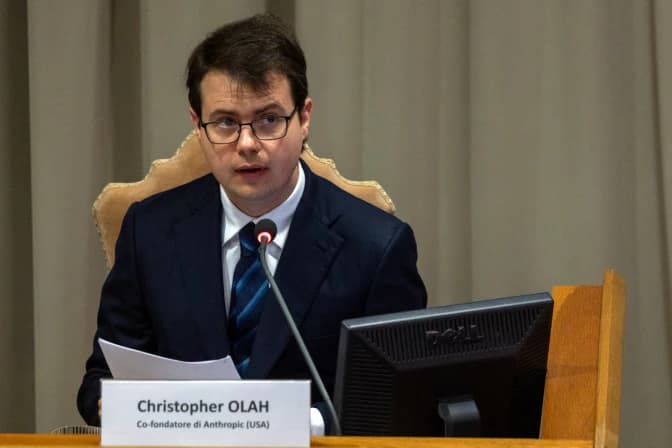
Anthropic co-founder Christopher Olah's call for ethical discernment in AI development highlights the growing moral and spiritual challenges posed by technology, echoing biblical warnings about human wisdom and the need for divine guidance.
Proverbs 3:5-6
Direct Principle“Trust in the Lord with all your heart, and do not lean on your own understanding. In all your ways acknowledge him, and he will make straight your paths.”
Why this passage
In its original context, Proverbs 3:5-6 is a foundational wisdom command: the believer must not rely on autonomous human reasoning but submit every decision to God. The 'own understanding' (Hebrew: binah) refers to human intellect operating independently of divine revelation.
This principle directly applies to the ethical challenges Olah raises. When AI developers grapple with questions of human flourishing and moral duty apart from God's revealed truth, they are leaning on their own understanding.
The verse calls for a radical acknowledgment of God in every domain, including technology.
Historical context, theological significance, application today — denomination-neutral, ~1,000-word walk-through.
Behold, the wisdom of man apart from God is ever a snare. As Proverbs 3:5 warns, 'Trust in the Lord with all your heart, and do not lean on your own understanding.'
When even the architects of AI confess the need for discernment, we are reminded that all human invention must bow to the Creator's design. Let us pray that those shaping this powerful tool would seek not merely human flourishing, but the glory of God.
Today's Prayer
Pray that AI developers and leaders would be granted humility and wisdom to submit their work to God's truth, and that the Church would be equipped to engage these technologies with biblical discernment.
Further Scripture
Additional passages that illuminate this event, each grounded in a distinct interpretive lens.
“But you, Daniel, shut up the words and seal the book, until the time of the end. Many shall run to and fro, and knowledge shall increase.”
Why this passage
Daniel 12:4 is a prophecy about the end times, describing a period of unprecedented travel and explosion of knowledge. The Hebrew word for 'knowledge' (da'at) encompasses not just information but technical and scientific understanding.
This increase is tied to the 'time of the end' when God's purposes are being fulfilled.
The exponential growth of AI knowledge and capability fits this prophetic pattern. The rapid advancement of artificial intelligence—a technology that processes and generates knowledge at superhuman speed—is a striking echo of Daniel's vision.
The ethical dilemmas Olah raises are part of this acceleration.
How it applies
The very fact that AI developers must now convene to discuss the ethics of their creation is a sign of the times. Knowledge is indeed increasing, and with it comes new moral weight.
This should stir believers to watchfulness, knowing that such technological acceleration is part of the prophetic landscape before Christ's return.
“See, this alone I found, that God made man upright, but they have sought out many schemes.”
Why this passage
Ecclesiastes 7:29 is a wisdom observation about the human condition: God created humanity in righteousness, but humans have invented countless devices and schemes (Hebrew: chishbonot—calculations, inventions, contrivances). The word carries the sense of complex, clever designs that depart from God's original simplicity.
This verse provides a theological framework for understanding technology. AI is the latest and most sophisticated 'scheme'—a human invention that can be used for good or ill.
The ethical challenges Olah identifies are symptoms of this deeper reality: human ingenuity untethered from God's design produces moral complexity.
How it applies
Olah's call for discernment implicitly acknowledges that AI, like all human schemes, carries moral risk. Scripture's diagnosis is more direct: the problem is not merely ethical but spiritual.
Without submission to the God who made man upright, every new invention becomes another scheme that distances us from our created purpose.
Related by Scripture
Other events we've interpreted through the same passage or hermeneutical lens.
In A World First, Fully AI-Designed, Needle-Free, “Universal” Coronavirus Vaccine Completes Human Trials
Technology & SurveillanceShares Daniel 12:4Labour will make AI ‘work for the workers’, says Liz Kendall
Technology & SurveillanceShares Daniel 12:4Japan enacts law centralising intelligence gathering amid privacy fears
Technology & SurveillanceShares Daniel 12:4AI is massively increasing China’s new weapon development speed: scientists
Technology & SurveillanceShares Daniel 12:4The Government Can Nearly Track Your Every Move with These Cameras – Stalkers and Hackers Can Too
Technology & SurveillanceShares Daniel 12:4
Community launching soon
Get the invite by email when the Watchman's Wall opens
Share this article
Source: ewtnnews— we link to the original for full context.